
COVID-19 and Democracy in Southeast Asia: Building Resilience, Fighting Authoritarianism
Download Asia Centre’s second baseline study examines trends under which Southeast Asian governments have used crises as opportunities for their political advantage. This report, centred around the Coronavirus Disease 2019 (COVID-19), highlights the routine response from governments with the announcement of emergency decrees and laws, suspension of civil freedoms, corruption of electoral democracy, censorship, digital surveillance measures, and framing human rights activists as national security threats. Post-crises, governments then enact long term laws and policies that effectively shrink civic space. Their methods also include limiting media and journalists’ watchdog activities through fake news and defamation labels, whilst substantially contributing to the dwindling civil society funding. A set of recommendations are also prescribed for the United Nations, governments, donors, and civil society.
Civil Society Empowerment must be at the Centre of COVID-19 Recovery Efforts
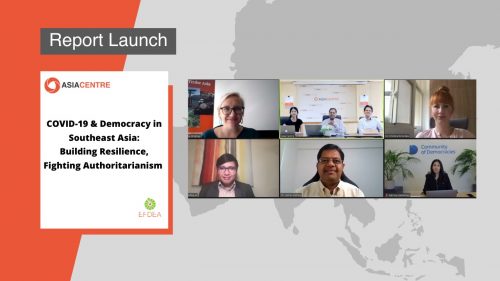
On 9 December 2020, Asia Centre released its baseline study “COVID-19 and Democracy in Southeast Asia: Building Resilience, Fighting Authoritarianism”. This report examines the state of democracy and human rights in the region, from 1 January 2020 to 30 November 2020, and the accelerated regression thereof due to COVID-19. The report was presented by Dr. James Gomez, Regional Director of Asia Centre. Following the unveiling, key themes of the report were discussed by Dr. Rebecca (Bec) Strating, Executive Director, La Trobe Asia, La Trobe University; Dr. Kristina Kironska, Researcher, Palacky University of Olomouc; Celito Arlegue, Executive Director, Council of Asian Liberals and Democrats (CALD); and Patricia Galdamez, Permanent Secretariat, Community of Democracies. Dr. Robin Ramcharan, Executive Director of Asia Centre, moderated the event. The report’s key finding notes that COVID-19 has accelerated the regressionof democracy in Southeast Asia, which has over two decades and several crises been a focus of government attacks. Government responses to crises, in line with regression over two decades, have built on one another. Building on the findings of the report, Dr. Gomez added that there is a real risk of governments expanding these temporary laws to be long-term laws and practices that will further shrink civic space. Dr. Rebecca (Bec) Strating, assessed the report’s findings under the lenses of international relations, by noting the geopolitical impact of flailing US power in the region as China’s autocratic reach expands. Dr. Kristina Kironska, expanded on the reports’ electoral democracy findings by noting how the pandemic’s emergency laws have expanded the authority and reach of “those in power”, especially in Myanmar during the country’s general elections in November. Celito Arlegue, noted that despite the far reaching presence of authoritarianism in the region, democratic practices to contain a crisis can not be argued as ineffective; and later expanded on the necessity of democracy activists and defenders to be creative and innovative. Patricia Galdamez, provided an overview of the impacts that COVID-19 has had on democracy and human rights – globally; emphasising that public access to the internet, and the protection of Freedom of Association, must be guaranteed. Following the contribution of discussants, Dr. Robin Ramcharan led the Q&A session where participants could send pressing questions to speakers. After this session, Dr. Ramcharan made his closing remarks and emphasised the importance of a strong civil society, working alongside governments, in post-COVID-19 recovery efforts. The report’s main recommendation is to shore up civil society by increasing their involvement internationally, giving them a voice at muli-lateral discussions and to ensure they are adequately resourced and supported so they can continue to occupy and operate in the civic space. COVID-19 and Democracy in Southeast Asia: Building Resilience, Fighting Authoritarianism was released to mark the United Nations’ International Human Right Day, 10 December 2020, with its theme of ensuring human rights are central to COVID-19 recovery efforts. Watch the report launch here, and download the report here. Read thematic opinion pieces based on the report’s findings in The Bangkok Post, Jakarta Post and Australian Outlook. *This report is a collaboration between Asia Centre and Empowering Fundamental Freedom Defenders in Southeast and East Asia.
COVID-19 and Democracy in Southeast Asia
Download Full Report ABSTRACT COVID-19 and Democracy in Southeast Asia: Building Resilience, Fighting Authoritarianism examines trends under which Southeast Asian governments have used crises as opportunities for their political advantage. This report, centred around the Coronavirus Disease 2019 (COVID-19), highlights the routine response from governments with the announcement of emergency decrees and laws, suspension of civil freedoms, corruption of electoral democracy, censorship, digital surveillance measures, and framing human rights activists as national security threats. Post- crises, governments then enact long term laws and policies that effectively shrink civic space. Their methods also include limiting media and journalists’ watchdog activities through fake news and defamation labels, whilst substantially contributing to the dwindling civil society funding. A set of recommendations are also prescribed for the United Nations, Governments, Donors and Civil Society Organizations. CONTENTS PAGE Executive Summary Introduction Background Laws and Policies Curbing Protests Eroding Electoral Democracy Stifling Political Criticism Attacking the Media Increasing Surveillance Funding Shifts Recommendations Conclusion Bibliography SUPPORT ASIA CENTRE Help Asia Centre speak up for human rights. Your donation can help highlight human rights violations, bring people together for action and support advocacy for human rights protection. Donate Now
Women Lead 2019-20 Journalism for an Equitable Asia Awards
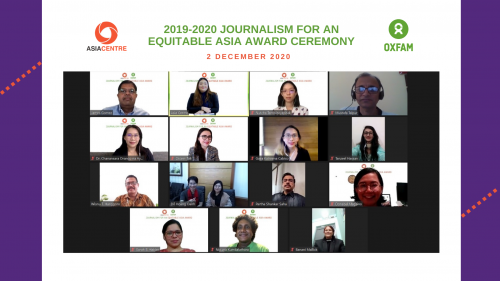
Women led at the Journalism for an Equitable Asia Award Ceremony on the 2nd of December 2020 at 2 PM – 3.30 PM (GMT+7, Bangkok). The female-dominated field of the top ten journalists were positively judged on their delivery of high-quality articles on the issues of poverty and inequality in Asia. Out of the twelve journalists, who wrote the top ten articles, eleven were women. Asia Centre and Oxfam in Asia convened an online award ceremony in place of a face-to-face event due to the ongoing COVID-19 pandemic travel advisories. For this year’s nominations, there were 100 submissions, from 7 countries in the region including Bangladesh, Malaysia, Myanmar, Pakistan, The Philippines, Thailand and Vietnam, with 25 merit awards, 10 prize awards with 3 winners all of whom were invited to attend the event. Nipuna Kumbalathara, Media and Communications Lead – Asia, Oxfam International, welcomed all to the event and dedicated the event to all the journalists who continuously use their voice against deep injustices. Mustafa Talpur, Regional Advocacy and Campaigns Manager – Asia, Oxfam International, in his keynote remarks encouraged emphasising inequalities and injustices as a political agenda in Asia and the Pacific. During the event, the 3 prize winners were announced by Asia Centre and Oxfam in Asia: Winner of the award and $1000 prize money was the Turkish journalist Ms. Didem Tali with her article “Our Mother Sold Us for One Lakh Each” published on “New Naratif”. The story about two sisters and other victims in Myanmar, who faced human trafficking clearly convinced the judges. In second place and the winners of $750 came two journalists from the Philippines, Ms. Jessica Bartolome & Ms. Donabel Magsino followed, for their story “A very long summer” published on “GMA News Online”, a group of farmers for over five months. They documented their daily struggles and how their situation worsened due to “El Niño”. In third place came Ms. Nutcha Tantivitayapitak, the Thai journalist and winner of $500 prize money reported in her article “The forest reclamation case : when the court sent the Sapwai villagers to prison and off their land”, on the case of Thai villagers who illegally lost their land and their fight against the court. Her article was published in the “Prachatai”. Dr. James Gomez, Regional Director of Asia Centre, congratulated the winners, finalists, the merit awardees and all who submitted their award tickets for speaking up against inequalities and poverty, in particular towards women as a whole through various lenses. At the same event, the launch of the nominations of the awards in 2021 was announced by Nipuna Kumbalathara, Regional Advocacy and Campaigns Manager – Asia, Oxfam International exploring the theme of inequality crisis and the pandemic. For those interested in the nominations for next year’s cycle can submit entries here: https://bit.ly/36lPkDX. We, Asia Centre and Oxfam in Asia, hope to receive your nominations soon and see you at the next award ceremony!
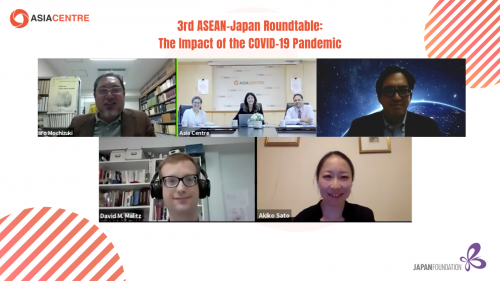
3rd ASEAN-Japan Roundtable: The Impact of the COVID-19 Pandemic
On 18 November 2020, Asia Centre, in partnership with the Japan Foundation, convened the 3rd ASEAN-Japan Roundtable on the topic of “ASEAN-Japan relations: The Impact of the COVID-19 pandemic”, the video of which can be viewed here. Experts in ASEAN-Japan relations came together to discuss the impact of COVID-19 in Japanese society and Japan’s relationship with ASEAN countries in terms of economy, geopolitical developments and people-to-people relations. Dr. Robin Ramcharan, Executive Director, Asia Centre, welcomed the speakers and participants in his opening remarks that recapped the content of the Centre’s 1st and 2nd ASEAN-Japan round tables held in 2017 and 2019. In introducing the 3rd Roundtable, Dr. Ramcharan pointed to recent developments in ASEAN-Japan relations in the context of the Japanese Prime Minister’s latest visit to Southeast Asia. The speakers at the Roundtable made the following points: Prof. Saul Takahashi, Osaka Jogakuin University: He pointed to the shift in attitude needed by Japanese policymakers to promote human dignity towards migrant workers thereby creating a strong Japan-ASEAN relationship. Prof. Takahashi said that the travel restrictions placed on foreign residents in Japan who were migrants, spouses and students was an infringement of their human rights. Dr. David Malitz, BALAC,Chulalongkorn University: He examined the shift in Japanese investment, due to COVID-19, from Thailand to Indonesia and Vietnam. Dr. Malitz’s comments further noted the shift from manufacturing towards the service, education, and human resource sectors. Dr. Saikaew Thipakorn, Director, Japan-ASEAN Studies Centre, Chulalongkorn University: She examined COVID-19’s impact on the daily lives of people in Japan and in the ASEAN countries. Dr. Thipakorn discussed the ‘new normal’, influenced by the impact of digital- literacy and divide, and further addressed self-sufficiency policies. Dr. Thipakorn noted, these developments raise questions about who should standardize digital regulation and how to promote self-sufficiency without disrupting globalisation. Akiko Sato, Human Rights Now: She examined the impact of the COVID-19 pandemic on Japan’s economy and human rights issues. Japan has experienced the human rights violations of migrant workers, children, women, persons with disabilities and privacy issues in its business sector. To rectify these issues, Ms. Sato prescribed that Japan learn from the human rights institutions in ASEAN which can build on the existing Japan-ASEAN economic relationship. Prof. Taro Mochizuki, Osaka University: He presentedthe philosophical perspective of COVID-19 as a war between citizens and soldiers. This war can lead to a shift in identity from citizen to soldier, as aligned with authoritarianism. Prof. Mochizuki emphasised that instead of using the war metaphor, civil solidarity and civic duty should be promoted while international and regional solidarity should be strengthened on a civil level. The main takeaway of the event is that the mutual collaboration between Japan and the ASEAN countries should be promoted to both maintain existing relationships and tackle the impact of the COVID-19 pandemic. However, this relationship should be based on a mutual understanding and respect of each other which currently is far from satisfactory. This event is the 3rd ASEAN-Japan Roundtable convened by Asia Centre with the support of Japan Foundation. The Centre has convened two earlier events: 2017: 1st ASEAN-Japan Roundtable: Multipolar Asia-Pacific Century, that focused on ASEAN-Japan economic and business relations in relation to human rights 2019: 2nd ASEAN-Japan Roundtable: Competing for Influence in SEA that discussed Japan’s non-economic approach to maintaining relations with ASEAN. Asia Centre looks forward to partnering with the Japan Foundation to convene future events.
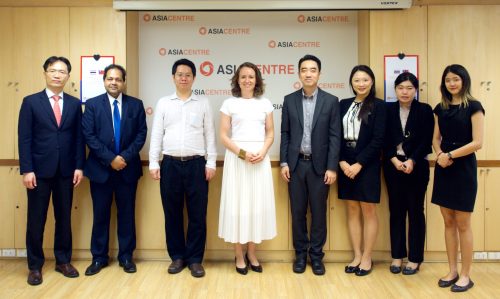
Asia Centre Convenes “Infodemic” Discussion
Asia Centre, in partnership with the Taipei Economic and Cultural Office in Thailand (TECO) and the Thai Media Fund, convened a discussion on “Countering the COVID-19 Infodemic: Sharing Best Practices” on 4 November 2020. The session, which brought together speakers from Taiwan and Thailand, examined the impact of the COVID-19 pandemic creating an “Infodemic” which has challenged countries trying to tackle issues of disinformation, misinformation and too much information as there has been a surge of fake news related to COVID-19, placing vulnerable communities at risk to the public health arena and national security. Ambassador Lee, Ying-Yuan (Taiwan’s Representative to Thailand) introduced the session highlighting that the COVID-19 pandemic has spread disinformation and misinformation. He compared the intensity of the dissemination of false information as a pandemic and, thus, creating an “Infodemic”. Audrey Tang (Digital Minister, Taiwan) discussed the need for transparency where civil society and citizens, online communities and media consumers act as the solution to counter this “Infodemic”. The Minister said every individual must play a role in becoming “fact-checker” themselves. Summer Chen (Taiwan Fact Check Center), Lilly Min-Chen Lee (Global Research Program Manager, Doublethink Lab, Taiwan) and Chitpong Kittinaradorn (ChangeFusion) expressed the need for a collaborative approach to tackle COVID-19 on a global scale. The speakers demonstrated that one of the ways to collaborate was through inoculation of correct information and fact checking systems; for instance, #CoronaVirusFacts Alliance and International Fact-Checking Network (ICFN) in Taiwan that can then be utilised by organisations to tackle the virus-like spread of disinformation and misinformation. Prof. Warat Karuchit (Associate Dean, Graduate School of Communication Arts and Management Innovation, NIDA) shared his efforts to alleviate the accumulated communication crisis; for instance, one of his effective methods was to deliver policies, decrees and laws in common parlance. Therefore using key political figures and trusted organisations to transmit well designed digital content over social media platforms works well to inform the public about COVID-19 relevant information. The main takeaway from the event is the importance of fusing public and civil communities to work together and network to produce solutions. One of the proposed solutions is a coordinated act of becoming “super-correctors” – what this means is that during a heightened situation of disinformation everyone comes together to immediately respond and debunk false information. Apart from discussing solutions to the challenges of COVID-19, this event once again demonstrates the close partnership between Asia Centre, Taiwanese institutions and the Thai Media Fund and the potential for future collaborations on other projects.
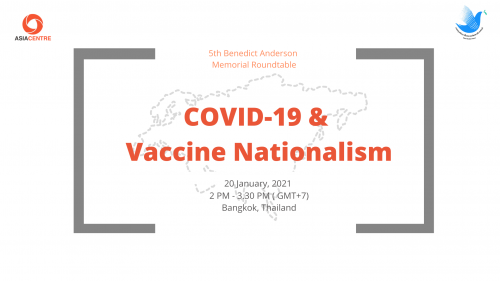
5th Benedict Anderson Memorial Roundtable: COVID-19 & Vaccine Nationalism
Asia Centre will convene the 5th Benedict Anderson Memorial Roundtable entitled, ‘COVID-19 & Vaccine Nationalism’. The event, held in partnership with the Thai Media Fund, will take place next year on January 20, 2021 at 2 PM – 3.30 PM (Bangkok, Thailand, GMT+7). This event will review the implications of pre-purchase agreements being made between governments and vaccine manufacturers to secure and prioritise a country’s needs before others. In particular, it will examine how high demand for a COVID-19 vaccine, now commonly known as ‘vaccine nationalism’, will affect Asia. Since 2016, Asia Centre has convened 4 memorial roundtables to examine the work of renowned scholar, Benedict Anderson, on nationalism as well as to honour the significance of his studies on the impact of nationalism in the Southeast Asian region. His seminal work Imagined Communities invited exploration of nationalism beyond European confines. These memorial round tables hold in-depth discussions and debates exploring ideas and analysis of Anderson’s work between respected scholars, professors and lecturers across Southeast Asia. To date Asia Centre has convened the following memorial roundtables: “1st Benedict Anderson Memorial Roundtable: Debating Imagined Communities” (2016) discussed the understanding of nationalism and debated its level of relevance in contemporary society and its contribution to foster the development of Anderson’s concept ‘imagined communities’; “2nd Benedict Anderson Memorial Roundtable: Nationalism, Citizenship and Statelessness” (2017) provided an overview of Anderson’s concept of ‘imagined communities’ and interpreted his ideas to convey how nation-states and nationalism are modern constructions and citizens share a sense of community through common values and shared rights; “3rd Benedict Anderson Memorial Roundtable: Gender and Nationalism in Asia” (2018) examined Anderson’s work on nationalism, as seen through a gendered lens in order to bridge the gap between the growing discourse on nationalism and gendered perspectives and, most recently, “4th Benedict Anderson Memorial Roundtable: Chinese Nationalism and Its Impact on Southeast Asia” (2019) critically discussed Southeast Asia’s growing fear of China’s rise as a global power and its impact on the region in the age of information and disinformation. Having held 4 memorial round tables, Asia Centre aims to further Anderson’s work by exploring a new wave of nationalism, vaccine nationalism, and see how we can understand Anderson’s ideas and analysis on nationalism and contemporary issues surrounding it. Register for the Roundtable here. For more information, please feel free contact us at research@asiacentre.org
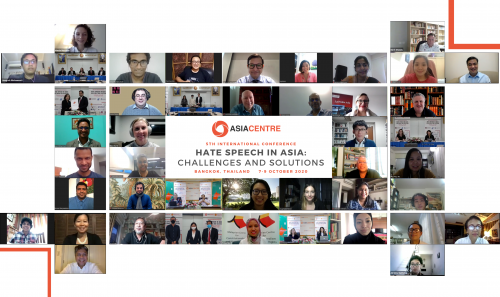
5th International Conference (2020): Hate Speech in Asia: Challenges and Solutions
From 7 to 9 October 2020, Asia Centre convened its fifth International Conference on Hate Speech in Asia: Challenges and Solutions. Due to the ongoing COVID-19 travel and health advisories, this conference was convened as a hybrid event with participants joining in-person as well as teleconferencing from locations worldwide. The Law Faculty of Thammasat University was the location for the first day of the conference. Thereafter, starting that evening, panels were hosted in Asia Centre’s office and online. Into its 5th year, Asia Centre’s annual conference continued to grow from the previous year in spite of the pandemic. There were 18 partners who convened fifteen panels and one information session. The Centre facilitated the presentations of 47 speakers of which 45% were female. Furthermore, during these three days, a total of 40 people attended physically at the Law Faculty, Thammasat University whilst all others logged in online for all other conference sessions over the three days. Moderated by Belen Bode, Partnership Officer of Asia Centre, the conference’s first day opened with welcome remarks from Munin Pongsapan, Dean of the Law Faculty and Thammasat University; Dhanakorn Srisooksai, CEO of the Thai Media Fund; Pierre Hagmann, representative of the Swiss Embassy in Thailand; Frederic Spohr, Head of the Friedrich Naumann Foundation in Thailand and Myanmar and Robin Ramcharan, Executive Director of Asia Centre. Asia Centre’s 18 partners for this conference were the Faculty of Law at Thammasat University, Taiwan Foundation for Democracy, Thai Media Fund,and Friedrich Naumann Foundation. The panel partners were the Sanya Dharmasakti Institute For Democracy (SDID); the Embassy of Switzerland in Thailand; NIDA’s Graduate School of Communication and Innovation Management; Graduate School of Letters, Osaka University; Internews; La Trobe University; Strengthening Reconciliation Processes in Sri Lanka (SRP) Deutsche Gesellschaft für Internationale Zusammenarbeit (GIZ); Australian Human Rights Institute of the University of New South Wales; Malaysian Reform Initiative (MARI); International Republican Institute (IRI); Moonshot CVE; M Ravi Law; Council of Asian Liberals and Democrats (CALD) and the American Jewish World Service. Day One On the first day, discussants addressed how hate speech fuels conflict in Thai democracy emphasising cultural aspects; hate speech, religion, and racism in Thailand noting topics such as passive hate speech and digital literacy; philosophical perspectives of hate speech and the impact of linguistics in creating social divide; and the political weaponization of hate speech and its impact in Malaysia, Myanmar and Sri Lanka. Day Two On the second day of the conference, panelists discussed the multi stakeholder inputs needed to address some of the key symptoms of hate speech such as nationalism, xenophobia, political ideologies, religion and minority groups. The role of government, private and public sector, and civil society were further touched upon throughout the day. Social media companies, as facilitation platforms of hate speech, were examined from both narratives. The nature of gender, mobilisation tactics, youth and importance of digital were emphasised once again. Discussants also noted populist religious groups’ knowledge sharing which is displayed through hate speech campaigns sharing similar information, format and trends. Day Three The third and final day of the conference commenced with discussions on a hate speech project led by the Online Hate Prevention Institute’s Andrew Oboler. Later in the day, during the CALD panel Abhisit Veijjajiva (Former Prime Minister of Thailand) and Francis Pangilinan (Senator to the Republic of the Philippines) discussed issues related to political hate speech and the need for a neutral standard setter. The third day’s speakers also discussed the legal regulation of blasphemy with focus on the courts and prosecutors, politicians and governments. Further, the relationships between regulation and religion in incorporating cultural dimensions were examined. The role of Artificial Intelligence (AI) software to regulate hate speech on social media platforms were also noted. In terms of regulation, discussants shifted responsibility between governments and technology companies. Conference’s Key Focus Over the 3 days, the conference participants addressed amongst others the religious, cultural, ethnic, legislative, political, and technological aspects of hate speech which contribute to the multi-faceted dimension of the issue. The key focus of the conference evolved around legal and non-legal solutions that public, private and civil society stakeholders can take to mitigate the spread and harm of hate speech. Although legal measures were mainly touted there were concerns over who defines what is hate speech and the overall impact on freedom of expression. As conversations progressed, three clear commonalities in the discussants’ analysis emerged: The increasing role of social media as a hate speech facilitator; the reinvigoration of hate speech pushed by COVID-19; and the lackluster efforts from technology companies and governments alike in rectifying the issue. Panel Sessions and Conference Proceedings A range of issues related to hate speech were discussed over the course of three days. Papers submitted will be made accessible via the Conference Proceedings later in November 2020. Thereafter Asia Centre will announce a separate book project on Hate Speech in Southeast Asia. Recordings of panel sessions and a video overview of the conference are also available on Asia Centre’s YouTube channel. 2021’s 6th International Conference: COVID-19 in Asia Asia Centre and the National Institute of Development Administration also took the opportunity to announce their partnership for next year’s conference. Professor Yubol Benjarongij (NIDA’s Graduate of Communications and Innovation Management) outlined the rationale for the 6th International Conference “COVID-19 in Asia: Communication, Nationalism, Technology” from 6 to 8 October 2021. Professor Benjarongij mentioned the next conference will allow participants the timeframe to assess how COVID-19 has impacted communications infrastructures, led to the rise of nationalism and discuss how technology has changed the way we work and do business. Asia Centre is presently calling for expressions of interest to partner for the 2021 conference. To register your interest, please send an email to research@asiacentre.org
Hate Speech in Southeast Asia
Download Full Report ABSTRACT Hate speech, often disseminated online, is increasingly a problem in Southeast Asia with consequences of violence and communal strife. As a result, several countries in Southeast Asia such as Singapore, Malaysia, Myanmar and Thailand have introduced or are revising bills aimed at securing social, racial or religious harmony. Non-legal measures to foster social cohesion, interfaith dialogues and social harmony activities have also been used to address hate speech and promote cross-communal understandings. A majority of states in Southeast Asia have also signed the International Convention on the Elimination of All Forms of Racial Discrimination (ICERD) to signal their committment to to the elimination of racial discrimination and the promotion of understanding among all races. This report recommends a range of measures to alleviate these concerns. Among them, is a primary recommendation to officially recognise newer forms of hate speech and a set of secondary recommendations to promote understanding and diversity. CONTENTS PAGE Preface Acknowledgements Executive Summary Introduction Background Forms of Hate Speech Legal Measures Policies and Practices ICERD Role of Technology Companies Recommendations Conclusion Bibliography SUPPORT ASIA CENTRE Help Asia Centre speak up for human rights. Your donation can help highlight human rights violations, bring people together for action and support advocacy for human rights protection. Donate Now
Hate Speech Solutions Require Multi-Stakeholder Approach
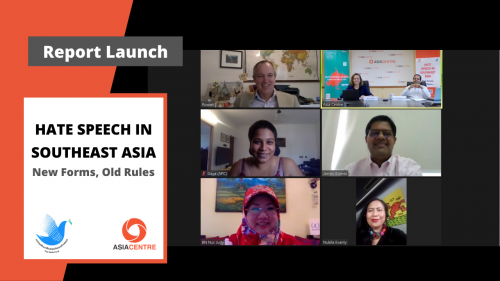
Hate speech in Southeast Asia has evolved into new forms and requires a multi-stakeholder approach for finding sustainable solutions. Civil society, governments and technology companies need to work together to address the issue. This was the general consensus that emerged when Asia Centre launched its report, Hate Speech in Southeast Asia: New Forms, Old Rules, via webinar on July 22nd. Some 200 people registered to attend the event via Zoom which was also live streamed over Facebook and shared widely. Dr Robin Ramcharan, Asia Centre’s Executive Director presented the report. He noted, that “apart from those based on race and religion, new forms of hate speech have been directed towards foreign nationals such as migrant workers and refugees; members of the LGBTI community; and those with different political values, ideologies and affiliations.” The report’s primary recommendations include broadening the parameters to include new forms of hate speech and a set of secondary recommendations that call policies and policies not to be discriminatory and restrict freedom of expression. Technology companies are also asked to take responsibility and do more to eradicate hate speech’s spread on their platforms. Following the presentation, discussants Nukila Evanty, Executive Director, Women Working Group, Indonesia; Nur Judy Binti Abdullah, founder and executive director of Project Women and Girls Development, Brunei; Rowan Reid, Asia Programs Manager for Internews, Australia; and Gayatri Khandhadai, Asia Policy Regional Coordinator at Association for Progressive Communications, provided their reactions to the report. Nur Judy binti Abdullah, Founder and Executive Director of Project Women and Girls Development shared, “In Brunei Darussalam, the COVID-19 pandemic has led to a rise in sexual harassment experiences online. Work from home for women and online classrooms for children has made them vulnerable to sexual harassment over social media platforms. The online sexual harassment has contributed to an increase in mental health issues and our organization has helped raise awareness among women and girls to report the perpetrators to relevant authorities for proper action. Nukila Evanty, Executive Director, Women Working Group, noted that “Indonesia’s President Jokowi is relying on the ITE law’s subjective racial and ethnic discrimination terminology used in hate speech laws to favour himself and silence his critics. As a result, government spokespeople are unfazed by the consequences of their statements and are quick to link surges in COVID-19 infections to religious mass gatherings to escape their responsibilities.” Ms Evanty added, “It is important to note that the constitutional court has previously repealed penal code articles that have been used to silence criticism toward the president. The court has argued that continuing with such legal proceedings is an infringement on constitutional rights.” Rowan Reid, Asia Programs Manager, Internews, said, “Most ASEAN governments already have a questionable approach to free speech, and recently many have either introduced or are considering “fake news” laws which go beyond their stated purpose and limit political criticism and deny other human rights. Civil society needs to work with governments to ensure that new laws or changes to existing laws are suitably narrow in focus to address just hate speech and cannot be manipulated to serve other less democratic means.” Gayatri Khandhadai, Asia Policy Regional Coordinator at the Association for Progressive Communications commenting on South Asia said, “Technology companies are involved in the increased hate speech in India and Bangladesh. Fear of physical spaces and activities have led us to move entirely online. Governments such as the Indian government have used technology platforms to increase blame on foreign states and minorities for the influx of infection rates. Social media platforms, aware of these trending problems, have not adequately remedied them. In fact, any remedy given, was towards fact checking infection rates and not limiting hate speech. There is a normalisation of hate by technology companies who benefit from the financial income that the increased use of their platforms have seen during COVID-19.” Dr James Gomez, Asia Centre’s Regional Director, explained why governments cannot be the sole arbiters of hate speech. He said, “Governments in Southeast Asia have been responsible for spreading hate speech. Often they set the tone for how the media, those online and the wider population respond to others within the community.” Dr. Gomez further added, “that government rhetoric on identity and ethnicity had driven genocide and crimes against humanity in Cambodia, Indonesia, Myanmar, Philippines and Southern Thailand in the region’s recent history. Hence, stakeholders such as civil society as well as technology companies need to play a role in keeping governmental hate speech in check.” The ensuing discussion noted that the public must educate themselves to learn how to stop the spread of fake news – which governments in the region have capitalized on as hate speech to censor criticism. In addition to this, media literacy must be encouraged so as to ensure governments are not the only stakeholders that can argue critical reasoning of information. At the same time, all stakeholders must take accountability to ensure the information they spread is accurate and factual. In summing up, Belen Bode, Asia Centre’s Partnership Officer, who moderated the event, said, “Controlling hate speech cannot be an excuse to limit freedom of speech – a fundamental element of the UN declaration of human rights. Asia Centre report calls for a multi-stakeholder approach as governments should not be the only ones responding to hate speech. A ground up approach that includes civil society and technology companies would lead to more sustainable solutions. “Hate Speech in Southeast Asia: New Forms, Old Rules” can be downloaded from here, and the event’s livestream recording can be seen here link. Download Full Report
Hate Speech in Southeast Asia: New Forms, Old Rules
Download Hate speech, often disseminated online, is increasingly a problem in Southeast Asia with consequences of violence and communal strife. As a result, several countries in Southeast Asia such as Singapore, Malaysia, Myanmar and Thailand have introduced or are revising bills aimed at securing social, racial or religious harmony. Non-legal measures to foster social cohesion, interfaith dialogues and social harmony activities have also been used to address hate speech and promote cross-communal understandings. A majority of states in Southeast Asia have also signed the International Convention on the Elimination of All Forms of Racial Discrimination (ICERD) to signal their committment to to the elimination of racial discrimination and the promotion of understanding among all races. This report recommends a range of measures to alleviate these concerns. Among them, is a primary recommendation to officially recognise newer forms of hate speech and a set of secondary recommendations to promote understanding and diversity. All which should not result in any discrimination or infringement of rights.
Asia Centre and Oxfam Announce 2019 Journalism Award Finalists
Asia Centre and Oxfam in Asia are pleased to announce the finalists for the 2019 Journalism For An Equitable Asia Award. As thought leaders and creators, journalists have the skills and voice to expose social issues of inequality to build the public’s understanding and support for equality, #humanrights, and #sustainability. Many journalists across Asia fight the injustice of #inequality and poverty. Journalism for an Equitable Asia Award, co-hosted by Asia Centre and Oxfam in Asia aims to recognize them and encourage more journalists to write for a fairer #Asia. Here are the finalists: Aidila Razak is Special Reports Editor at Malaysiakini, where she explores topics which go beyond the daily headlines. She has worked as a journalist for a decade, covering Malaysian politics and socio-economics. She has a keen interest in using data and technology to find innovative ways to do better journalism. She is passionate about freedom of expression and social justice, and hopes her work can contribute to a more equitable and inclusive society. Read her article “Whither Integration? How our children are growing up in separate bubbles”, here. Anna Lawattanatrakul holds a Bachelor of Art in Language and Culture from Chulalongkorn University and a Master of Letter in Modern and Contemporary Literature and Culture from the University of St Andrews in Scotland. She is currently a reporter for Prachatai English and is focusing on reporting gender-based violence and discrimination. She is also a translator and contributed three stories to “This Flower” a translated volume of Katherine Mansfield’s short stories, published in early 2019 by Gammemagie Publishing. Read her article “13-year-old girl’s escape from forced marriage highlights the neglected issue of Thailand’s child brides”, here. Banani Mallick is currently working at the Daily Observer as a reporter. She writes on various aspects of the environment, giving special focus on air and river pollution, climate change issues (including its impact on the health of women and children), Sundarbans’ (ecology and biodiversity) plastic and chemical pollution in the Bay of Bengal, and possible measures to combat climate change. She also writes on various human rights issues that include early marriage, child labor, domestic workers, dowry and health issues. Read her article “Endless miseries haunt women victims of climate change”, here. Didem Tali is a multimedia journalist and a documentary filmmaker covering issues of human rights, gender, and culture in Southeast Asia and Europe. Her work has been featured by the New York Times, National Geographic, The Guardian, Financial Times, BBC, CNN, NPR, and many more. She currently writes for New Naratif. Read her article “Our Mother Sold Us for One Lakh Each”, here. Do Haong Oanh is a graduate of the Academy of Journalism and Communication. As a tourism reporter, she has had the opportunity to travel to various places, including areas home to ethnic minorities. Their lives, customs and culture alongside the scenery of their hometown attracted her to write about these women. Do Hoang Oanh is a writer for Vietnam Investment Review. She co-wrote this article with Nguyen Thi Hao. Read their article “Woman power riding high in ethnic minority communities”, here. Donabel Magsino is a graduate of Bachelor of Arts in Development Studies at the University of the Philippines-Manila. She first pursued writing scripts for sociopolitical college plays and eventually built her path to the newsroom of GMA Network in 2015. Dona is currently the Senate beat reporter of GMA News Online. She hopes to write more development-oriented stories as she explores the legislative sphere. She co-wrote this article with Jessica Alaina Bartolome. Read their article “A Very Long Summer”, here. Gaea Katreena Cabico has been a reporter at Philstar.com for roughly three years. She covers topics that include complex national issues especially those related to human rights. She wrote explanatory reports on the war on drugs, the Philippines’ exit from the International Criminal Court and nationwide health crises. She has been shifting to environmental reporting because it impacts fundamental rights like the right to livelihood, right to life and right to health. Read her article “Fed by the waters. Coastal waters in Bulacan that have provided food and livelihood for decades may soon be paved over for an airport project.”, here. Jessica Alaina Bartolome is a senior content producer for GMA News Online, the online news arm of one of the Philippines’ largest broadcast networks. A multimedia journalist since 2014, she creates visually-driven stories and special reports, using her knowledge in photography, video production, graphic design, and writing to tell important stories for online consumption. She co-wrote this article with Donabel Magsino. Read their article “A Very Long Summer”, here. Nutcha Tantivitayapitak was born in 1993 in Bangkok, Thailand. She graduated in Film and Photography, Faculty of Journalism and Mass communication at Thammasat University. She is a journalist at Prachatai where she focuses on wellbeing, art and culture. Read her article “The forest reclamation case: when the court sent the Sapwai villagers to prison and off their land”, here. Nguyen Thi Hao has worked in media, radio, television and print for ten years. During her career she has had particular interest in topics about women. These include gender equality, women in business, women’s political participation and ethnic minority women. Her interests have led her to talk with various inspiring and admirable women. She notes “These women have shown an important role in ethnic minority communities’ development.” Nguyen Thi Hao is a writer for Vietnam Investment Review. She co-wrote this article with Do Haong Oanh. Read their article “Woman power riding high in ethnic minority communities”, here. Partha Shankar Saha is a senior sub editor of Prothom Alo, the largest Bengali daily in Bangladesh. He started his career with a national research organization that deals with environmental and human rights issues. His areas of interest are water, land, human rights, indigenous people and development economics. He is co-authors of at least six books on environment, development and human rights issues. Read his article “Water discrimination in cities and villages, among rich and poor”, here. Sarah B.
Hate Speech Echoes Government Speak
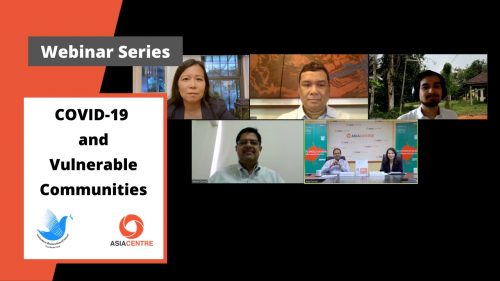
Hate speech in society towards vulnerable communities often reflects the discriminatory and prejudicial language by government officials and political leaders. In Southeast Asia, the spike in hate speech against migrant workers, refugees, undocumented workers, ethnic minorities and the homeless can be attributed to this trend. This was the analysis offered by speakers at Asia Centre’s webinar on COVID-19 and Vulnerable Communities on 24 June 2020. (watch it here) The webinar attended by over 114 attendees of 380 registrants, offered a thorough discussion on hate speech arising from government and political speak. The event follows an earlier webinar on COVID-19 and Hate Speech held on 27 May, 2020, both partnered with the Thai Media Fund (watch it here) and read the article here. Four speakers addressed the webinar, Ms. Khin Mai Aung from Doa-A-Yae: Coalition for Human Rights in Burma and an Asia Centre Associate (USA) via vodcast (due to the US time difference), Prof. Jude William R. Genilo from the University of Liberal Arts Bangladesh, Mr. Lutfi Hakim as an independent communications professional and Asia Centre’s Associate (Malaysia) and Dr. Chanansara Oranop na Ayutthaya from the National Institute of Development Administration. Focusing on the Rohingya minority and other religious and ethnic groups, Ms. Khin Mai Aung pointed out that there is unequal government enforcement of social distancing and quarantine measures of minority communities in Myanmar. Laws and policies aimed at protecting the vulnerable in Myanmar are used as tools of oppression and social control. For instance, the pandemic has provided the government a convenient excuse to enforce emergency laws especially in conflict areas where minorities are under siege. The COVID-19 spurred governmental suppression of minorities and other vulnerable groups is fueling hate speech among Buddhist extremists. Watch her vodcast here. Also addressing the situation among the Rohingya refugees, Prof. Jude William R. Genilo highlighted the inevitable impact of hate speech that originates from state authorities in Bangladesh. He also noted that government inaction is occurring and giving rise to governmental discourse that the Rohingya community have become a burden. This has led to negative perceptions of the refugees as news circulates about delayed repatriation, overpopulation, alleged drugs networks, environmental destruction and their reluctance to move to another location. This negativity arising from government discourse about the Rohingyas is causing hate speech to take root. Mr. Lutfi Hakim noted the importance of the language used by state officials, which sets a tone for how the media and wider population view vulnerable communities. He examined the plight of undocumented workers and migrants in general, especially their dehumaniztion through prejudicial language used by authorities. The fear of the ‘other’ – migrants as a security threat – has led the authorities to securitize the ‘threat’ from migrants. He recommended that it is important to identify the causes of insecurities and re-anchor the narrative so that it clarifies the policies and power structures that allow for these insecurities to fester. In Thailand, said Dr. Chanansara Oranop na Ayutthaya, the pandemic can trigger an outburst of discrimination and hate speech against vulnerable groups on social media. She highlighted one incident of Thai returnees, during the height of the pandemic, that refused to self-isolate citing excuses that they were not informed when they landed in Thailand. When government officials announced that they had their personal information to track them down and pursue legal action, personal details of these returnees were anonymously leaked over social media giving rise to hate speech against this group. In the Q&A section, participants engaged with the speakers over details of their presentations and expertise related to incidents of violence against the Rohingya and how the community can engage on the Internet in countering hate speech against them, inter-communal tensions in South Thailand and regional sensibilities regarding the alleged “China virus” that has spread globally. With the webinar concluded, attention now turns to the launch of Asia Centre’s report, “ Hate Speech in Southeast Asia: New Forms, Old Rules”, a collaborative study with the Thai Media Fund, scheduled for 22 July, 2020. You can register here. The report will be presented at Asia Centre’s International Conference on Hate Speech in Asia; Challenges and Solutions from 7-9 October 2020 and registration for the event is still open. The event has 11 international partners confirmed and will be held in collaboration with the Thai Media Fund, Faculty of Law, Thammasat University, Friedrich Nauman Stiftung and the Taiwan Foundation for Democracy. For more information contact: research@asiacentre.org.
Hate Speech: Measures Shouldn’t Infringe Rights
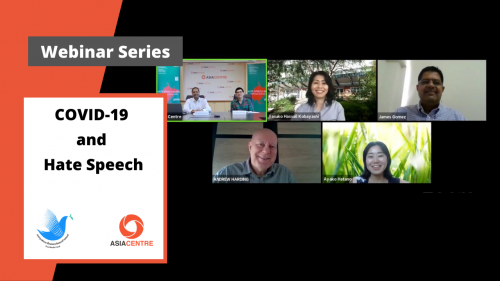
Legal and non-legal measures to regulate hate speech should not infringe on freedom of expression. This was the cautionary advice arising from speakers and participants at Asia Centre’s first webinar that discussed the impact of COVID-19 crisis on hate speech in Asia. Over 215 attendees from a total of 395 registrants took part in the proceedings (See link to video). The webinar was the first of two on hate speech convened with the support of the Thai Media Fund. A second webinar, “COVID-19 and Vulnerable Communities”, is scheduled for 24 June 2020 which will discuss COVID-19’s impact on vulnerable and marginalized communities. Asia Centre’s regional director Dr. James Gomez and 4 speakers, Prof. Andrew Harding of the National University of Singapore, Ms. Ayako Hatano of the University of Tokyo, Prof. Yasuko Hassall Kobayashi of Ritsumeikan University and Mr. Wasin Punthong of Thammasat University raised different viewpoints during the event moderated by Dr. Robin Ramcharan, Executive Director, Asia Centre. The webinar kicked off with a presentation of Asia Centre’s draft baseline study on Hate Speech in ASEAN, produced in collaboration with the Thai Media Fund. Dr. James Gomez outlined the key findings of the report. The main point was that hate speech analysis needs to move beyond the traditional racial and religious markers. Hence, it needs to encompass hate speech towards other groups such as the LGBT community, refugees and asylum seekers and migrant workers as well as those holding different political values and ideology. The report calls for expanding the definition of hate speech taking into account these other forms. In considering such expansion, a cautionary note was sounded by Prof Andrew Harding against over-regulating hate speech. Dr. Harding noted the potentially deleterious impact on freedom of expression from any change to include new groups. Such expansion should not be too hasty and should be guided by key principles: necessity, proportionality (to the mischief being addressed) and a high threshold for limiting free speech. From an international human rights law perspective, limitations on rights need also to be considered, noted Ms. Ayako Hatano. She pointed to the applicability of international standards: the International Convention on the Elimination of Racial Discrimination (ICERD), the International Covenant on Civil and Political Rights (ICCPR) and the Rabat Plan of Action in this regard. Moving away from law, Dr. Yasuko Hassall Kobayashi called attention to the need for building social resilience in the context of post-colonial states. Majority-minority dynamics inherited from the colonial era, she noted, perpetuated in-group and out-group mentalities that are characteristic to the “nation-state” idea. New tools for building social trust were required. In this connection, the role of rational and reasonable political discourse was treated by Mr. Wasin Punthong. He highlighted the deep divide in Thailand over political values between generations and social classes in a society marred by inequality. He said that the problem in Thailand is about implementation of the existing law which is quite selective. Thereafter participants were able to put questions to the speakers. These included the role of nationalism in fostering hate speech, the effectiveness of interventions or programmatic responses to hate speech, and that of exploiting cultural and political identities to mobilise electoral constituencies for political gain. Overall, the thrust of the discussion pointed to the need to address hate speech firmly through various legal and non-legal measures but to proceed cautiously in order not to infringe on rights, especially freedom of expression. Asia Centre will continue its exploration of hate speech at the next webinar “COVID-19 and Vulnerable Communities” on 24 June 2020. The findings drawn from the webinars will be used to finalise the baseline study in July 2020. The report will be presented at Asia Centre’s International Conference on Hate Speech in Asia; Challenges and Solutions from 7-9 October 2020. The event has 10 international partners confirmed and will be held in collaboration with the Thai Media Fund, Faculty of Law, Thammasat University, Friedrich Nauman Stiftung and the Taiwan Foundation for Democracy. For more information contact: research@asiacentre.org
Asia Centre resumes operations, strengthens online capacity
Introduction Asia Centre has resumed office operations and has taken steps to strengthen its online capacity. The Centre is re-starting activities following a requisite COVID-19 postponement of some events and 10 weeks of remote working. Selected postponed activities will now move online, while the Centre enhances its online meeting capabilities and presence over social media. Postponed Activities The Centre’s first response to the COVID-19 pandemic began when it announced on 16 March 2020 that in-person activities will be postponed. These included halting the Melbourne Outreach planned for 23-27 March 2020 that consisted of meetings and lectures as well as two half-day seminars one each at Chiang Mai University on 29 April 2002 and Prince of Songkla University on 22 May 2020 in HatYai. Other events postponed was the Journalism for An Equitable Asia Award Ceremony and Workshop with Oxfam in Asia in Bangkok scheduled for 2-3 April 2020. Following consultation with all partners on 6 April 2020, Asia Centre announced its annual international conference, Hate Speech in Asia: Challenges and Solutions will be moved from 8-10 July 2020 to 7-9 October 2020, with a possible postponement to 3-5 December 2020 if the situation warrants it. Work From Home On 18 March 2020, following the postponement of planned activities, Asia Centre initiated remote working for all staff and interns. During the remote working period, Asia Centre’s management team held daily video calls via Zoom, coordinated through Whatsapp and utilized Google Document to work on projects. In this way, the Centre’s operations related to administration and accounting, research and publications, social media updates and media engagement continued to run smoothly. Asia Centre was in regular communications with partners and participants and kept them informed about the status of projects and took their inputs onboard. During this time, bookings for the use of Asia Centre meeting space was discontinued. Office Re-opening Following the phased opening of the Thai economy on 3 May 2020, Asia Centre’s management team initiated plans for the resumption of limited services and operations. To facilitate this, an on-site inspection was undertaken of the Phayathai Plaza Building to observe its health and social distancing protocols. Thereafter, an office inspection and deep cleaning was initiated for Asia Centre’s premises. Thereafter, the Centre developed a set of guidelines and protocols to ensure the safety of all staff and interns that included, including mask-wearing, temperature checks, clean hands policy, and 2m social distancing. To minimize the risk of transmission, all face-to-face events at Asia Centre remain discontinued. Installing Video-Conferencing System As part Asia Centre’s limited operations, some postponed activities have now been re-designed as webinars. To prepare itself for such activities, the Centre installed a video-conferencing system and upgraded its Zoom Pro account to enable up to 500 participants to join its webinars. Hosting webinars will also become part of the new service that Asia Centre will provide partners moving forward. The Centre expects in-person events, up to the 3rd quarter this year, to be largely postponed. Hence switching to video conferencing enabled meetings would be a solution for meetings and activities. Strengthening Social Media Presence Anticipating that more outreach will take place online, the Centre has launched a social media strengthening initiative. Starting the first week of June, Asia Centre will run a campaign to boost its followers on all social media platforms such as Facebook, Instagram, LinkedIn, Twitter and YouTube. The Centre has long been using Facebook as its major channel to connect with the public. The move to connect with audiences from different social media platforms will also mean that Asia Centre will be reaching out to different audiences and using different approaches. Conclusion While COVID-19 did impact Asia Centre’s operations in the short term. However, through the early actions taken and strategic planning, the Centre has been able to respond quickly to the changing situation. Asia Centre is now well prepared to confidently operate in a post-COVID-19 situation.
Call for Chapter Proposals
Call for Chapter Proposals Fake News and Elections in South Asia BOOK PROJECT Proposal to Established Publisher South Asia has not been spared the scourge of fake news that has spread globally in the social media era. Strategic exploitation of fake news negatively affects fact-based democratic discourse and the conduct of elections, the most basic indicator of governmental legitimacy. At election-time disinformation and misinformation exact a toll on democracy, especially in contexts of low-literacy. The central theme of this book is on disinformation, fake news, hoaxes and foreign influence operations immediately prior to and during elections that have taken place in South Asia since 2016. The key question being addressed is whether the different types of fake news had an impact on voter behaviour, candidates’ policy positions, the electoral results and the politics of identity in each country. Chapters on the respective South Asian countries probe the following specifically: the digital, legal and political landscape; specific disinformation campaigns and/or influence operations against politicians or groups; strategies, tools, and information infrastructures used to do so; and the electoral/political impact of such disinformation or influence operations. Each author grounds their work in relevant theoretical frameworks and social science methodologies. Asia Centre invites high quality proposals for chapters of a forthcoming book on Fake News and Elections in South Asia. Interested authors may submit a title, an abstract of 300 words (max), 5 keywords and a bio of 100 words (max) per author for consideration. See sample. Submit your abstracts to Mr. Yawee Butrkrawee at research@asiacentre.org Submission deadline: 30 June 2020 Selected chapter proposals will be invited to submit a full chapter of 6000-8000 words. Each chapter submission will incur an editorial fee of USD$300. Click here for more details. Editors: James Gomez and Robin Ramcharan For examples of Asia Centre’s recent publications see links below: National Human Rights Institutions in Southeast Asia: Selected Case Studieshttps://www.palgrave.com/gp/book/9789811510731 The Universal Periodic Review of Southeast Asia: Civil Society Perspectiveshttps://www.palgrave.com/gp/book/978981106225h
Call for Chapter Proposals
Call for Chapter Proposals Fake News and Elections in East Asia BOOK PROJECT Proposal to Established Publisher Asia Centre invites high quality proposals for chapters of a forthcoming book on Fake News and Elections in East Asia. Interested authors may submit a title, an abstract of 300 words (max), 5 keywords and a bio of 100 words (max) per author for consideration. The central theme that chapters must focus on is disinformation, fake news and foreign influence operations immediately prior to and during elections that have taken place in the years 2016, 2017, 2018, 2019 and 2020 in East Asia. Chapters on Japan, Hong Kong, South Korea, Taiwan as well as chapters on China’s influence operations targeted at elections and political activities in these countries are encouraged. The chapters can analyse the East Asia situation as follows: an overview of the digital, legal and political landscape an outline of specific disinformation campaigns and/ or influence operations against politicians or groups dissect the strategies, tools, and information infrastructures used to do so assess the electoral/political impact of such disinformation or influence operations ensure the research is guided by a relevant theoretical framework and research methodology Submit your abstracts to Mr. Yawee Butrkrawee at research@asiacentre.org Submission deadline: 30 May 2020 Selected chapter proposals will be invited to submit a full chapter of 6000-8000 words. Each chapter submission will incur an editorial fee of USD$300. Click here for more details. Editors: James Gomez and Yasuko Hassall Kobayashi For examples of Asia Centre’s recent publications see links below: National Human Rights Institutions in Southeast Asia: Selected Case Studieshttps://www.palgrave.com/gp/book/9789811510731 The Universal Periodic Review of Southeast Asia: Civil Society Perspectiveshttps://www.palgrave.com/gp/book/978981106225
Call for Chapter Proposals
Call for Chapter Proposals Fake News and Elections in Indonesia: The Politics of Identity BOOK PROJECT Proposal to Publisher: Palgrave Macmillan Asia Centre invites high quality proposals for chapters of a forthcoming book on Fake News and Elections in Indonesia: The Politics of Identity. Interested authors may submit a title, an abstract of 300 words (max) and bio of 100 word (max) for consideration. The central theme that chapters must focus on is disinformation, hoaxes and fake news immediately prior to and during the presidential elections of 2019. Authors are recommended to make comparisons to the 2014 presidential elections and to also discuss the post-2019 elections scenario. The key question to address is whether the different type of fake news had an impact on voter behaviour, candidates’ policy positions, the electoral results and the overall politics of identify in Indonesia. Chapters that examine and evaluate efforts to combat fake news or discuss government legal and policy measures are also welcome. The research needs to be guided by a relevant theoretical framework and research methodology. The chapters can analyse the Indonesian situation as follows: The internet, legal and political landscape Specific disinformation campaigns against candidates, politicians or groups Islam, the politics of identity and gender dimensions Independent fact-checking initiatives and government policies Submit your abstracts to Mr. Yawee Butrkrawee at research@asiacentre.org Submission deadline: 31 August 2020 Selected chapter proposals will be invited to submit a full chapter of 6000-8000 words. Each chapter submission will incur an editorial fee of USD$300. Click here for more details. Editors: Dr. James Gomez and Wisnu T. Hanggoro For examples of Asia Centre recent publications see links below: National Human Rights Institutions in Southeast Asia: Selected Case Studieshttps://www.palgrave.com/gp/book/9789811510731 The Universal Periodic Review of Southeast Asia: Civil Society Perspectiveshttps://www.palgrave.com/gp/book/978981106225
The Emerging Human Rights Protection Architecture of Southeast Asia
This work is currently being drafted. Check back later for updates.
Business and Human Rights in Asia: Duty of The State to Protect
Buy Now Abstract In this book the authors examine the State’s duty to protect human rights in Asia amidst rising concern over the human rights impact of business organisations in Asia. States in the region have recently begun to consider the need for rules and policies in this area. This work examines the upswing in interest in business and human rights (BHR). It focuses on the duty of the State in the region to uphold their existing obligations, which has hitherto been understudied. It examines a range of inter-connected issues: the advent of international standards, the UN Guiding Principles on Business and Human Rights, the challenges inherent in the formulation of National Action Plans on business and human rights, the need for improved legislation and policies, access to remedies and conflicts with indigenous peoples over business activities. The book also treats innovative themes such as BHR in the era of smart cities, ethical consumer behaviour and a human rights management system, which are emerging areas of enquiry in relation to business and human rights. It concludes with a range of critical issues to be addressed, including the need for an assessment of COVID-19 pandemic’s impact on BHR in Asia and beyond. This book is part of Asia Centre’s exploration of the nascent regional human rights architecture that is facing significant challenges in protecting human rights. The body of work offered by this book showcases the progress achieved and challenges across Asia. Table of contents Introduction: Business and Human Rights in a Complex Westphalian Order. Gomez, James; Ramcharan, Robin Chapter 2: Does the slipper fit? National Action Plans on Business and Human Rights in South East Asia. White, Michael Chapter 3:National Action Plans on BHR: Norms, Procedures, Pitfalls. Gomez, James; Ramcharan, Robin Chapter 4: Multinational Corporations and Human Rights in Indonesia: The Need for Improvement in Legislation. Ghufron, Nurul; Evanty, Nukila Chapter 5: All Carrots and No Stick: Human Rights Regulation of Companies in Japan. Takahashi, Saul Chapter 6: States’ Rights to Development of Natural Resources versus Indigenous People’s Rights: Resource Corporations and Free, Prior and Informed Consent. Storey, Matthew Chapter 7: Effect of Minimum Wage on Employment Security: The Case of Precarious Workers in Myanmar. Nguyen, Hanh; Lin, Min Zar Ni; Ngwenya, Samukelisiwe Chapter 8: Recent Development on the Access to Remedy in Business and Human Rights in Indonesia. Prihandono, Iman; Religi, Fajri Hayu Chapter 9: The Current State of Affairs for Access to Remedy for People and Communities Affected by Alleged Arbitrary Takings of Land in the Agribusiness Industry in ASEAN. Soa, Socheata Chapter 10: As Smart Worlds Collide: Citizen Agency and Human Rights in the Smart City. Woodier, Jonathan; Zingerle, Andreas Chapter 11: Towards an Empirical Understanding of Ethical Consumption in Southeast Asia. Polomski, Daniel; Klukas, Emily; Mullen, Matthew Chapter 12: Designing a Human Rights Management Systems Standard Framed By the Value Of Human Life: A Practical Approach to Business Enterprise Human Rights in Asia. Sadlier, Robert Chapter 13: Conclusion-State’s Duties To Protect: New Issues in the Post-COVID 19 Era. Gomez, James; Ramcharan, Robin
National Human Rights Institutions in Southeast Asia: Selected Case Studies
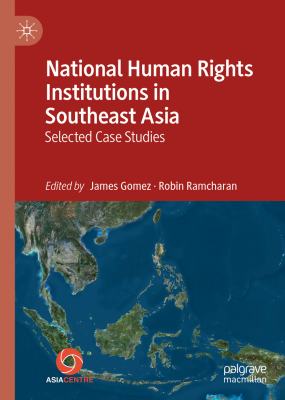
Buy Now Abstract This book reviews Southeast Asia’s National Human Rights Institutions (NHRIs) as part of an emerging assessment of a nascent regional human rights architecture that is facing significant challenges in protecting human rights. The book asks, can NHRIs overcome its weaknesses and provide protection, including remedies, to victims of human rights abuses? Assessing NHRIs’ capacity to do so is vital as the future of human rights protection lies at the national level, and other parts of the architecture—the ASEAN Intergovernmental Commission on Human Rights (AICHR), and the international mechanism of the Universal Periodic Review (UPR)—though helpful, also have their limitations. The critical question the book addresses is whether NHRIs individually or collaboratively provide protection of fundamental human rights. The body of work offered in this book showcases the progress of the NHRIs in Southeast Asia where they also act as a barometer for the fluid political climate of their respective countries. Specifically, the book examines the NHRIs’ capacity to provide protection, notably through the pursuit of quasi-judicial functions, and concludes that this function has either been eroded due to political developments post-establishment or has not been included in the first place. The book’s findings point to the need for NHRIs to increase their effectiveness in the protection of human rights and invites readers and stakeholders to find ways of addressing this gap. Table of contents Introduction: National Human Rights Institutions in Southeast Asia: Challenges to the Protection of Human Rights. Gomez, James (et al.) Chapter 1: National Human Rights Institutions: From Idea to Implementation. White, Michael J. V. Chapter 2: National Human Rights Institutions in Southeast Asian States: The Necessary Foundation for an Efficient ASEAN Intergovernmental Commission on Human Rights. Martin, Céline Chapter 3: National Human Rights Institutions and the United Nations Human Rights Treaty Body System: A Rebuttal to the Skeptics. Zipoli, Domenico Chapter 4: Assessing the Effectiveness of the Myanmar National Human Rights Commission in the Wider Regional Geo-Political Context. Lang, Niki Esse Chapter 5: From Transition to Government Accountability: Opportunities for the Myanmar National Human Rights Commission. Traglia, Francesca Paola Chapter 6: Komnas HAM: Discrepancies Between Its Mandate and the Indonesian Constitutional Framework. Evanty, Nukila Chapter 7: Strengthening Komnas HAM and Building Synergies with Other National State Institutions on Human Rights. Samsul, Inosentius Chapter 8: The Protection Capacities of NHRIs in the Philippines, Thailand and Timor-Leste. Gomez, James (et al.) Chapter 9: Advocating for a National Human Rights Institution in Singapore, Gomez, James (et al.) Chapter 10: Mental Health and Human Rights: The Role of Komnas HAM. Clair, Kimberly Chapter 11: Bridging Gaps and Hopes: Malaysia’s National Human Rights Commission and Rights Related to SOGIESC. Koh, Henry Chapter 12: Komnas HAM and the Land Rights of Indigenous Peoples: National Inquiry as a New Mechanism for the Settlement of Disputes. Yulianti, Isnenningtyas Chapter 13: The Protection Capacities of NHRIs. Gomez, James (et al.)
Asia Centre Builds Momentum for Malaysia Branch
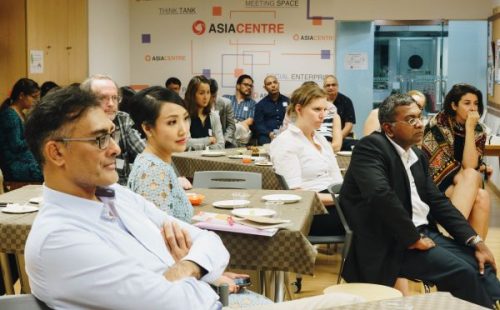
Since 2016, Asia Centre’s has undertaken a series of Malaysia-related activities to build momentum for a new branch in Johor Bahru. To date the activities include discussions on Malaysia’s political transition, co-convening events on fake news, engagement with Malaysian media and exploratory partnership meetings with institutions based in Malaysia. Collectively these efforts form the basis upon which Asia Centre Malaysia, first publicly announced in 2018, will build its programme of activities moving forward. Asia Centre began discussing Malaysia’s political transition as early as May 2016, when the Centre hosted Professor William Case, a well-known Malaysian studies scholar, who shared his analysis of the 1MDB scandal’s impact on Malaysian politics. He argued that the stable authoritarianism practiced by Malaysia was resilient to democratic pressures. When Malaysia experienced a change in government in May 2018, the issue of political transition was revisited in June 2018, when the Centre hosted a post-election roundtable. Malaysian speakers, Dr. Mohd Azizuddin Mohd Sani (PhD), Professor of Politics and International Relations at the School of International Studies, Universiti Utara Malaysia (UUM); Lutfi Hakim, independent consultant and a former associate of IMAN Research; and Dr. Victor Karunen, former UN official with UNICEF observed that the challenge for the new government of Pakatan Harapan (PH) was its ability to usher out the politics of ‘money, race and patronage’ and to bring about a fundamental change in Malaysian politics. The discussions continued in July 2018 when Asia Centre’s co-hosted an event in Kuala Lumpur with IMAN Research and Gerakbudaya Bookshop entitled “Democratic Transition in Malaysia: Impacts on Southeast Asia”. The Malaysian speakers included Masjaliza Hamza, a sub-editor for Malysiakini, Dr. Vilashini Somiah, Head of Research, IMAN Research, and Dr. Lee Hwok Aun, a senior fellow and co-coordinator of the Malaysia Studies Programme at the Yusof Ishak Institute of Southeast Asia Studies. At that event speakers highlighted the need for Malaysia to consolidate its democratic transition through institutional reforms that will ensure independent checks and balances. Asia Centre later added to this debate by penning an op-ed in August 2018 that discussed the establishment of a ‘Malaysian Democracy Foundation” or MDF. The op-ed argued that the MDF presents a unique opportunity to further institutionalize democracy in Malaysia as well as act as a catalyst in Southeast Asia and beyond. If established, MDF would be the first such Foundation in Southeast Asia. The debate around Malaysia’s political transition continues in Malaysia, and in November 2019, Asia Centre’s Dr. James Gomez was invited to deliver the Opening Speech at “Malaysia Transition Weekend,” organized by an NGO called Empowering Fundamental Freedom Defenders in Southeast and East Asia (EFDEA). In his speech, Dr. Gomez provided a regional overview of the challenges to democratic transitions in Asia which set the context for the discussion on Malaysia’s transition. Apart from political transition, another topic that Asia Centre has contributed to is the issue of fake news in Malaysia. Given that Malaysia was the first Southeast Asian country to pass a fake news legislation in April 2018, Asia Centre initiated several activities around that issue. In April 2019, in partnership with University of Nottingham, Malaysia (NUM) and Gerakbudaya Bookshop, Asia Centre convened a seminar on Fake News Industry: Developments in SEA and Malaysia. Moderated by Professor Zaharom Nain of University of Nottingham, Malaysia, Kuala Lumpur-based panelists included, Jahabar Sadiq, Editor of Malaysian Insight; Dr Craig J Selby, Managing Director of public relations firm, Orchan Consulting; and Darshini Kandasamy, an Editor at Malaysiakini. At the seminar, participants reviewed media literacy and other non-legal measures put in place to tackle issues surrounding fake news in Malaysia and the wider region. In July 2019, Nottingham University, Malaysia, School of Media, Languages and Cultures organised a panel on Fake News in Malaysia at Asia Centre’s 4th International Conference on Fake News and Elections in Asia. Ngo Sheau Shi, Universiti Sains Malaysia; Azmyl Yusof, Sunway University; Zaharom Nain, Nottingham University; and Mahyuddin Daud, International Islamic University Malaysia discussed a range of issues related to law, media literacy, politics, religion and women as its related to fake news in Malaysia and exchanged views with other presenters from the region. When Malaysia announced that it was going to abolish its Fake News bill following the change in government, Asia Centre weighed in on the debate through an op-ed. When the repeal was initially rejected by the Senate, the Centre highlighted, even with the delay around the repeal of Malaysia Fake News Bill, it offered Malaysia an opportunity to manage racial disinformation that can lead to social tensions. However, the op-ed pointed out that existing laws or new laws if enacted should not impinge on the quality of debate on this issue. In undertaking activities related to political transitions and fakes Asia Centre has often been approached by Malaysia’s BFM radio to comment on current developments in the region. Centre representatives on various times have commented on fake news issues and legislation in Southeast Asia and Singapore. Time to time the Centre was also asked to comment on elections and political transitions in Thailand. In December 2019, Asia Centre co-convened with Oxfam in Asia the Malaysia launch event of the Journalism for an Equitable Asia Award. The award is aimed at journalists to encourage them to report on issues of inequality. The aim of the Award is to promote strong journalism and acknowledge the hard work of journalists who have persisted in reporting on inequality in spite of the challenges the media industry faces. The event was held at the Gerakbudaya Bookshop and the speakers and media was coordinated by Orchan Consulting Asia. The event was covered and reported in Malaysia’s Chinese language Sin Chew and China Press and in English in The Star. Given the engagement with Malaysia, Asia Centre staff and interns have been making regular trips to Kuala Lumpur for events coordination and meetings as well as receiving visitors in Bangkok. As a result, Asia Centre has been able to establish working relationships with Kuala Lumpur based academics, civil society representatives, diplomatic missions, government
Fake News and Elections in Southeast Asia
Abstract Elections in Asia are increasingly witnessing a rise in information manipulation to influence voter views and behavior. Behavioral manipulation takes place as electoral candidates, political parties and interest groups take to social media to spread fake news with the aim of discrediting their opponents and gaining support for their electoral candidates and/or political parties. In this book, the authors will assess the impact of fake news on electoral outcomes in Southeast Asia from the years 2018-2020. The aim is to provide an understanding of the evolving issues related to fake news and elections and to review its implications for democracy in Asia.

Asia Centre’s Dr. Gomez Awarded 2020 Taiwan Fellowship
Asia Centre’s Regional Director, Dr. James Gomez has been awarded Taiwan’s Ministry of Foreign Affairs (MOFA), 2020 Fellowship, to undertake research on disinformation operations, fake news and hate speech in Southeast Asia. Known as the Taiwan Fellowship, it is awarded to foreign scholars and experts who plan to undertake part of their research at Taiwanese universities or academic institutions. The 2020 Taiwan Fellowship is the third in three years for Dr. Gomez. In 2019, Dr. Gomez received a Sumitomo Foundation Grant and in 2018 he was awarded the Korea Democracy Foundation Research Fellowship both times to undertake research on fake news in Southeast Asia. Dr. Gomez was nominated for the Fellowship by the Taiwan Economic and Cultural Office (TECO) based in Bangkok, Thailand for his work as convenor of Asia Centre’s Freedom of Expression project 2019-2022. The award is for 12 months and will begin later in January 2020. During the Fellowship, Dr. Gomez will be affiliated with the Department of Diplomacy at National Chengchi University with short stints at other universities. Apart from research, in 2020, Dr. Gomez will also be exploring the feasibility of establishing an Asia Centre programme in Taiwan. To this end, Dr. Gomez discusses possible programme components and collaborations options with various Taiwanese organizations. The MOFA Taiwan Fellowship, Sumitomo Foundation Grant and Korea Democracy Foundation Research Fellowship underscore Asia Centre’s expertise in disinformation operations, fake news and hate speech. They also help Asia Centre build networks and extend its reach into East Asia via the awarding countries of Taiwan, South Korea and Japan. The 2020 Taiwan Fellowship comes on the back of Asia Centre’s engagement at various times with Taiwanese institutions, think-tanks and universities in 2018 and 2019. Read more about Asia Centre Taiwanese engagement here.