
Business and Human Rights: More Stakeholder Participation Needed in Southeast Asia
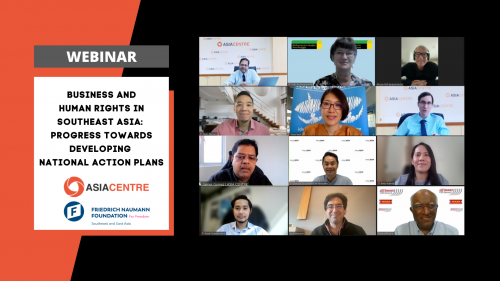
While welcoming the uptake of the BHR agenda across Southeast Asia, panelists in the online forum: ‘Business and Human Rights in Southeast Asia: Progress Towards Developing National Action Plans’(NAPs) emphasised gaps in advocacy on business and human rights across the region. Collectively they noted the need for more stakeholder participation from parliamentarians, business organisations and other non-governmental organisations in NAPs development processes. The event, co-convened by Asia Centre and the Friedrich Naumann Foundation for Freedom, was held on 15 December 2021, 10.00 AM – 4.00 PM Bangkok Time, to mark the launch of the joint publication: ‘Business and Human Rights in Southeast Asia: Developing National Action Plans’. The event focused on identifying the way forward for the progressive adoption of NAPs in the region. In welcoming speakers and participants at the start, Moritz Kleine-Brockhoff, Head of Regional Office Southeast and East Asia, Friedrich Naumann Foundation For Freedom, noted that a decade after the adoption of the United Nations Guiding Principles (UNGPs) on BHR there has been an uptake of the UNGPs in Southeast Asia. This was also highlighted by Dr. Robin Ramcharan, Executive Director, Asia Centre, who presented the key findings of the book. He said that countries in the region have been undergoing, albeit slowly, NAP-development processes in the past few years, following the footsteps of Thailand, which adopted one in 2019, and other Asian countries. Hence, the BHR and NAPs are becoming part of a widening human rights architecture in the region, though progress has been slowed down by political certainty in places like Indonesia and Malaysia and also by the current COVID-19 pandemic. He noted further key findings of the book, namely: that regional NAPs development still faces challenges in that key stakeholders, notably parliamentarians and business organisations, have not yet been involved in NAPs processes; that there has been a lack of awareness and interest in the BHR agenda among these two sectors; that NAPs must be better aligned with international human rights standards; that through language that is closely aligned with international human rights instruments and best practises, NAPs can play a role in deepening a culture of human rights and democracy in the region, which has seen a regression in both areas in the last decade. NAPs are tools to hold both States and their businesses accountable. These points were echoed across two panels of experts. The first panel, from 10 AM to 12 PM on ‘The State of NAPs Development in Southeast Asia’ was joined by Paolo Zamora, Programme Manager, Council of Asian Liberals and Democrats and Vicky Bowman, Head of the Myanmar Centre for Responsible Business. Tricia Yeoh, CEO, Institute for Democracy and Economic Affairs, moderated the panel. The second panel, from 2 PM to 4 PM was a roundtable discussion ‘Business Organisations and NAPs: Prospects for Advancing the BHR Agenda’. It was joined by Betty Yolanda, Asia Regional Manager, Business and Human Rights Resource Centre, Thomas Thomas, CEO at ASEAN CSR Network, Edmund Bon Tai Soon, Lawyer, AmerBON, Saul Takahashi, Asia Centre Advisory Board and Professor of Human Rights and Peace Studies at Osaka Jogakuin University. Husai Chantarawirod, Regional Programme Officer, Regional Office Southeast & East Asia, Friedrich Naumann Stiftung, moderated the discussion. Echoing important elements of NAP development that are treated in the book, both panels pointed: the need for greater inclusivity and transparency in the development of NAPS, which must involve parliamentarians in the drafting and monitoring of NAPs; setting up strong mixed regulatory frameworks on BHR in addition to providing incentives for Business Organisations (BOs); and the inclusion of Civil Society Organisations (CSOs) as well as National Human Rights Institutions (NHRIs) as key stakeholders in the NAPs development processes to better advance national BHR agendas. The book’s Chapter 2 by James Gomez and Robin Ramcharan of Asia Centre noted these challenges to the uptake in the UNGPs in the region. Speakers acknowledged that NAPs processes are rightly Executive-driven but pointed to the need for greater inclusivity of stakeholders, notably parliamentarians who can hold governments to account in upholding their human rights obligations. Chapter 3 of the book by Paolo Zamora and Francis Abaya of CALD drew attention to the missing role of Parliamentarians. The lack of interest and understanding of BHR among BOs have resulted in their low involvement in implementing NAPs. Having NAPs as a starting point, future BHR agendas could aim at offering a ‘smart mix’ of regulations that already exist for BOs along with guidelines on voluntary action that could be made. Chapter 4 of the book by Thomas Thomas for IDEAS treats the reluctance of BOs to engage on the BHR agenda. Panelists, echoing the book’s findings, pointed to the need to be as inclusive as possible and to involve CSOs and NHRIs in National Baseline Assessment (NBAs) to ensure a comprehensive assessment of the needs of each jurisdiction. The lack of consultation can lead to the exclusion of critical issues that feature across all countries including environmental degradation, the rights of indigenous peoples, and the protection of human rights defenders – among other issues that CSOs and NHRIs have brought up. Gender issues are often excluded from consideration. In his Closing Remarks, Dr. James Gomez, Regional Director, Asia Centre said there is a need for greater awareness of and training on the BHR agenda and how stakeholders can effectively contribute to NAP development processes. This calls for national and regional awareness building and for the development of toolkits to better guide small and medium size businesses, which are the backbone of most economies. The concluding Chapter 5, by Asia Centre, summarises pathways for future action for parliamentarians and for better engaging BOs. The discussion and the book are part of Asia Centre’s ongoing work on National Human Rights Institutions and BHR in Southeast Asia. They were follow-ups to the Centre’s 3rd International Conference on ‘Business and Human Rights: Holding Governments Accountable in Asia’ in 2018 and to its previous work, Business and Human Rights in Asia: The Duty of States.
COVID-19 Disportionately Impacts Women’s Rights
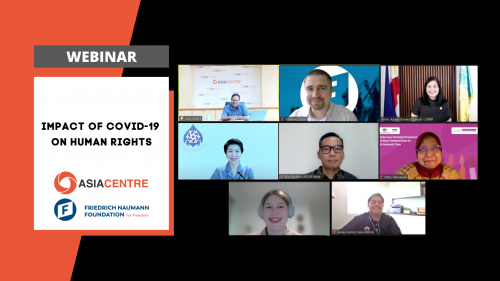
Commissioners from different human rights bodies highlighted that during the pandemic, women disportionately faced various challenges. Despite the operational difficulties, the various commissions nevertheless have tried their level best to call out these COVID-19 related rights violations. Officiated by Frederic Spohr, Head of Friedrich Naumann Foundation in Thailand and Myanmar, these and other issues were highlighted during the International Human Rights Day Roundtable Discussion ‘Impacts of COVID-19 on Human Rights’ on 9 December 2021. The discussion was part of Asia Centre’s ongoing work on National Human Rights Institutions (NHRIs) in Southeast Asia. It held its 2nd International Conference on ‘National Human Rights Institutions in Southeast Asia: Challenges of Protection’ in 2017. In 2020, it co-published with Palgrave Macmillan a book on ‘National Human Rights Institutions in Southeast Asia: Selected Case Studies’. The Centre has also engaged with the National Human Rights Commission of Thailand and its Regional Centres. In 2021, it participated in ‘The Official Launch of the Regional Center for Human Rights Study and Coordination’ at the Faculty of Political Science, Ubon Ratchathani University. Moderated by Asia Centre’s Executive Director, Dr. Robin Ramcharan, the discussion was joined by human rights commissioners who included: Lorraine Finlay of the Australian National Human Rights Commission (AHRC), Retty Ratnawati (Komnas Ham Perempuan), Karen Gomez-Dumpit of the Commission on Human Rights of the Philippines (CHRP), Pornprapai Ganjanarintr, Chairperson of NHRCT (appearing via video: see full video and script) and Eric Paulsen, Malaysian Representative to the ASEAN Intergovernmental Commission on Human Rights (AICHR). Through the discussions, impact on the rights of women during the pandemic featured prominently. Collectively, the commissioners noted issues of gender-based violence against women during lockdowns, such as increased domestic violence. Worsening the situation was that shelters providing care for victims of violence were forced to shut down, without governments providing alternative primary channels for refuge. Pregnant women faced difficulties accessing health services. The commissioners also pointed out that workers in women-dominated fields continue to be exploited. Further, they highlighted the criminalisation of Human Rights Defenders (HRDs), especially of women HRDs. Indeed, more broadly across the regions, HRDs faced increased prosecution for their criticisms of Governments’ mismanagement of the pandemic. Children, and youth more broadly, also faced serious challenges with accessing services that address mental health given the deep psychological impact of isolation during lengthy lockdowns. The elderly were also affected in that the pandemic restrictions, including lockdowns, did not properly address their situation and, more generally, the disabled in society. The net effect of the measures to handle the pandemic was to deprive them of critical health and social services. These challenges have compelled human rights commissions to take actions in protecting human rights. These actions include engaging with governmental agencies to ensure policies are up to human rights standards, providing trustworthy information to the public and continuing to monitor and establish mechanisms to receive complaints of rights violations. It was noted that the commissions faced significant operational challenges in meeting their mandates, notably investigating complaints, to provide protection services for their constituents. They were also subject to the same lockdown measures and restrictions on assembly. Finally, attention was called to the work of AICHR, the ASEAN-level human rights body, which has continued to work on human rights issues amidst the pandemic, with its activities and events constrained by the existing framework to promote human rights. Nevertheless, it was able to issue a press statement by Representatives reaffirming the rights of peoples to access quality health-care services and medical facilities – underlining the principle of proportionality in the restriction of human rights during states of emergency. Asia Centre’s Regional Director, Dr. James Gomez, in his vote of thanks, stressed the Centre’s intention to continue tracking the work of regional and national human rights mechanisms. He noted that there is a need to publicise the good work of the commissions as the public is still unclear of what they do and their effectiveness. The event was co-convened by Asia Centre and the Friedrich Naumann Foundation for Freedom, Thailand. Earlier at the start of the proceedings, tributes were paid to the late Chito Gascon, former Chair of the CHRP who succumbed to COVID-19. You can view the event’s livestream recording here. Asia Centre works on issues related to human rights commissions in the region. If you would like to collaborate with the Centre on this and other human rights concerns, send an expression of interest to contact@asiacentre.org.
Asia Centre Pens Agreement With Naresuan University
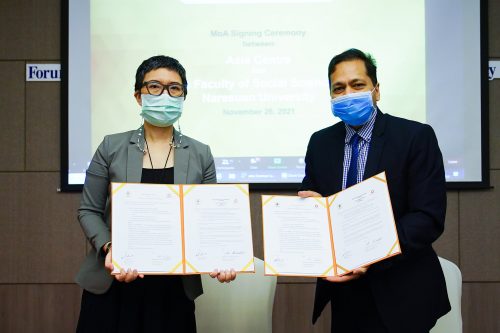
On 26 November 2021, Dr. Robin Ramcharan, Executive Director, Asia Centre and Dr. Napisa Waitoolkiat, Dean of the Faculty of Social Sciences, Naresuan University, Thailand signed a Memorandum of Agreement (MOA) to establish a framework of future cooperation. The MOA marked the collaboration between the organisation in a two-part event on ‘Strengthening the Milk Tea Alliance: Building Democracy and Freedom through Speakers and Discussion’ supported by the Taiwan Foundation for Democracy. The first, was held on 26 November 2021 at the Topland Hotel in Phitsanulok, Thailand and the second, on 1 December 2021 at Asia Centre in Bangkok, Thailand. Dr. James Gomez, Regional Director, Asia Centre, during the events, provided an overview of the global state of democracy and the rising authoritarianism of Asia, and highlighted some of the key movements in the region. Pointing to the findings of Asia Centre’s baseline study: ‘COVID-19 and Democracy in Southeast Asia: Building Resilience, Fighting Authoritarianism’, he said governments have been taking actions against such movements, especially during the COVID-19 pandemic. Dr. Gomez suggested holding joint activities such as ‘democracy festivals’ to increase awareness and understanding of democracy and human rights in Asia. Both events also included inputs from Pongpop Dansamanchanchai, Alumnus, Faculty of Social Sciences, Naresuan University, who encouraged the building of Thai democracy networks and highlighted decentralising democratic norms to other regions in the country. In the first event, Sai Htong Kham, Education University of Hong Kong updated on the situation in Myanmar and the ongoing protests there, where he stressed the importance of regional solidarity. In the second event, Toe Kyi, a 1988 generation activist, said although the price for democracy is high, through the ongoing civil disobedience movement, it was clear that people in Myanmar are willing to pay this price for their freedom from military rule. Sugreeya Wannayuwat, a Thai political activist, explained the value of regional alliances like the Milk Tea Alliance that connected Thai democracy movements and brought its issues onto the world stage. In addressing questions for next steps, Dr. Gomez said that those interested in developing concrete action plans can undertake evidence-based research, capacity building activities and advocacy campaigns to strengthen democracy. For those working in authoritarian environments, efforts can start with informal communication and advocacy, and providing people the opportunity to learn about democracy. Digital tools can also be used to coordinate activities and share knowledge. However, he cautioned, as did other speakers, that these efforts come with risks and those leading these initiatives should be prepared to weather the consequences. Following the events, Asia Centre discussed collaboration with the Faculty of Social Sciences, Naresuan University for the year 2022, including possible partnership in organising the 7th International Conference, Freedom of Expression in Asia, 24-26 August 2022. Asia Centre undertakes evidence-based research, organises events, undertakes advocacy and signs MOUs with organisations with whom it has a track record of cooperation. The Centre has several ongoing MOUs with INGOs, NGOs, universities and parliamentary networks. If you would like to collaborate with the Centre and sign an MOU, send an expression of interest to contact@asiacentre.org Asia Centre works on human rights issues related to freedom of religion or belief, hate speech and racial discrimination. If you would like to collaborate with the Centre on evidence-based research, co-coveneing activities or other projects. Send an expression of interest to contact@asiacentre.org
Media Spotlight Can Help Address Vaccine Inequality
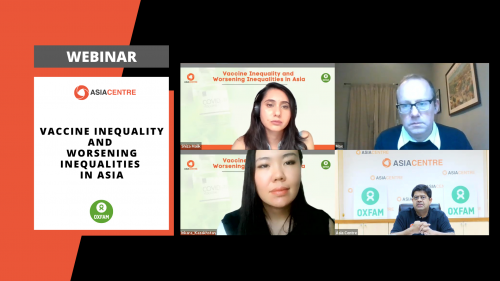
Vaccine inequality is a growing concern in Asia, where the biggest challenge in keeping the pandemic at bay is the vaccination rates of a country. Hence, verified information on vaccine’s efficacy, and the equity of vaccine provision and distribution is important in putting a spotlight on the underlying inequalities that affect efforts to combat the COVID-19 pandemic. This concern was the main theme of the webinar: “Vaccine Inequality and Worsening Inequalities in Asia” co-convened by Oxfam International and Asia Centre on 24 November 2021, 3:00 PM – 4:30 PM. The event was part of Oxfam International and Asia Centre’s efforts to discuss the issue of vaccine inequality and open the nominations for the 2021-2022 Journalism for an Equitable Asia Award – now in its 3rd year. In her opening remarks, Shiza Malik, Regional Communications and Media Leads—Asia, Oxfam International, welcomed the panel with a brief overview of the Journalism for an Equitable Asia project which encourages journalism that highlights inequality in Asia. The focus of the “2021-2022 Journalism for an Equitable Asia Award” is on recognizing works that report on the disparity of vaccine allocation, unaffordable costs of healthcare, and preventable deaths. Max Lawson, Head of Inequality Policy, Oxfam International, explained that COVID-19 pandemic has worsened economic inequalities: rich countries were getting more vaccines and recovering faster in a big part from hoarding the vaccines. Existing patent models have also helped pharmaceutical companies to profit from and limit access to vaccines that were developed with taxpayers’ money. Consequently, he urged the need for small countries to have the capacity to acquire or manufacture cheap, license-free vaccines. Inkara Mukatova, Program Officer, Civil Society Development Association, gave an overview of the COVID-19 situation in Central Asia. Disinformation on death rates and quality of vaccines has hidden the true extent of the problem in the region and has created vaccine hesitancy among Central Asians. The geopolitics of the region has also meant that governments’ hands are tied with Russian and Chinese vaccines which may not be as effective as others. What would help Central Asia is commitments and cooperation on a global level that ensures access to effective vaccines to those most in need. Dr.James Gomez, Regional Director, Asia Centre, presented a regional overview that showed the correlation of vaccination rates and death rates in Asian countries. Apart from differences in vaccination rates between sub-regions in Asia, he also pointed to the challenges and discrepancies within countries when accessing vaccines. He stressed the need for comprehensive plans to provide vaccines in preventing additional COVID-19 related deaths. Thereafter, Dr. Gomez introduced the 2021-2022 Journalism for an Equitable Asia Award. He said the nominations are open now and the submission deadline is on 31 January 2022. Eligible journalists must have published two or more pieces about healthcare inequality between 1st January 2021 and 31st January 2022, and the articles submitted for nomination should be at least 650 words in length, in English. Nominated articles will be judged by a Judging Panel of media and inequality experts, representatives from the Asia Centre, Oxfam International, and independent practitioners. The top 3 winners will receive cash awards, the top 10 journalists will be invited to participate in the awards ceremony, and merit certificates will be given to the journalists ranked from 11st to 15th places. The award ceremony will be held on 22 March 2022 in Bangkok, Thailand. Discussion during the Q&A largely centred on the role of journalism. It was recognised that journalists can be part of wider efforts by local communities and civil societies to ensure fact-based understanding of vaccines. Additionally, it was noted that journalists can shed light on attempts by governments to manage information during the pandemic. Hence, journalists and the media can hold governments to account even as they try to silence criticism. In his closing remarks, Mustafa Talpur, Regional Advocacy and Campaign Leads—Asia, Oxfam International, highlighted the importance of journalists picking up people’s concerns and bringing them to the spotlight. In this way, he said, journalists can help pave way for a more equitable Asia. The 2021-2022 Award is third in the series of the Journalism for an Equitable Asia project in partnership with Oxfam International. You can view the 2019-2020 award ceremony and brief summary of the winning articles here; for the 2020-2021 award, you can visit here. You can learn more about the award and nominate your favourite articles here. The event’s live stream recording can be seen here. Asia Centre works on human rights issues related to freedom of religion or belief, hate speech and racial discrimination. If you would like to collaborate with the Centre on evidence-based research, co-coveneing activities or other projects. Send an expression of interest to contact@asiacentre.org
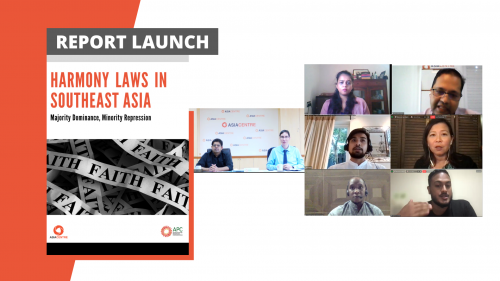
Anti-Discrimination Laws Needed To Protect Minorities
Anti-discrimination laws and independent commissions are needed to protect minorities disadvantaged by legal measures that are claimed to be enacted to maintain social harmony. This was a major recommendation arising from the discussion during Asia Centre’s launch of its new baseline study “Harmony Laws in Southeast Asia: Majority Dominance, Minority Repression” The study, in partnership with the Association for Progressive Communications (APC), was released during an online event on 22 November 2021 as part of the 7th annual Southeast Asian Freedom of Religious Belief (SEAFORB) Conference. The report reviews how “harmony” and other laws in Malaysia, Myanmar, Philippines, and Singapore have limited freedom of religion or beliefs (FoRB) and accentuated racial discrimination. In her welcoming remarks, Pavitra Ramanujam, Project Coordinator, APC, pointed to the growing ethno-religious authoritarianism in the region that has resulted in crackdowns on minorities, activists, and journalists. She highlighted the importance of analyzing impacts of new legal measures to address issues related to religious, racial harmony, and hate speech. Dr. Balazs Szanto, Senior Researcher, Asia Centre, in his welcome remarks, said the study was coming at a very important time where intolerance has creeped into the global political landscape, including the Southeast Asian region. Dr. James Gomez, Regional Director, Asia Centre, presented the new report. He said that the suite of “harmony” and other laws perpetuate the dominance of the ethno-religious majorities in the four countries studied. The intersectionality of religion and ethnicity facilitates an environment that props up majoritarian groups and suppresses the voicing of grievances by minority communities. Dr. Gomez recommended passing anti-discrimination laws and establishing indepednet anti-discrimination commissions to monitor, track and seek remedies to discriminatory laws and policies. Lutfi Hakim, Asia Centre Associate and Columnist, discussed the situation in Malaysia where racial discrimination are tied with religious intolerance as the Malay-Muslim majority pushes back against the religious practices of non-Muslims. He added that a lack of understanding of discrimination and public sensitivity of the issue among the majority population created difficulties for governments in creating a reform on religious and racial issues. He concluded that conversations on human rights need to take place to for change towards unity and tolerance of different groups. Khin Mai Aung, Advisory Board Member, Asia Centre, explained that the current political developments in Myanmar are a result of majority rule without systemic protection of minorities. It came about from a system where rights of minorities were continuously peeled away. The increasing use of harmony laws after the coup seized power have been oppressing ethno-religious minorities. Asst. Prof. John Phillip Binondo, Lecturer at De La Salle University Manila, presented four issues which hindered racial harmony in the Philippines: the absence of official data about the ethno-religious diversity, the lack of independent bodies to assess legal measures, the profiling of the Muslims and indigenous people, and the role of the Catholic Church. He stated that robust studies on ethnic inequality as well as a better understanding across ethnicity and religion are needed to overcome these systematic racial and religious issues. Subhas Nair, a rapper, offered his lived experience as a “brown skin” minority in Singapore. He explained that in the city-state minority representation rules create an idea of ‘model minority’ leaders who are tokenised in service of the ethnic majority rather than actually work for the community they are supposed to represent. Furthermore, through a process of reverse engineering, Singapore’s Ethnic Integration Policy in public housing delivers a Chinese majority voting base. He ended by emphasising the importance of having measures to create racial equity and to hold the government accountable. Among the questions raised by the participants included was the possible merits of limiting FoRB to harmonize societies or whether FoRB will spark violent protests like that in the US. The speakers responded by saying that laws that restrict FoRB are counterproductive to the goal of reaching tolerance of different beliefs and ethnicities. They added that oftentimes the US is used as a bogeyman for not having anti-discrimination measures in the first place. After the presentations, a key focus of the Q&A session was whether the main responsibility for ethics lies with the individual, organisation, society or was it structural. The discussion pointed to an need for individual responsibility as well as an accompanying change needing to happen at the societal level to influence the institutional level. Since journalists remain in a tough position, the voices of NGOs and the public are crucial to push for stronger ethics. Their support and their demands will be the main drivers of change. Therefore, observers and readers also share a responsibility in promoting ethical reporting. “Harmony Laws in Southeast Asia: Majority Dominance, Minority Repression” can be downloaded from here, and the event’s live stream recording can be seen here. Asia Centre works on human rights issues related to freedom of religion or belief, hate speech and racial discrimination. If you would like to collaborate with the Centre on evidence-based research, co-coveneing activities or other projects. Send an expression of interest to contact@asiacentre.org
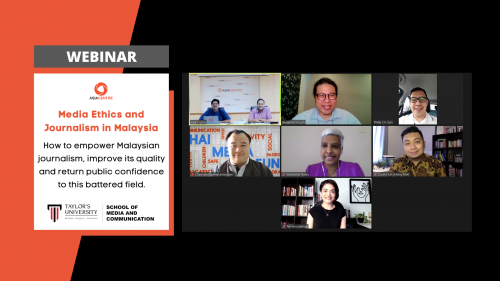
Malaysian Journalists Influence Media Ethics But Need Support
In the absence of a progressive legal framework to establish a Media Council and a complimentary Code of Ethics, the actions of journalists as influencers and their adherence to ethical standards and values are what drives quality journalism in Malaysia. While their role is admirable, their impact remains low and needs to be backed up by other stakeholders. These were the key perspectives that emerged on 12 October 2021, during the webinar ‘Media Ethics and Journalism in Malaysia’ co-convened by Asia Centre, in collaboration with the School of Media and Communication of Taylor’s University. The event, supported by the Taiwan Foundation for Democracy, aimed at giving an overview of the challenges and issues facing journalists in the country. The event started with welcome remarks by Dr. Charmnan Ngammaneeudom, Advisor at the Thai Media Fund, expressing his concerns over opinions preceding facts in mainstream media. This impacts impartiality and leads to partisanism and interferes with the journalists’ mission of bringing out the truth. Philip Gan Chee Keat, Programme Director at the School of Media & Communication, Taylor University, Malaysia, outlined the ever–stronger need for reliable sources of information in the era of post–truth instigated by fake news. He thus noted that reporters need to hold tight to the principles of honesty and integrity in their investigations. Dr. Robin Ramcharan, Executive Director, Asia Centre, encouraged journalists to hold fast to ethics and values, especially now that big social media groups driven by profit are leading the news distribution and facilitating the spread of disinformation through their algorithms. Following the welcome remarks, and the first to speak, Wathshlah Naidu, Executive Director of the Centre for Independent Journalism, set the scene by highlighting the instability of journalists’ employment due to moving ownership of companies and lack of funds. Moreover, undue restrictions of access to media platforms during COVID–19, the crackdown on freedom of reporting and a lack of Right to Information (RTI) legislation, are compromising the independence, freedom and ethics of media companies and reporters alike in Malaysia. Independent Broadcast Journalist, Tehmina Kaoosji, touched on female journalists, developments related to the media council and sustainability of the industry. She said the most heavily affected among journalists were women, especially during the pandemic, as they had to take on childcare duties with the closing down of schools and nurseries. They are also the target of attacks on their legitimacy as journalists. She believes strong female mentors can inspire more young women to become journalists and combat women’s underrepresentation in the media world. Dr. Benjamin YH Loh, Senior Lecturer School of Media and Communication, Taylor’s University Malaysia and Asia Centre Associate, introduced the legal framework journalism in the country. The politicization of legal prosecution has led local media to provide the bare minimum in their news coverage. He then drew from the Society of Professional Journalists’ Code of Ethics. to express his wish for Malaysian journalists: serve the role of watchdogs, give a voice to the voiceless, be sensitive in deciding what to publish or not, support civil discourse while considering the long–term implications of their publications, and be transparent in explaining their ethical choices and processes to their audience. Zurairi A. R., News Editor from Malay Mail, expressed there were ethical considerations when the media amplified social media posts, which were meant for a small circle, and reported them as news sometimes without the consent of the original contributor. This inevitably leads to privacy breach of individuals. Another issue was the practice of local media quoting non-experts, or non-stakeholders, unnecessarily making them authoritative voices affecting the vulnerable individuals such as members of the LGBTI community. After the presentations, a key focus of the Q&A session was whether the main responsibility for ethics lies with the individual, organisation, society or was it structural. The discussion pointed to an need for individual responsibility as well as an accompanying change needing to happen at the societal level to influence the institutional level. Since journalists remain in a tough position, the voices of NGOs and the public are crucial to push for stronger ethics. Their support and their demands will be the main drivers of change. Therefore, observers and readers also share a responsibility in promoting ethical reporting. In closing the webinar and thanking speakers and participants, Dr. James Gomez introduced the Asia Centre’s office in Iskandar Puteri, Johor Bahru, Malaysia. He explained that Asia Centre Malaysia is positioned as the media hub for the Centre’s creative works and communications-related projects. He also outlined key media outputs coming up next year—such as infographics, short videos and podcasts—associated with the Centre’s evidence-based research on press freedoms, building momentum to the 2022 International Conference on Freedoms of Expressions in Asia (24 to 26 August 2022, Bangkok Thailand). This event marks the beginning of the collaboration between Asia Centre and the School of Media and Communication at Taylor’s University Malaysia. A memorandum of agreement is in the making between the Centre and Taylor’s University with plans to collaborate on a joint report on internet freedoms in Malaysia. The full recording of the event can be viewed here. Asia Centre works on issues related to freedom of expression. If you would like to collaborate with the Centre on evidence-based research, co-coveneing activities or other projects. Send an expression of interest to contact@asiacentre.org
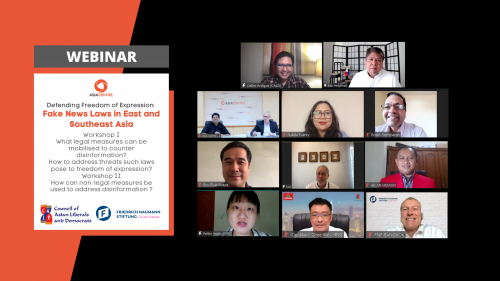
Workshop on Tackling Disinformation
Asia Centre, in collaboration with the Council of Asian Liberals and Democrats (CALD) and the Friedrich Naumann Foundation for Freedom (FNF), convened a two-day workshop on 25 September and 2 October 2021. These workshops, moderated by Mr. Celito Arlegue, Executive Director of CALD, is a follow-up to Asia Centre and CALD’s baseline study, ‘Defending Freedom of Expression: Fake News Laws in East and Southeast Asia’ published in February 2021. On the first day, the main focus was on legal ways to address disinformation and how to mitigate the threats such legislation poses to freedom of expression. Hence, the participants considered the questions, “What legal measures can be mobilised to counter disinformation? How to address threats such laws pose to freedom of expression?” Chair of CALD Sen. Francis ‘Kiko’ N. Pangilinan opened the first workshop session. In his welcome remarks, he recalled how for a long time disinformation has been rampant and has been threatening democracy. He called on every participant to be a good influencer for their networks: the best countermeasure to disinformation is the truth—as long as it comes out “fast, fair and fun”. Thereafter, Dr. James Gomez, Regional Director of Asia Centre, outlined the evolution of legal measures used against disinformation. He pointed to an emerging approach known as the ‘Gateway’, which allows for a total surveillance and for shutting down the whole domestic internet system. With its very intrusive reach, it has instilled fear of surveillance and self-censorship among internet users, in particular journalists, human rights defenders and activists. To counter it, Dr. Gomez recommended the introduction of Privacy and Data Protection legislation to lessen fear of surveillance, and for the government to share information under a Right to Information Act. Reacting to the presentation, Asst. Prof. Dr. Lasse Schuldt, Legal Expert from Faculty of Law Thammasat University, examined how fake news laws infringe on freedom of expression, and whether a distinction between facts and opinions should be made clearer. He noted that fake news legislation tends to be vaguely-worded, hence it opens up to a wide interpretation by local authorities, allowing the use of such legislation against political opponents and dissenting voices. To counter this risk, Dr. Schuldt suggested procedural safeguards. Members from the CALD network were then invited to give their input, drawing on their country’s experience with fake news. Kiat Sittheeamorn, Member of Parliament of the Democrat Party, Thailand, and Vice President of Liberal International recommended a regional or global approach rather than domestic legislation to tackle fake news and disinformation, as the issue transcends borders. Helmy Hidayat, Foreign Affairs Directorate of the Indonesian Democratic Party of Struggle (PDIP) gave an extensive presentation of his country’s background and the various ethnic and religious communities. In Indonesia, fake news, he stated, is often disseminated as part of hate speech intended to stir up religious tensions, as well as xenophobia. During the COVID-19 crisis, hoaxes were used to question the competency of the government as well as endangered public health. In closing the first workshop, Cong. Francis Gerald “Blue” Abaya, Secretary General of CALD, acknowledged that laws originally aimed at fighting malicious disinformation are being used to censor critical content and protect government leaders from criticisms. The tightening of the grip on freedom of expression should be addressed by an urgent revision of laws to preserve fundamental freedoms and human rights. On the second day the focus shifted to non-legal ways to address disinformation and the helpfulness of transparent information sharing and fact-checking from the media literacy. Hence, on the second day, participants discussed: “How can non-legal measures be used to address disinformation?” Starting the workshop, Dr. James Gomez, Regional Director, Asia Centre, highlighted key non-legal measures used to combat disinformation. These included: government transparency, fact-checking, technology companies filtering, quality journalism and media and information literacy. He said, non-legal measures should be prioritized over legal measures as the latter often result in violations of freedom of expression. Non-legal approach also allows for more involvement of stakeholders, creating a holistic learning curve for both audiences and the organisations that implement the aforementioned measures. Nukila Evanty, Executive Director of the Women Working Group, raised the important question of mobilizing non-legal measures against disinformation in Indonesia. She said the country is particularly vulnerable to disinformation as 89% of its citizens use the internet. Over 1,600 hoaxes related to COVID-19 have been listed from January 2020 to June 2021, with prominent politicians, ministers, and influential figures sometimes unknowingly spreading disinformation themselves. Ms. Evanty highlighted how religious figures and influencers are being levered into fact-checking information by the government. Two representatives from CALD then brought input from their country’s experience in relation to non-legal measures. Ms. Peifen Hsieh of the Democratic Progressive Party of Taiwan, presented the Taiwan Model for combatting disinformation. Efficient government reactions that relay transparent, readable, fast responses, with regular disinformation correction broadcasts were key. Mr. Hng Chee Way of Parti Gerakan Rakyat Malaysia, presented the Malaysian government initiatives, centered around the creation of anti-fake news websites. He said, people respond well to trusted sources for combating misinformation. In the Malaysian case, the COVID-19 pandemic experience has shown, trusted sources of information can alleviate the impact of disinformation. Moritz Kleine-Brockhoff, Head of Regional Office, Southeast and East Asia, Friedrich Naumann Foundation for Freedom gave the closing remarks, outlining the main lessons from the workshops: No fake news is good: Misinformation undermines trust systematically We are not powerless: There are several measures we can take Fake news is ideologically and politically driven Agreeing with the closing remarks, Dr. Robin Ramcharan, Executive Director, Asia Centre concluded that misinformation is a pressing issue that needs to be dealt with. The significance of countermeasures can not be understated. On that note, he welcomed the continued collaboration with CALD and FNF on workshop and training initiatives. You can download, ‘Defending Freedom of Expression: Fake News Laws in East and Southeast Asia’ here Asia Centre works on issues related to freedom of expression. If you would like to collaborate
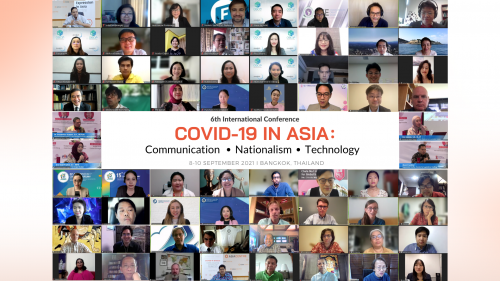
6th International Conference (2021): COVID-19 in Asia: Communication, Nationalism and Technology
From 8 to 10 September 2021, Asia Centre convened its 6th International Conference on COVID-19 in Asia: Communication, Nationalism and Technology. Due to the ongoing travel and health advisories at the time, the conference was convened as an online event with participants using teleconferencing software to join from different locations and across international time zones. Into its 6th year, Asia Centre’s annual conference continued to grow, with 17 partners who convened 15 panels. The Centre facilitated the presentations of 51 speakers of which 57% were male and 43% were female. The Conference examined a variety of impacts the pandemic has had on different societies in Asia. One key issue that came up was that of COVID-19 ‘infodemic’ and the challenges it posed. Through the different panel sessions, there was an attempt to identify possible solutions to it such as media and digital literacy, as well as government transparency and increased collaboration with civil society groups. The first day opened with welcome remarks from conference partners: Prof. Dr. Yubol Benjarongkij, Dean of the Graduate School of Communication Arts and Management Innovation at NIDA, Ms. Varinrumpai Puntanaree, Deputy CEO of the Thai Media Fund, Mr. Frederic Spohr, Head of the Friedrich Naumann Foundation for Freedom in Thailand and Dr. Robin Ramcharan, Executive Director of Asia Centre who also acknowledged the partnership of the Taiwan Foundation for Democracy. The recording of the welcome remarks will be available on Youtube soon. Asia Centre’s panel partners who convened the different sessions for the 2021 event were as follows: NIDA’s Graduate School of Communication and Innovation Management, Faculty of Management Science Suan Sunandha Rajabhat University, College of Social Communication Innovation Srinakharinwirot University, Faculty of Communication Arts Chulalongkorn University, CMU, Friedrich Naumann Foundation for Freedom (FNF), Centre for Applied Nonviolent Action and Strategies, Osaka Jogakuin University, Kyushu University, Graduate School of Letters Osaka University, Harm Reduction International, Expertise Agency of The Indonesian House of Representatives (Badan Keahlian DPR RI), Internews, Council of Asian Liberals and Democrats (CALD) and International Republican Institute (IRI). On the first day, 5 Thai universities across 4 panels discussed the impact of COVID-19 on the business sector and the main communication challenges that arose in Thailand. The discussion underlined the inequality in internet infrastructure and access to information as well as the importance of developing digital literacy of the population, as every daily activity moved online. Toward the end of the day, the political dimension was discussed. Political analysts and human rights specialists from Thai government institutions and university addressed the state of democracy and human rights in Thailand under the pandemic. The most important takeaway is their call for more transparency in managing the health crisis. On the second day of the conference, 4 panels co-convened by 3 Japanese universities put together regional and international speakers to cover the COVID-19’s impact on regional levels in education, xenophobia and politics more generally. In addition, 2 INGOs discussed the pandemic’s impact on human rights and democracy, outlining the impact of the pandemic on civil society participation as demonstrations were forbidden in many countries. They also outlined the disproportionate impact the securitisation of the COVID-19 response had on vulnerable communities. On the third day, 4 panels consisting of parliamentary researchers, political party representatives and media professionals discussed and evaluated legal, economic and political measures taken to fight the COVID-19 pandemic, with a special attention given to the role of vaccines and their manipulation to fit national interests over regional or global interests. The last panel of the conference examined the manipulation of the pandemic by governments to reduce political opposition during elections. Over the 3 days, the conference participants addressed the political, cultural, social, educational and technological aspects of the pandemic. The key focus of the conference was infodemic and misinformation during the pandemic, the decline of trust in public institutions, the lack of transparency in governments’ crisis management, and the politicisation of public health measures by authoritarian governments in the region to increase their power to the detriment of the most vulnerable groups. As the conference progressed, the links between nationalism, communication and technology became self-evident. In wrapping the conference, Dr. Robin Ramacharan, Executive Director of Asia Centre announced the next year’s 7th International Conference, ‘Freedom of Expression in Asia: Academia, Media and Internet”, in Bangkok, on 24, 25 and 26 August 2022. Asia Centre is presently calling for expressions of interest to partner for the 2022 conference. To register your interest, please send an email to research@asiacentre.org Papers submitted will be published in the Conference Proceedings later in November 2021. Recordings of all three days of the conference are already available on Asia Centre’s YouTube channel and Asia Centre’s Facebook page.
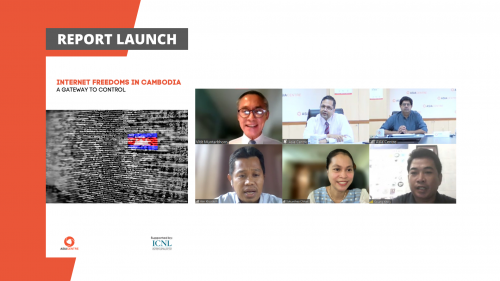
Data Protection Can Ease Fear in Cambodia
Data protection is needed in Cambodia to address self-censorship arising from the monitoring and persecution of online users. This was the key theme that emerged during the online launch of Asia Centre’s baseline study: “Internet Freedoms in Cambodia: A Gateway to Control” on 1 September 2021. In his opening remarks, the UN special rapporteur on the situation of human rights in Cambodia, Vitit Muntarbhorn stated that the government needs to comply with international human rights standards. Given decreasing internet freedoms in Cambodia, he recommended that data protection and access to information be instituted to enable people to express their opinion without fear. Dr. James Gomez, Asia Centre’s Regional Director presented the report. He said provisions in the constitution, the penal code, the law on telecommunications, the inter-ministerial Prakas No.170, the national internet gateway and the draft of cyber crime law allow the government to monitor and persecute online users resulting in fear. Hence, people have become reluctant to express their political opinion online. This has led to acute self-censorship that has caused people to refrain from posting and sharing information, only consume online content privately, cease accessing political content and avoid online political participation. In responding to the report, Sokunthea Chhan, Media Development Director of the Cambodian Center for Independent Media (CCIM), expressed her concern over the safety of female journalists. In particular, independent female journalists who work on human rights, politics and environment issues. She pointed out that 3 female journalists have recently been jailed by the government for simply reporting the news. Him Khortieth, Research & Advocacy Manager of the Cambodian Journalists Alliance Association (CamboJA), shared that 90.65% of the journalists in Cambodia are concerned for their safety when reporting on scandals and over 80 % are similarly concerned when reporting on human rights issues. In 2021, 40 persons were arrested for questioning the government’s handling of the pandemic and 7 of the media outlets had their licenses revoked for “stealing information” and incitement over fake news. Soung Khoy, Child and Youth Empowerment Coordinator at the Child Rights Coalition Cambodia, explained the fear among the younger generation in accessing information and producing content. He said that people in Cambodia, especially children and youth, are afraid of legal charges for posting or commenting online. Some are even weary to express their own political opinion over the internet or even talk about human rights and social justice using their private platforms. Wrapping up the discussion, Dr. Robin Ramcharan, executive director at Asia Centre, emphasized the importance of data protection legislation as it can ensure people’s safety while accessing information and expressing their views online. In this context, a data protection and privacy act can shield people in Cambodia from undue surveillance and sharing of their personal information. This can prevent the use of personal data for political persecution and reduce fear among online users. Lorem ipsum dolor sit amet, consectetur adipiscing elit. Ut elit tellus, luctus nec ullamcorper mattiThe report is already available on Asia Centre’s website here. The report launch session can be viewed here. Asia Centre works on issues related to freedom of expression. If you would like to collaborate with the Centre on evidence-based research, co-coveneing activities and briefings or other projects. Send an expression of interest to contact@asiacentre.orgs, pulvinar dapibus leo.
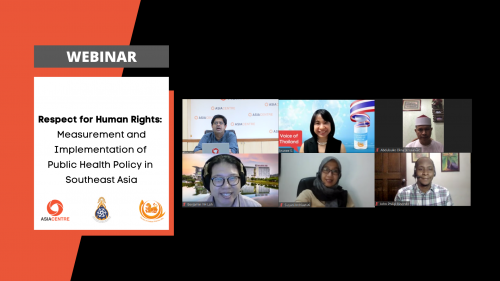
Covid-19 Policies Impact Information Rights
The COVID-19 related infodemic in Southeast Asia is affecting access to accurate information. This is in part caused by the implementation of the government’s public health policies for the pandemic. Censorship of information on the COVID-19 situation, propaganda from state-sponsored media to spin a positive image of the government and other policies are the key causes of disinformation. This was the major view that emerged from speakers of session two’s panel discussion, “Respect for Human Rights: Measurement and Implementation of Public Health Policy in Southeast Asia”. Six presenters from Indonesia, Malaysia, Philippines, Singapore, Thailand and Southern Thailand provided their insights on the situation. Dr. Arunee Santhitiwanich, Assistant Professor at the Faculty of Political Science, Ubon Ratchathani University, observed that the Thai government responded to the infodemic through the use of emergency legislation. Laws were used as tools to restrict access to content over the internet and the media. Human rights activists criticising the work of the ministry of interior’s COVID-19 center were prosecuted. This has increased distrust of government information as inequality in vaccine distribution, healthcare treatment and the overall ineffective management of the pandemic continues. Abdulsuko Dina, Columnist at Matichon weekly and Vice-President of Civil Society Council of the Southernmost Thailand said a reform of the justice system is needed. There is a need to reconcile trust and reliability between the federal and the local government, which is the main cause of the infodemic in Southern Thailand. One suggestion he made was to decentralise the vaccine import process. Dr. James Gomez, Regional Director at Asia Centre, highlighted the situation in Singapore where the healthcare policy implementation needs to account for the high number of foreigners. This has led to concerns among Singaporeans that they are being treated as second class citizens in their own country. Given the high rate of vaccinations, the debate centres upon the rights of the vaccinated and unvaccinated as the city-state opens up. Dr. Suyani Indriastuti from the Faculty of Social and Political Science, University of Jember, provided an insight into Indonesia. She noted the problem of data validation from separate sources of information indicate a difference in terms of statistics and reality, also pointing out the difference between culture and religion as they each influence compliance to health concerns differently. Dr. Benjamin YH Loh, Senior Lecturer at the School of Media and Communication, Taylor’s University Malaysia, explained the political instability in the country and its impact on the management of the COVID-19 pandemic. The lack of information on vaccinations has been the main cause of the influx, affecting vulnerable groups. Xenophobia has been directed at migrant workers and refugees, arising from misinformation that they are the primary virus carriers in the country. John Phillip Binondo, Assistant Professorial Lecturer, International Studies Department, De La Salle University-Manila, said the situation in the Philippines was confusing as many different regulation policies like the Enhanced Community Quarantine (EQC) and Modified Enhanced Community Quarantine (MECQ) had conflicting COVID-19 regulations. This served to cause confusion, rather than be a benefit to the Philippine population. Despite having experienced the longest community quarantine, the Philippines has continually suffered the consequences of such uncertain policy and unreliable communication. Effects of this have resulted in severe economic recession, social disruption and a reduction in the credibility of the Philippine governments. Pulling the discussion together, Dr. Robin Ramcharan, Executive Director at Asia Centre, summarised the lessons for Southeast Asia. He emphasised the need for increased information sharing between federal, local and civil society in order to deal with the infodemic. He also called for more cooperation between government and civil society to ensure the accessibility of accurate information in combating the COVID-19 infodemic. Governments are obligated to provide people with accurate and essential information, allowing criticism is absolutely necessary in fostering a transparent environment There were several questions raised after the discussion. The full details of the panel discussion session can be viewed here. The panel discussion provided an opportunity to review the healthcare policies in Southeast Asia and their impact on accurate information during the COVID-19 pandemic. Combined with the presentation and discussion from session one “Infodemic and SDGs: Internet Freedoms in Southeast Asia”, it is clear that the COVID-19 infodemic has severely impacted internet freedoms and restricted access to accurate information. Asia Centre’s newly released report “Infodemic and SDGs: Internet Freedoms in Southeast Asia”, can be downloaded here and is the second Asia Centre report published in collaboration with the Thai Media Fund. The first report, “Hate Speech in Southeast Asia: New Forms, Old Rules” available here was published in July 2020 and was our first collaboration. The first event writeup for session one of the event, a report launch entitled “Infodemic and SDGs: Internet Freedoms in Southeast Asia”, can be accessed here Asia Centre works on issues related to freedom of expression. If you would like to collaborate with the Centre on evidence-based research, co-coveneing activities or other projects. Send an expression of interest to contact@asiacentre.org https://youtu.be/i–LU_4fiW0
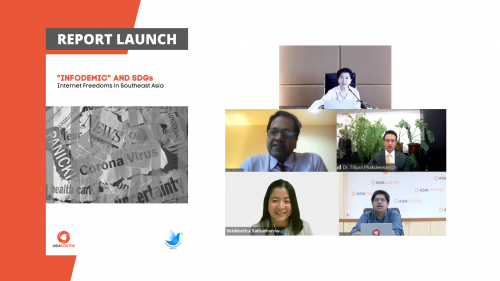
“Infodemic” Infringes Right to Accurate Information
Large amounts of false or misleading information related to the COVID-19 pandemic, referred to as an “infodemic”, and the attempts to combat it, have actually infringed on the right to accurate information. Additionally, framing the “infodemic” as purely citizen-induced, a premise that wholly excludes government accountability, further exacerbates the infringement. This critical point was articulated during the launch of “Infodemic and SDGs: Internet Freedoms in Southeast Asia”, an Asia Centre report in collaboration with the Thai Media Fund. The launch was the first of a two-part event, “Human Rights in the Time of COVID-19: Lessons Learned from Southeast Asia” held on Friday 20th August. The event was co-convened by Asia Centre and the Faculty of Political Science of Ubon Ratchathani University. It was supported by the Taiwan Foundation for Democracy (TFD), the Thai Media Fund (TMF) and the Empowering Freedom Defenders in East and Southeast Asia (EFDEA). Dr. Robin Ramcharan, Executive Director of Asia Centre, introduced the event and speakers, and thereafter went on to outline how the United Nations Sustainable Development Goals of 9.c (Access to the Internet) and 16.10 (1&2), (Fundamental Freedoms and Access to Information) are essential indicators with which to measure the infodemic’s consequences and impacts. Dr. Titipol Phakdeewanich, Director, Regional Centre for Human Rights Study and Coordination at the Faculty of Political Science, also welcomed the speakers and guests. He pointed out the significant challenges that COVID-19 has brought about. He emphasised that it is now all the more important to host these online sessions, so that we can continue to discuss issues that affect citizens’ human rights, particularly rights for the vulnerable and marginalised. In her opening speech, Ms. Pornprapai Ganjanarintr, Chairperson of the National Human Rights Commission of Thailand highlighted the need to set up effective national measures for human rights protections in alignment with international standards. This step should also include increased collaboration and consultations with INGOs and CSOs in order to further streamline and enforce human rights guarantees and standards. Dr. James Gomez, Regional Director of Asia Centre, kicked off the presentation of the key findings of Asia Centre’s seminal report “Infodemic” and SDGs: Internet Freedoms in Southeast Asia”. Contextualising the report, he said COVID-19 has spurred an ‘infodemic’ that impacts the right to accurate information. Further, given that information is largely being shared over the internet and social media, we need to consider internet freedoms. Gleaning examples from fact-checking initiatives and institutions, Asia Centre found that the ‘infodemic’ of false or misleading information, comprised 4 primary categories:1. Virus Origin – Unsubstantiated hypotheses, namely that the virus was bioengineered in a Wuhan Laboratory or that it originated from the U.S., and was created in exchange for material benefits, or to distract citizens from other political issues.2. COVID-19 Infection and Death Numbers – speculation of possible, unconfirmed or underreported clusters of cases or death resulting from the virus, as well as what type of person is more likely to be a virus carrier. 3. Bogus Remedies – Unproven cures for the virus. Claims concern the use of local herbs, traditional medicines, or even religious or magical rituals4. Vaccine Efficacy – False information over reactions to different types of vaccines or their long term effects. This also includes false reports of vaccine provisions by hospitals and other agencies. Contrary to the statist narrative emerging from governments across Southeast Asia, Dr Gomez brought to light how national and local governments and officials have also been key instigators of the infodemic. Authorities have consistently underreported and denied the presence of COVID-19 in their country or local area, in efforts to save face and prevent backlash from the general population. They have also overstated vaccine production and provisions. False information such as this has the real potential to seriously endanger vulnerable groups. This fact however, is not reflected in legislation, with governments enacting new laws that focus almost exclusively on citizens, disregarding the need for their own accountability. Within Southeast Asia, governments responded to this infodemic phenomenon, by utilising ‘fake news’ clauses in various legal provisions to deliver heavy collateral damage on freedom of expression. Asia Centre’s report utilises the SDGs, specifically 9.c and 16.10 relating to access to information and internet freedoms, to help measure the impact of the new legislation that has been ostensibly implemented to combat the ‘infodemic’. It found that the newly enacted laws allow incumbent parties to censor debate, criminalise and withhold access to information, severely regressing the overall state of internet freedoms in the region. Violation of these vague and broad laws, consists of arrests, harassment, and heavily disproportionate legal penalties. The net result is that the suppression of internet freedoms, has led to a suppression of accurate information. Dr. Sirinbhattra Sathabhornwong, Lecturer in Public Policy and Local Government at Ubon Ratchathani University, echoing the report, presented sobering figures highlighting the limited press and expression freedom in Southeast Asia, which COVID-19 has only served to decline. Reinforcing some of Dr Gomez’s points, and utilising SDG 16.10 (Access to Information) as the appropriate indicator, she detailed that COVID-19 and its infodemic, has exacerbated the exposure of government tendencies to punish citizens who access sensitive information. This is because they pose a threat to the state sponsored narrative. There were several questions raised after the report presentation and discussion. The full details of the report launch session can be viewed here In wrapping up the 1st session of the event, Dr Gomez stated that in his opinion, media literacy is the primary “vaccine” and solution for the infodemic. If the strengthening of media literacy can occur, individuals will be able to navigate online safely and make well-informed decisions about their veracity. However, in advocating for media literacy, one should be mindful of those favouring their own perspectives. Asia Centre’s newly released report “Infodemic and SDGs: Internet Freedoms in Southeast Asia”, can be downloaded here and is the second Asia Centre report published in collaboration with the Thai Media Fund. The first report, “Hate Speech in Southeast Asia: New Forms, Old Rules” available
Asia Centre and Destination Justice Sign MOU
Asia Centre and Destination Justice signed a Memorandum of Understanding on 4 July 2021. This MoU marks the start of the organisations’ collaboration on Thailand related projects, starting in 2021 and builds on 5 year of prior cooperation on regional issues. On 28 July 2021, Asia Centre and Destination Justice, together with other partners filed a submission: “Protection of Human Rights in the Context of Peaceful Protests During Crisis Situations” to the Special Rapporteur on the Freedom of Assembly and of Association. The submission draws attention to the protection of human rights activists and protesters in the context of crisis and emergency situations and the ensuing limitations to freedom of movement. The submission follows an op-ed “Thailand faces the spotlight on human rights” which was published in the Bangkok Post on 23 July 2021. In that piece both Asia Centre and Destination Justice highlighted the human rights situation of activists and protesters in Thailand, particularly to the very stringent bail conditions they were being subjected to. Earlier on 23 February 2021, Asia Centre contributed and co-sponsored a joint UPR Submission together with Destination Justice, “Human Rights Defenders and Fundamental Freedoms in Thailand” on 24 March 2021. The submission focuses on human rights defenders (HRDs) ranging from first-time protesters through to seasoned human rights advocates. The submission details how fundamental freedoms have been eroded in Thailand, particularly under the COVID-19 related emergency rule. In the Thai pipeline is a briefing note on the proposed Thai Supporting and Promoting Civil Society Organisation Act (SPCSO) and Law on Operations of Non-for-profit Organisation (LONGO), both aim to strengthen government control over local, regional and international CSOs and NGOs. Asia Centre and Destination Justice plan to study these laws and assess their alignment with international standards. This MoU also formalizes pre-existing collaboration between the two organizations: In August 2019, Asia Centre’s Dr. James Gomez met with Doreen Chen, Director of Destination Justice, met on the sidelines of the International Conference on Protection of Rohingya Survivors and Accountability for Genocide at Sogang University, South Korea. Thereafter, both organisations were part of a coalition that drew attention to and called for the boycott of businesses that collaborate with the Myanmar military. However cooperation between the two organisations began in 2016, when Céline Martin, then Destination Justice’s Litigation Program Coordinator based in Cambodia, participated in the Centre’s 1st International Conference of Asia Centre: Universal Periodic Review (UPR) in Southeast Asia, An Evidence-Based Regional Assessment. Ms. Martin subsequently participated as a speaker for Asia Centre’s 2nd and 3rd International Conferences on National human rights Mechanisms in Southeast Asia: Challenges of Protection (2017) and Business and human rights: Holding Governments Accountable in Asia (2018). Moving from the 3 international conferences in Bangkok, Destination Justice and Asia Centre had extended their collaboration into Cambodia on the Universal Periodic Review by co-convening a seminar entitled “Advocating for human rights in Cambodia: Is the Universal Periodic Review Effective?” on 3 November 2018, at the National University of management in Phnom Penh. On the occasion of the seminar, Asia Centre released its first book: The Universal Periodic Review of Southeast Asia: Civil Society Perspectives, in which Destination Justice has authored one chapter. Asia Centre signs MOUs with organisations with whom it has a track record of cooperation.The Centre has several ongoing MOUs with INGOs, NGOs, universities and parliamentary networks.
Timor-Leste’s Problematic “Internet” Laws
Timor-Leste’s government must set out clearly defined steps in the drafting process of its legislation, including ensuring there are consistent and adequate opportunities for consultation with the country’s stakeholders. These concerns over inadequate consultation have arisen on the back of three proposed laws on defamation, cybercrime and privacy that stand to impact internet freedoms. The draft Criminal Defamation Law, proposed in June 2020, would reinstate criminal defamation in Timor-Leste’s Penal Code and provide an easy path to criminalise critical opinions against the state or its officials. The draft Cybercrime Law, proposed in January 2021, does not provide adequate protection to human rights defenders who call out rights violations by accessing online data, and poses concerns for data privacy and protection due to its vague nature. While the draft Data Privacy and Protection Law is not publicly available as of 14 July 2021, its provisions must prioritise the protection of citizens’ right to privacy. These “internet” laws are seen as likely to be used to reel online political expression as the country experiences increased internet connectivity and a rise in the use of social media to progress democratic ideals. The sharp scrutiny of government figures and critical debate on digital platforms has resulted in a push for legislation that can be used to crack down on criticism. These were the key issues aired during Asia Centre’s report launch “Timor-Leste: Internet Freedoms Under Threat” held on 14th July 2021, where the Centre shared its report findings on the impact of these laws on the state of internet freedoms in Timor. (watch here). Dr. Ramcharan, Executive Director at Asia Centre in his opening remarks to signify the report launch, made reference to the French Bastille Day – on the same day as this event. He said that this flashpoint of the French revolution had a significant and lasting impact on freedom of expression in France, paving the way for increased political debate and critique. The internet, Dr. Ramcharan added, is the needle that has moved the political debate in contemporary Timor. Dr. James Gomez, Regional Director at Asia Centre, then went on to present the findings of the report. He detailed the impacts that current legislation has upon digital freedom, and the concerns and potential impacts that the new draft laws may have on freedom of expression. The report also provides specific recommendations, enabling the promotion and protection of internet freedoms, freedom of expression and access to information online in Timor-Leste. Contextualising the report, he said that in order to understand the full gravity of the recent legislative developments in Timor, one should look at Southeast Asia as a whole and draw lessons from its experiences. Dr. Gomez directed the audience to examples within the Centre’s other report: Myanmar: Dismantling Dissent – Crackdowns on Internet Freedoms, where it displays that unscrupulous operators in critical sectors such as telecommunications are uncongenial for fostering democracy. Nukila Evanty, Executive Director of the Women’s Working Group, addressed internet freedoms through a gender lens. She highlighted that women and girls everywhere, including in Timor-Leste, continue to face discrimination online. The low affordability of smartphones continues to make internet access difficult for them. However, women are still more active on social media compared to their male counterparts, particularly with the running of small businesses and activism. The elimination of barriers of inequality should be prioritised to enable increased involvement of women in public and political participation. Marta Da Silva, researcher at La’o Hamutuk, highlighted the need for greater consultation with civil society in relation to the legislative drafting process. This however, comes with an issue of language accessibility. Many Timorese do not understand Portuguese, the sole language of parliament, creating a conspicuous information void and making political participation difficult for the majority. She noted that digital security is also a concern. As the country’s critical infrastructure opens up to foreign direct investment, people’s rights to privacy needs assurance, and the government needs to find the means to effectively implement these safeguards. She ended with a call for the promotion of a safe internet space through a ban on pornography and disturbing or graphic images. She believes such a ban would be a good step in preventing sexual assault, online bullying and harrassment. Adilson da Costa Junior, Strategic and Engagement Lead of Oxfam in Timor-Leste, expounded on the need to align the implementation of internet and media freedom-related legislation with transparency and human rights mechanisms. da Costa further elaborated on how the agenda-setting priorities by the government of the day would determine when these internet freedom-infringing laws would be implemented. Legislation is a valuable political tool, it is feasible that the shelved draft defamation law will be passed eventually, as the political impetus exists. Dr Gomez concluded the discussion. Again, while speaking from a regional angle, he made reference to Timor’s continued pursuit of accession to the ASEAN. The authoritarian-heavy nature of the group could potentially compromise Timor’s protection of human rights and internet freedoms, given the groupings’ poor performance in these issues. He emphasised that the implementation of the draft legislation in its current form, risks Timor’s internet freedoms staining the country’s democratic identity. To ensure that Timor protects itself from enacting unjust “internet” legislation and other laws, it needs to clearly signpost the processes for proposed laws. Transparent communication and consultation with civil society and other stakeholders should be at the heart of this process. Asia Centre’s newly-released report “Timor-Leste: Internet Freedoms Under Threat” can be downloaded from (here) and is a part of a series of reports on the state of internet freedoms that include Myanmar and Cambodia Asia Centre works on issues related to freedom of expression. If you like to collaborate with the Centre on evidence-based research, co-coveneing activities or other projects. Send an expression of interest to contact@asiacentre.org
Securitisation of Health Protocols: Impact on Vulnerable Communities
In responding to the COVID-19 pandemic, governments across the Asian region have adopted (exceptional) health protocols to contain and arrest the spread of infections, and are now focusing on acquiring vaccines and rolling vaccination programmes. Many of the measures adopted have been characterised by a securitisation of health protocols and have either failed to address the specific needs of vulnerable communities, or worsened their already precarious conditions. To facilitate discussions on these trends, and identify avenues for positive change, on 18 June 2021 Asia Centre, Harm Reduction International (HRI) and UNITE Global Parliamentarians Network to End Infectious Diseases (UNITE) co-hosted a closed peer-to-peer event, “The management of the COVID-19 pandemic in the Asia Pacific Region: good practices and lessons learned”. The meeting featured Ministers and Members of Parliament from Bangladesh, India, Malaysia, Nepal Pakistan, the Philippines, Sri Lanka, and Vietnam who were briefed by WHO officials, experts, and civil society. The aim was to reflect on the various COVID-19 responses and share lessons learned through comparing the experiences and challenges faced by each country. Speaking about the importance of enhancing accountability within the implementation of health protocols, Ajeng Larasati, HRI Human Rights Lead, emphasised the need for countries to discuss and adapt best policies and practices from one another, highlighting the various roles which governments, parliaments, and enforcement authorities have in ensuring just and effective health protocol implementation. In her opening remarks, Dr Adeeba Kamarulzaman of the World Health Assembly Science Council outlined the critical need for the alignment of health protocol with evidence-based and rights-centred research. Dr Kamarulzaman pointed out that amidst an epidemic, the disproportionate effects on health and economic viability are made even more pronounced. Against a backdrop of the backsliding of human rights and the Sustainable Development Goals, the development of health-oriented and multi-stakeholder strategies are imperative in ameliorating the crisis at hand. Dr Tamano Matsui, World Health Organisation’s Programme area manager for health emergency information and risk assessment, provided an overview of the state of the pandemic 18 months after its emergence. Dr Matsui noted that the resurgence of cases can be attributed, among others, to countries’ early lifting of control measures and the development of variants, thus underscoring the need for proper border legislation to mitigate the importation of virus variants. Moving forward, countries must focus on strengthening their detection and response capacities, as well as integrating non-pharmaceutical action within protocols. Dr Nina Sun, Deputy Director of the Jonathan Mann Global Health and Human Rights Initiative at the Drexel University Dornsife School of Public Health, evaluated the compliance of public health emergency responses across the world with human rights standards. A key concern was a widespread lack of judicial review of emergency measures which has contributed to perpetuating discrimination within health protocol implementation, resulting in the poor public health results, as well as negative social justice and human rights impacts. Dr Sun underscored that rights and people-centred approaches are crucial to the overall success of health policies, and thus moving forward, advocated for the integration of science and community needs within the response framework. Dr James Gomez, Asia Centre’s Regional Director, elaborated on how the pandemic has been increasingly treated as a public security rather than a public health threat. Anticipating the findings of the upcoming Asia Centre’s report, “The Securitisation of COVID-19 Health Protocols: Policing the Vulnerable, Infringing their Rights”, Dr Gomez paused on three main securitisation models: militarised, securitised and blended civil response. Presenting data from Indonesia, Malaysia, the Philippines, Singapore and Sri Lanka, he underlined how both securitisation and data surveillance potentially infringe on privacy rights of citizens, and underlined the need for enhanced support directed towards vulnerable groups. The presentations were followed by an exchange of experiences and lessons learned among Ministers and Parliamentarians. Representatives of Bangladesh, India, Malaysia, Nepal Pakistan, the Philippines, Sri Lanka, and Vietnam, Ministers and Members of Parliament (MPs) highlighted the adoption of similar health and social distancing protocols, including border controls, quarantine, curfews and lockdowns. Acknowledging the imperative for a people and community-centred approach in tackling the virus, they also surfaced the pressing need for existing gaps within healthcare systems to be addressed, including hospital vacancy and oxygen provision. Consensus was also reached that a multi-stakeholder task force is necessary in ensuring the proper integration of health leadership and government accountability within protocol implementation, as well as in enhancing the country’s readiness capacity. Additionally, Parliamentarians underscored the urgency of complementing preparedness measures with the long-term solution of vaccination programmes. Ministers and MPs alike pleaded with the international community to ensure equitable vaccine distribution. In spite of having the financial capability to procure vaccines, most cited supply disruptions and ‘vaccine apartheids’, resulting in relatively low vaccination rates in the Asian region. Moreover, in larger countries, inherent gaps within vaccine administering have caused wide inequalities and civic instability. Lastly, within pandemic protocol frameworks, support for vulnerable groups was highlighted as an imperative in ensuring the success of health policies. In light of the pandemic that has exerted a disproportionate effect onto the vulnerable, representatives agreed that extensive protection must be provided. It was also established that enhanced support for the vulnerable would mitigate the spread of the virus. Thus, overall government accountability during declarations of state-of-emergencies was also reinforced during the discussion. The roundtable discussion emphasised the importance of having a multi-stakeholder and community-centred health approach backed by science and evidence-based research. In handling the pandemic, governments must enhance the preparedness of their healthcare systems, provide enhanced support towards the vulnerable and engage in global collaborative efforts that enhance the equitable distribution of vaccines. As a prelude to the full report, The Securitisation of COVID-19 Health Protocols: Policing the Vulnerable, Infringing their Rights, Asia Centre and Harm Reduction International have published an advance briefing note, Waging War Against COVID-19: The Securitisation of the Health Response in Five Asian Countries
Timor Leste Risks Downgrading Freedoms With New Laws
Amidst recent pushback to protect internet freedoms, it remains to be seen if Timor-Leste will retain its high rankings in “freedoms” in the long-term, as the country seeks membership in ASEAN, a grouping whose freedom rankings exhibit a sharp decline. While the country ranks highly in terms of academic and press freedom, with internet freedom likely to be on a similar upward trajectory, access to the internet and emerging laws present a challenge. These were the broad assertions made during an online town hall titled “Timor-Leste: Internet Freedoms Under Threat” held on 4 June 2021 by Asia Centre to share its preliminary findings on internet freedoms in Timor and Southeast Asia (watch here) and gather feedback and recommendations in preparation of Timor-Leste ‘s Third Cycle UPR submission. A key challenge to realising internet freedoms in Timor-Leste is its telecommunication infrastructure. With cable connections limited, signals unstable and access expensive in part as a result of limited competition among service providers, there is a correlation between the state of infrastructure and ensuring better access to information. Timor-Leste is currently expanding its internet and cable infrastructure and has approved connecting to Australia’s network at an estimated cost of between 40 to 60 million ($USD). The majority of Timor’s citizens rely on the cellular network to access the internet, however the cost is incredibly high relative to the Gross National Income of its citizens. For example, a block of 10GB of Mobile Broadband Data is USD $25 in Timor with a GNI (PPP adjusted) of $4,970, while in Indonesia it is $6.75 and $11,970 respectively. Overall, the cost of accessing the Internet in Timor-leste is the highest in Southeast Asia by a significant margin. Yet as internet connectivity improves in Timor, the question of whether the country will follow the path of its ASEAN neighbours in restricting internet freedoms, or continue on her democratic trajectory remains. Improving telecommunications infrastructure and accessibility in Timor-Leste has led to the rise of the internet being used to express opinion, scrutinise political incumbents and progress democratic ideals. While Article 40 and 41 provide guarantees on freedom of expression, there is a push in Timor-Leste to reinstitute criminal defamation through draft laws in 2020 (Criminal Defamation) and 2021 (Cybercrime Bill). These laws, primarily articulated by those criticised authorities, seem to be aimed at curbing any just critique or debate. Often, the reasons behind these draft laws have been articulated either by those who feel hurtful, or were not used to the level of transparency and accountability required for an office holder; rather than for the benefit of the community as whole. While the draft law on criminal defamation faced pushbacks from civil society actors and the general populace and appears to be on hold at the moment. The sentiment in Timor that these laws will be implemented is strong. With increasing internet use, issues of data protection are an emerging concern. While Constitutional provisions are present to protect personal data and privacy in Articles 36, 37 and 38, they are considered insufficient. There is a need to ensure that personal data collected is not misused to persecute individuals who share critical opinions of the state, and that data is not shared without permission, as it has done by its ASEAN neighbours. Data protection measures implemented should focus on the rights of individuals, with strong independent oversight mechanisms. It is expected that Timor-Leste will examine new Data Protection laws, however, if we look across Southeast Asia, this trend of legislating against critics is further entrenching and empowering the authoritarian regime. Something that Timor-Leste needs to avoid. Increased internet access has unfortunately resulted in the proliferation of the traditional yet negative cultural notions with which women are generally viewed in Timorese society, for example domestic violence is sadly considered by both men and women as an acceptable form of discipline. This attitude has manifested online in rising hate speech and threats of violence against young girls and women. Laws to protect women and other vulnerable groups on the internet need to be in place and strengthened. Additionally, digital and media literacy in public institutions such as schools and universities should be a matter of priority in order to tackle the issue at the root, particularly against the backdrop of growing internet usage and connectivity in Timor. Timor’s efforts to improve connectivity and introduce new legislation that may curb freedom of expression is a struggle over its own values that led to its independence. Yet, in pursuing accession to ASEAN, an organisation dominated by authoritarian states, the emergence of these proposed draft laws is a concerning hint at Timor-Leste’s new conflict with its own democratic identity. Resistance from civil society groups has been encouraging, yet based on trends in the region it is not difficult to envisage the end result will be a less democratic Timor. Time will tell. As Timor-Leste aspires to be part of ASEAN, it needs to ask itself a hard question whether it wants to join the authoritarian club and behave the same. The event, which was live-streamed, occasionally intervened by representatives from the Timor ICT department and attended by participants from Timor-Leste and Australia, is part of a series of consultations to gather feedback on the Asia Centre’s report on internet freedoms in the country. Asia Centre works on issues related to freedom of expression. If you like to collaborate with the Centre on evidence-based research, co-coveneing activities or other projects. Send an expression of interest to contact@asiacentre.org
Freedom of Expression A Fundamental Right
Academic, press and internet freedoms are a cluster of rights that form freedom of expression. To realise these rights, one must have access to accurate information and be able to express an opinion across platforms of one’s choice. This is a fundamental right and we can not allow it to be diluted by authoritarian governments who are increasingly challenging the universality of rights. To unpack these issues, Asia Centre, together with the May 18 Memorial Foundation, co-convened a panel, “Freedom of Expression and Democracy in Asia”. The event was held as part of the Gwangju Democracy Forum, and was hosted online and live-streamed over social media on 20 May 2021. Imperative that all categories of freedom of expression are recognised, Dr. James Gomez, Regional Director at Asia Centre, in his opening remarks highlighted academic, press and internet freedoms as forming a cluster of rights that make up freedom of expression. Presenting data from East, South and Southeast Asia, he pointed that scores in one area of freedom often tend to mirror scores in other areas and a deterioration of one freedom affects other freedoms in the cluster. Speaking about developments following the February 2021 Myanmar coup, Khin Mai Aung, an Advisory Board Member at Asia Centre, in a video recording, presented on the state of internet freedoms. She stated that social media has come under attack by the military junta, which sought to control the flow of information through internet shutdowns and throttling internet speeds. In response, the people are using encrypted channels of communication to bypass censorship. Given the ability of the people to adapt, she was hopeful that their resilience will ensure the military junta is overcome. Against the backsliding of democracy and human rights in Thailand, Yawee Butrkrawee, Programme Coordinator at Asia Centre discussed the state of freedom of expression in the country. He pointed out the culture of self-censorship, resulting from the attack of ultra-conservative groups on university staff and students, choice of news by major media outlets, manipulation of social media by the military, and legal threats by cabinet members, is a major inhibitor of freedom of expression. In a strong show of resistance, student-activists and the youth are engaged in a push back to reclaim and secure a civic space where free and open discussion can take place. Speaking on media regulation in Pakistan, Umar Bacha, award-winning journalist from Dawn, discussed the increased use of the law to silence criticisms against the government and military. Citing closures of media organisations, retrenchment of journalists, and increased control of social media, he emphasised how such laws target both traditional and new digital forms of media are worsening the state of media freedom in the country. Umar believes this challenge can be overcome if media outlets continue to train journalists to be better aware of legislation, and how to produce effective journalism without fear. An independent researcher from Taiwan, Lilly MC Lee analysed China’s increasing role in instigating information warfare in her home country and broadly in Asia. In Taiwan, the government had enacted a National Security Law, introduced a nationwide media literacy programme and encouraged the establishment of fact-checking groups to mitigate this problem. She said, despite China’s attempts to enhance its international position through the proliferation of fake news, a blend of laws and non-legal measures can be used to respond to China’s information warfare. In this way, freedom of speech can be defended and a democratic world order maintained. Pulling the discussion together, Dr. Robin Ramcharan, Executive Director at Asia Centre, emphasised the need to understand all dimensions of freedoms of expression. Protection of all forms of expression is vital, for the encroachment on rights of a singular facet creates an overall deterioration; realisation of this is key. He cautioned that authoritarian regimes are using economic progress as a justification to infringe upon human rights. In this regard, individuals have a significant role in protecting and advocating for their personal freedom of expression. The Gwangju Democracy Forum is the third in a series of democracy forums where Asia Centre has presented its work on freedom of expression. The previous ones included the Tokyo Democracy Forum on 16 February 2021 and the Kathmandu Democracy Forum on 6 November 2020. https://www.youtube.com/watch?v=g6cAEnYhTwE&list=PLy6qU5BKTny0QKVZFd9Hua5A2EYkXaUt6&index=10
Innovation Important to Overcome Media Hurdles
Media in the region are facing challenges both in terms of state censorship and financial sustainability. However, in almost all circumstances, innovation and improvisation were key to overcome these hurdles. “Celebrating Journalism: Reporting Without Fear” was held on 4 May 2021 to mark World Press Freedom Day. The event was organised in partnership with Asia Centre and Friedrich Naumann Foundation, with speakers from Internews, EFDEA and Taiwan Foundation for Democracy networks. The event was hosted online and live-streamed over social media (watch here). Frederic Spohr, Head of FNF Thailand and Myanmar, Friedrich Naumann Foundation for Freedom, in his opening remarks stated that many journalists and news organisations are under increasing pressure from governments and state-backed actors worldwide. Despite this, transparent and reliable journalism is still on the rise due to the ease of information sharing provided by the internet and through citizens’ group commitment for freedom of expression. Sao Phal Niseiy, editor-in-chief from Cambodianess, outlined how the COVID-19 lockdown of Cambodia in 2021 reduced the ability of news companies to report on current events. Instead, the pandemic has perpetuated government propaganda as only state sponsored media are allowed to move between regions, reducing journalistic integrity within the country. However, Cambodians do value transparent news sources as they provide a platform which they can trust in order to stay safe from the virus. Hence, there is a role for independent journalists and media companies to play. In Myanmar, citizens participating in the civil disobedience movement and the journalists there are deeply intertwined with the media. Commenting on the 1 February 2021 coup, Dr. Lisa Brooten, an Associate Professor in the College of Mass Communication and Media Arts at Southern Illinois University, said the military junta want total control over the media to legitimise themselves. Nonetheless, the use of social media platforms, creative citizen journalism, and the general populace’s commitment to democratic values, has caused the censorship and propaganda drives by the junta to fail. Speaking about Thailand, Chiranuch Premchaiporn, a former director of Prachatai, made the point that journalists are integral in the fight for freedom of expression, as they record events and have the ability to hold the government accountable. However, journalists face a constant decision between safety and quality coverage of current affairs. She enumerated examples of incidents where journalists have put themselves in danger during the student protest crackdowns in Thailand. She shared a quote from an imprisoned Prachatai journalist; “people and press are freedom partners”, citizens and journalists have to join hands together to guarantee freedom, true journalism means speaking up despite the risks. Daniel Marchette, General Manager of Southeast Asia Globe, discussed the challenges of sustainable business operations for small media outlets. He said that COVID-19 had accelerated the existing trends affecting the media industry. Smaller local news outlets relying on advertising and sponsorship, and those that are struggling to or haven’t made the transition to digital media, have been hardest hit. This has the potential to exacerbate the trend of acquisition of smaller media outlets, leading to a higher concentration of information sources, and fewer perspectives being shared as a result. Sonny Krishnan, Internews’ Regional Humanitarian Advisor COVID-19, pulled together the key points from speakers. He said, despite much negativity surrounding the state of the region alongside an overall fall in the press freedom index within Southeast Asia, there is hope. We can see this in how citizen journalists innovate and continue the critical reporting necessary to promote real awareness of ongoing events. Measures being taken by governments would not work without community support. Against a backdrop of an overall rise in authoritarianism already taking place in Southeast Asia, limiting media freedoms, COVID-19 has aided in accelerating this decline. Yet the pandemic has also brought to light the value that free media can offer in providing a platform people can turn to for reliable information, to keep them safe, and expose mismanagement by governments. Asia Centre works on issues related to freedom of expression. If you like to collaborate with the Centre on evidence-based research, co-coveneing activities or other projects. Send an expression of interest to contact@asiacentre.org https://www.youtube.com/watch?v=GzM6eMOJmGc
Academic Freedoms Deteriorate As Autocracy Strengthens in Asia
Academic freedoms in Asia have deteriorated as autocracy strengthens across the region. However, in building resilience and fostering change, academic, press and internet freedoms need to be considered together as they form a cluster of rights that collectively make up freedom of expression. This was the thrust of the interventions by speakers from Thailand, Taiwan, Hong Kong and Indonesia on 21 April 2021 when Asia Centre hosted the webinar, “Under Attack: Academic Freedoms in Asia”. The event, which attracted over 150 participants and live-streamed over social media (watch here), was co-hosted with Lund University’s Centre for East and South-East Asian Studies, Scholars at Risk network, EFDEA and Taiwan Foundation for Democracy . In his opening remarks, Asia Centre’s Regional Director James Gomez made a reference to studies showing the current state of academic freedoms in the East, South and Southeast Asia regions and countries. He said while press freedoms and internet freedoms are widely discussed, academic freedom is one of the less discussed dimensions of freedom of expression which the webinar seeks to address. Bencharat Sae-Chua, a lecturer from the Institute of Human Rights and Peace Studies at Mahidol University, commented that in Thailand the challenge to academic freedom comes from the ultra conservative elements of society. Royalists and other conservative groups are increasingly acting as vigilantes and attacking academics and students, who they view as being anti-monarchy. As a result, academic work and activities are monitored and these groups actively lobby universities and higher education authorities to expel the students and staff. In Indonesia, Herlambang Wiratraman, a Senior Lecturer of the Department of Constitutional Law, Faculty of Law at Airlangga University and a member of the Indonesian Caucus for Academic Freedom (KIKA) said, the attacks there mainly come from government officials. The last 5 years have seen a rise in the attack on academics and campuses, by government officials who lack an understanding of academic freedom and they are doing so with impunity. In order to respond to this situation, academics are banding together in groups and associations for mutual support and safety. Mubashar Hasan from Western Sydney University said that in South Asia such attacks come from academics and students who have different values and increasingly form the majority at many institutions of higher learning. Using examples from Bangladesh, India and Pakistan, he validated his points to show instances where progressive academics were attacked, sometimes with the support of religious groups, for their activities. As a result, academics and students can no longer be seen as being drivers of democratic transition or that pluralistic democracy can be nurtured at universities. Charles Chong-Han Wu, an associate professor of the Department of Diplomacy, National Chengchi University, said while there is academic freedom in Taiwan, there is a new challenge: the increased commercialization of higher education. This comes from Taiwan’s push to move up in the world university’s ranking which has compelled the government to encourage universities to prioritise and support research that are published in top-notch journals. This means academics now have less choices in terms of the type of research they want to do and where they can publish. Fu Hualing, a Professor at the Faculty of Law, The University of Hong Kong, pointed to the National Security Law in Hong Kong as the main challenge to academic freedom in the city-state. He said universities are trying to cope with the law while maintaining the spirit of dissent. He said that staff and students need to navigate the law’s prohibition as well as engage in dialogue between the university, student bodies and law enforcement agencies. In doing so, he was optimistic that academic freedom in Hong Kong can be maintained. Karin Zackari from Centre for East and Southeast Asian Studies and Scholars at Risk, Lund University, Sweden pulled the discussion together. She said that the deterioration of academic freedom around the world coincides with a decline in fundamental freedoms such as freedom of expression. As some rights are often defined by their universality and interdependence, a violation of one is bound to have impacts on another. In other words, the attacks on academic freedom is but a reflection of political repression broadly occurring globally. The webinar provided an opportunity to review and discuss the challenges to academic freedom in East, South and Southeast Asia. It was clear that the global backsliding of democracy has had an impact on academic freedoms. Asia Centre works on issues related to freedom of expression. If you like to collaborate with the Centre on evidence-based research, co-coveneing activities or other projects. Send an expression of interest to contact@asiacentre.org
Inequality Sharpens During Pandemic
Inequality sharpened during the COVID-19 pandemic, particularly among vulnerable communities in Asia. This was the principal theme in the stories of the 10 finalists which they shared during the 2020-21 Journalism for an Equitable Asia Award. You can watch the event here. Top 10 journalists from Asia, whose articles made it to the final round, wrote how the economic fallout from the COVID-19 pandemic affected workers in the informal sector. Already struggling under normal times, factory workers, home-based workers, sex workers, street vendors, transport workers—many of whom are women—suffered job losses and income deprivation leading to hardships. Already leading precarious lives, the vulnerable became more vulnerable as they borrowed money at high-interest rates from loan sharks or fell victim to scams run by bogus job placement agencies. In almost all these stories, governments were looked upon to provide support and relief which oftentimes was slow, intermittent or simply not forthcoming. In its second year, the Award received over 100 nominations filed by journalists based in Bangladesh, Cambodia, India, Indonesia, Malaysia, Myanmar, Nepal, Pakistan, Philippines, Singapore, Thailand, and Vietnam. The award is to recognise journalists whose articles highlight the issue of inequality in the context of the COVID-19 pandemic in Asia The Award ceremony, which was held both in-person and live-streamed over social media, was attended by journalists, media academics, civil society actors, and others from Asia and beyond. Lan Mercado, Oxfam in Asia, Regional Director, in her opening remarks, said that in Asia’s narrative the emphasis has always been on economic progress, yet the region is a place where 2/3 of the working poor live and eke out a living. COVID-19 has unfortunately escalated the problem, pushing people into extreme poverty and women have suffered disproportionately. Hence, she said, the work of journalists highlighting issues of inequality are very important. Dr. Robin Ramcharan, Executive Director, Asia Centre, in his opening remark, spoke about the quality of journalism. He noted that journalism standards have dropped over the years in part due to user generated content over social media. There is also increased distrust of the mainstream media due to sensationalism and politicisation. Initiatives such as Journalism for an Equitable Asia Award can encourage the writing of fact-based articles which in turn can help improve and reinforce quality journalism. This year, the top 3 prize winners and top 10 journalists received cash awards and certificates. All ten finalists received a $US 1,000 base award, while the top three prize winners received an additional $US 1,000 (1st Prize), $US 750 (2nd Prize), and $US 500 (3rd Prize) respectively. Krixia Subingsubing and Mariejo S. Ramos from the Philippines jointly clinched the first prize. Co-authors, their article, “Lockdown-weary jeepney sector faces Dec. 31 deadline” highlights the struggle of Jeepney drivers during the COVID-19 pandemic amidst pressures to modernise their vehicles. In a two part story, the authors narrate the financial hardships Jeepney drivers face and highlight calls for the government to do more in terms of subsidies and job security. The second prize went to Pakistani journalist, Umar Bacha, for his article “Braving hostile terrains and attitudes, the women at the heart of KP’s Covid-19 battle”. In the piece, he writes that Lady Health Workers (LHW) did receive salaries regularly while still being called upon to provide health care support in the rural mountainous area during the pandemic. The article urges the government to regularise LHWs, pay them a pension and not to deploy them for non-health care activities. Vietnamese journalists, Pham Thi Thu Ngan and Pham Thi Song Mai, secured the third prize for their series of articles, “Shirts faded from pandemic and invisible labor”. These articles capture how COVID-19 affected factory jobs and employment for young people resulting in income loss and hardship. These stories also expose the underbelly of “job brokers” who cheat and scam people for money in the false hope of finding them employment. In closing, Dr. James Gomez, Regional Director of Asia Centre, congratulated the finalists and praised all journalists who highlight the issue of inequality in their work. He said that as countries turn to vaccination, the inequitable distribution of vaccines amidst its scarcity will become an issue. Dr. Gomez said the work of journalists reporting on this issue would be important in the months ahead. Asia Centre and Oxfam in Asia, will begin preparations to announce the nominations for 2021-2022 Journalism for an Equitable Asia Award. We hope to receive your nominations soon and see you at the next award ceremony! If you want to know about the previous 2019-2020 Journalism for an Equitable Asia Award, you can watch it here and read about it here.
Getting To The Other Side of the Myanmar Coup
Asia Centre’s webinar, “Law and Lawlessness: Myanmar Coup and Human Rights” on 11 March 2021 discussed the 1 February 2021 Myanmar military coup. The event attracted over 88 participants and gathered over 1,000 views during its live-streaming (watch here). The one and a half hours discussion centred on strategies of “getting to the other side” – that is, end the protracted violence. Thereafter, assuming the military gives in and is cooperative, initiate an inclusive political process to draft a new constitution. This whole process of “getting to the other side” might take 10 to 15 years, if not longer. Asia Centre’s Regional Director, Dr. James Gomez opened the event by outlining the key developments in the 39 days preceding. He said to date international sanctions were limited in their effectiveness, Asian governments were rhetoric heavy and that the Myanmar people were being left very much on their own against the military. Given this situation, Dr. Gomez said the webinar was organised to raise awareness, gather expert opinion and find ideas for “getting to the other side”. The first speaker Khin Mai Aung, a lawyer and member of the Burmese diaspora, suggested inclusiveness as an approach. Drawing from previous lessons in Myanmar’s political history, she provided examples how the minority voices contributed to solutions for Myanmar. Although, the voices of Myanmar’s ethnic minorities are not much talked about, their voices can help create a vision to move beyond the current impasse. In this regard, the NLD party can play an inclusive role by bringing together Myanmar’s minorities to build a new national vision. The second speaker was Andrew Harding, a constitutional law expert from the National University of Singapore. He discussed the need for a new constitution that does not serve the interest of the military. The previous constitution did precisely the opposite and that’s why the military junta used the constitution as a justification. The Tatmadaw (Myanmar military) proclaimed the situation as an emergency and grabbed power. Dr. Harding pointed out that the actions of the military junta are actually illegal and should be clearly recognised as a coup. Hence, any new constitution should aim to avoid a similar situation from arising. Saul Takahashi, Professor of Human Rights and Peace Studies, Osaka Jogakuin University, was the third speaker. He analysed how countries, that associated with Myanmar, were responding to the situation. Taking the case of Japan, which is a major development aid donor, he pointed out, was clearly deficient on the human rights side. Instead, he highlighted that Japan described the coup as an emergency and that was not helpful. From this point of view, Japan should take action and stand on the side of human rights. The fourth speaker, Katherine Southwick, Atrocity Prevention Advisor, at the United States Holocaust Memorial Museum discussed the role of the international community. She said what is happening in Myanmar, resonates all over the world. Hence, the international community needs to come together and target the military junta. However, this needs to happen quickly. If the situation of violence continues unchecked in Myanmar, it will be harder for the international community to intervene. The final speaker was Raïss Tin Maung, Founder and board chair, Rohingya Human Rights Network. He said, while the Rohingyas were not able to participate in the protests on the ground due to risks, he felt that Rohingyas abroad, including those in the camps in Cox’s Bazar can support the protest through pledging solidarity. He highlighted that as long as the Rohingyas are welcome as citizens of Myanmar they will be willing to contribute towards building a new Myanmar. Asia Centre’s Executive Director, Dr. Robin Ramcharan, wrapped up the event by pulling together the ideas from the panelists and participants together on how to “get to the other side”. He particularly pointed out there are challenges about being united in the struggle and that solutions for Myanmar may take a long time due to the politics of the global order. He also said that multicultural federalism might be the way to be inclusive but whether this could be politically feasible within Myanmar remains to be seen. The webinar was co-convened by the Asia Centre and Taiwan Foundation for Democracy. It is part of a series of activities on Myanmar that includes interviews with the media (watch Dr. James Gomez on ABC Australia) , writing commentaries (read Myanmar’s troubles signal erosion of democracy in Southeast Asia) and undertaking evidence-based reports such as the “Myanmar Coup and Internet Shutdowns” If you are interested in partnering with Asia Centre on any of these activities do email us at contact@asiacentre.org
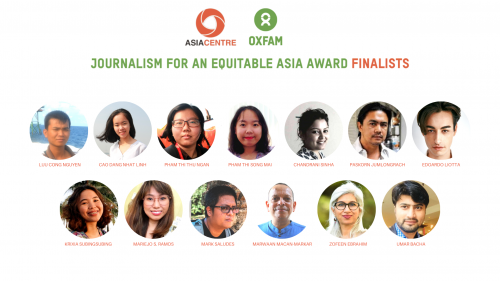
Asia Centre and Oxfam Announce 2020-21 Journalism Award Finalists
Asia Centre and Oxfam in Asia are pleased to announce the finalists for the 2020-21 Journalism For an Equitable Asia Award. As thought leaders and creators, journalists have the skills and voice to expose social issues of the challenges during the COVID-19 pandemic in Asia such as inequality, poverty and dysfunctional governance. Journalism for an Equitable Asia Award, co-hosted by Asia Centre and Oxfam in Asia aims to recognize them and encourage more journalists to write for a fairer Asia. Here are the finalists: Umar Bacha is a young journalist from Shangla, Khyber Pakhtunkhwa province in Pakistan. Currently associated with Dawn media group as a district reporter, previously he worked at the Express Tribune, Express news Tv and Aaj tv. Primarily, he is interested in reporting on human rights, education, tourism, and health. Read his article: “Braving hostile terrains and attitudes, the women at the heart of KP’s Covid-19 battle” here. Marwaan Macan-Markar is a Sri Lankan journalist who reported from the frontlines of the South Asian nation’s ethnic conflict for national newspapers in the 1990s. He then left for Mexico to write for an international news agency that covered the Global South. He has reported on political turmoil, human rights violations, poverty and inequality, economic change, natural disasters, and health pandemics in Latin America, Africa and Asia. He now covers Southeast Asia and South Asia for Nikkei Asia, a Tokyo-based publication. Read his article: “Thailand’s economic ‘death by a thousand cuts’ sows desperation” here. Mark Z. Saludes is a Manila-based writer and documentary photographer whose works focus mainly on social injustices, human rights, the environment, indigenous people, and the climate crisis. He is a reporter for the Catholic news site, LiCAS.news, and a contributing journalist to various international and national media entities. Human Rights Watch, a New York-based rights organization commissioned Mark to document child labor in the small-scale mining industry in the northern Philippine region of Bicol, which was published in September 2015 worldwide. He is currently working on an investigative reporting that tackles the condition of human rights in the country. Read his article: “Pandemic worsens situation of young mothers in conflict areas” here. Zofeen T. Ebrahim is a Karachi-based independent journalist who has written extensively on the environment, water, energy, climate change, women’s reproductive health, child rights, minority rights, labour rights, women’s work and empowerment. She contributes regularly to Pakistan’s largest national English daily (Dawn) as well as several international media organisations (IPS, The Guardian, The Third Pole and the Thomson Reuters Foundation to name a few). She strives to find links between issues like water scarcity, depletion of natural resources, loss of biodiversity, agriculture, sea pollution, renewable energy and climate change and how these issues impact communities. Read her article: “‘Moving mountains’: How Pakistan’sinvisible’ women won workers’ rights” here. Chandrani Sinha is an independent multimedia journalist, currently based in Guwahati Assam India. She has been reporting stories from Northeast India for 9 years. Currently, she contributes to both Indian and international media organizations. She intensively works on climate change in conflict areas, the environment, and sustainable development along with other human interest stories. She also covers the eastern corridor of India along with all the North-Eastern states. She is also the editor and founder of Badalta Northeast, a website dedicated to climate change sustainable development and solution journalism from NE. Read her article: “Climate refugees stripped of citizenship in Assam” here. Edoardo Liotta is a Singapore-raised and Southeast Asia-based journalist currently with RICE Media. At RICE, and in the past with VICE, Edoardo has penned stories about underprivileged groups across the region, focusing on the LGBTQ community, ex-offenders, migrant workers and sex workers. Read his article: “For Trans Women In Singapore, Appealing To High Beauty Standards Is A Matter Of Survival” here. Krixia Subingsubing, 25, is a journalist from the Manila-based broadsheet Philippine Daily Inquirer, the largest newspaper in the Philippines. She is currently covering the Office of the Vice President as well as the human rights beat for the paper. Most of her stories involve issues on social justice, with a particular focus on inequality, state-sponsored abuse and human rights violations. Some of her works on President Duterte’s war on drugs have also been similarly recognized by award-giving bodies. Mariejo S. Ramos is a reporter of the Philippine Daily Inquirer. She, along with fellow Inquirer reporter Krixia Subingsubing, bagged the best Investigative Report Award at the 41st Catholic Mass Media Awards in 2019 for their reporting on the brutal “war on drugs” in the Philippines. As a two-time fellow of the Southeast Asian Press Alliance’s Regional Reporting program, she wrote stories about the plight of female prisoners and how state-sponsored disinformation affects democracy. She has also written about various topics on social justice such as the drug war, indigenous communities, people with mental illnesses and mental health challenges, women farmers and prisoners, and the urban poor. Read their article: “Lockdown-weary jeepney sector faces Dec. 31 deadline” here. Pham Thi Thu Ngan is a 24-year-old writer under the pen name Pham Thu Ngan. As a young collaborator of the Social and Political Board of Thanh Nien Newspaper, she finds keen interest in fighting for the commoners and the vulnerable communities so they can get more advantages of social security. She learns and practices values: humanity, equality, freedom and justice. Besides her main work, she spends a lot of time for policy advocacy and educating the youth about human rights. Her spotlight reports are “Living in Can Gio Forest”, “Cho Ro ethnic trying to keep ancient spirit”, “Eat dew, sleep in the wind”. Pham Thi Song Mai has been a collaborator of Thanh Nien Newspaper since her internship. Her area in the newspaper office is Law and Court. There was a time she thought journalists were the people who can travel everywhere, meet many people. But when she knows there are a lot of vulnerable people out there but the policymakers cannot touch, she realizes that this job is also to fight, to write, to raise
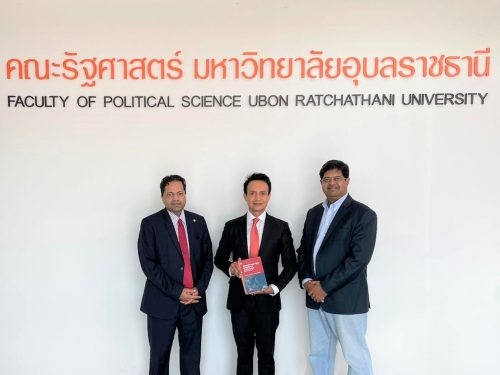
Asia Centre Connects with Human Rights in Ubon Ratchathani
On 5 March 2021, Asia Centre’s Drs. James Gomez and Robin Ramcharan participated in “The Official Launch of the Regional Center for Human Rights Study and Coordination” at the Faculty of Political Science, Ubon Ratchathani University. During the event, Drs. Gomez and Ramcharan, who are also the editors, presented Asia Centre’s publication “National Human Rights Institutions in Southeast Asia: Selected Case Studies“ to the Center’s founding Director, Dr. Titipol Phakdeewanich. At the sidelines of the event, Drs. Gomez and Ramcharan met with Mrs. Prakairattana Thontiravong, Commissioner Act on behalf of the Chairperson and expressed interest of partnership with the Commission and its other regional centres in Thailand. “The Regional Center for Human Rights Study and Coordination” at the Faculty of Political Science, Ubon Ratchathani University was established as part of efforts by the National Human Rights Commission of Thailand to set up regional knowledge centres within selected universities in the country. These centres disseminate information on the practice of human rights. There was also an opportunity to establish contact with representatives from Bangkok-based diplomatic missions. These included the Canadian Ambassador, Dr. Sarah Taylor and the Embassy of Sweden’s Political Officer, Jintana Sakulborirak. Drs. Gomez and Ramcharan also delivered remarks on COVID-19’s impact on human rights during a seminar hosted by Ajarn Kotchaphop Kornphetcharat. This presentation and others in Thailand are part of Asia Centre’s collaboration with the Taiwan Foundation for Democracy. The activities at Ubon Ratchathani University mark Asia Centre’s engagement with provincial universities and regional centres of the National Human Rights Commission of Thailand.
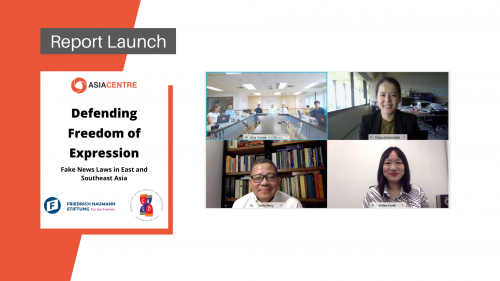
Asia Centre & CALD: Freedom of Expression Needs Defending
With internet shutdowns, throttling of internet server speeds, geo-blocking of social media posts, persecution of social media users, attacks against journalists and media organisations and outright censorship, freedom of expression in the region is in need of defending. This was the response of the reactors and participants to the contents of the report “Defending Freedom of Expression: Fake News Laws in East and Southeast Asia” released by Asia Centre and the Council of Asia Liberal and Democrats with the support of the Friedrich Naumann Foundation on 25 February 2021. About 100 people registered for the report launch. 65 attended the online event which was live-streamed via the Facebook pages of the two convening organisations, attracting 348 viewers. In his welcome remarks, Francis Gerald “Blue” Abaya, MP, Member, Philippine House of Representatives and Secretary-General, Council of Asian Liberals and Democrats stated that the aim of the webinar and report was to provide policy ideas to legislators, political party leaders, journalists and civil society activists to protect freedom of expression. The report was presented by Dr. James Gomez, Regional Director of Asia Centre who sketched the difference in approach to freedom of expression between countries that have multiparty legislatures and independent government institutions, and countries with one dominant political force and an absence of independent national institutions. He said, many countries in the region are using existing and new laws to constrain freedom of expression. With Covid-19 temporary and emergency laws, freedom of expression has deteriorated further. Echoing Philippines MP, Francis Gerald “Blue” Abaya, Dr. Gomez suggested that the key recommendations in the report be used as a policy toolbox of ideas to empower legislators, political party leaders, academics, civil society activists and journalists to protect freedom of expression. Following the presentation, Peifen Hsieh, Deputy Director, Department of International Affairs Democratic Progressive Party, Taiwan addressed the situation in her country and how citizens received information during the COVID-19 pandemic. She explained, in order to guard against COVID-19 disinformation, the Taiwanese government used legislation as a tool to criminalise the fake news. Taiwan’s Digital Minister Audrey Tang launched the principle of “3F” Fast, Fair and Fun in order to capture the attention of citizens about the fake news. John Nery, Columnist, Philippine Daily Inquirer highlighted the laws in the Philippines that are used to attack freedom of expression. The Philippines government misuses the cyber laws by wielding it as a weapon against those who are critical of its policies. As a result, many journalists have been arrested. He pointed out that in the Philippines, it is the government that is the primary source of fake news. Although the situation has improved, social-media continues to be the platform of disinformation. Siripa Intavichein, Chairperson, CALD Youth Deputy and a Spokesperson, Democrat Party, Thailand, provided her reactions to the report. She said, Thailand has regulations that can be used to prevent fake news, but these have been abused by the officials. For example, under Thailand’s Computer Crime Act the Thai military online disinformation campaign is illegal. However, judges and officials can decide whether to use the law or not to prosecute. As a result, the law appears biased towards those who have power. She argued that as a principle if someone has committed a crime they must be judged equally by the law. Presently this does not seem to be the case in Thailand. Moritz Kleine-Brockhoff, Regional Director, Southeast and East Asia Office Friedrich Naumann Foundation for Freedom rounded up the event. In his address, he noted the topic of freedom of expression has become an important topic of discussion in the last few years because of the threat it faces. He said, while propaganda is recognised as part of an authoritarian regime’s tool, what has changed is lying and fake news has become so mainstream in politics that it impacts freedom of expression and democracy. This event, moderated by Dr. Robin Ramcharan, Executive Director of Asia Centre, is part of the ongoing collaboration between the Council of Asian Liberals and Democrats and Asia Centre to work on issues related to freedom of expression. The report “Defending Freedom of Expression: Fake News Laws in East and Southeast Asia” can be downloaded from here, and the event’s livestream recording can be accessed here. This report is a collaboration between Asia Centre and the Council of Asia Liberal and Democrats
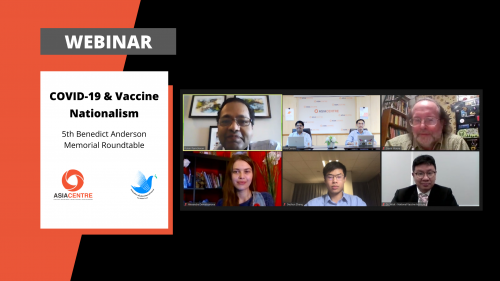
5th Benedict Anderson Memorial Roundtable: COVID-19 and Vaccine Nationalism
Rich countries have placed orders, received consignments and have begun inoculating their citizens, however, the reality of needing to inoculate foreign residents in their midst makes vaccination nationalism irrelevant. This was the general view emerging from Asia Centre’s webinar on 20 January 2021 entitled “COVID-19 and Vaccine Nationalism”. Asia Centre, in partnership with the Thai Media Fund and Taiwan Foundation for Democracy, convened its 5th Benedict Anderson Memorial Roundtable in remembrance of the late professor’s work on nationalism. The event was attended by 64 online participants with 798 Facebook Live views during the session. The session brought together academics, activists and health experts from all over the world to discuss the topic of vaccine nationalism. The opening remarks were given by Asia Centre’s Executive Director, Dr. Robin Ramcharan who outlined the key themes related to vaccine nationalism. He pointed out that vaccine nationalism primarily stemmed from competition to be the first to develop the vaccine and national pride in doing so. However, he asked the speakers and audience what is the reality on the ground? The first speaker was Asst. Prof. Wisit Tangkeangsirisin, Head of the Bureau of National Vaccine Capacity Development, from the National Vaccine Institute in Thailand. He provided an overview of the blueprint for COVID-19 vaccine access for Thailand. According to the national strategy he presented, there are three ways: 1) domestic R&D for vaccines; 2) technology transfer from AstraZeneca pharmaceutical firm and; 3) vaccine advance purchase agreement. He updated the audience on the progress of Thai’s vaccine development, noting that the mRNA vaccine from the Chula Vaccine Research Center is at the first clinical trial phase. The second speaker, Dr. David Moore, from Portland State University explained that nationalism is a product of the movement of people and commodities and provided insights into the rise of nationalism in the United States of America under Donald Trump’s presidency. Dr. Moore’s view was that more people are holding to ideas of national identity amidst fear of losing it to the impact of globalisation. Dechun Zhang, a PhD candidate at Leiden University was the third speaker. He presented on the development of COVID-19 vaccine in China. He listed the top three state-connected companies and their progress in the global vaccine race. He pointed out the Chinese characteristics of secrecy and non-disclosure in the way in which the vaccine was developed and distributed. This, he said, was the reason behind the growing but unspoken distrust among the Chinese population about the domestic vaccines. The final speaker was Alexandra Demitrianova, an activist from Slovakia and an Asia Centre’s Associate. She approached the topic from an European Union perspective highlighting the inequality between nations and the rising sense of nationalism within the members of the union. She said financial and political power member countries in the EU varied, and as a result, the smaller and weaker members benefit from an umbrella EU approach in acquiring vaccines for the whole block. Asia Centre’s Regional Director, Dr. James Gomez, responded to the speakers. He said, vaccine nationalism is intellectually and practically problematic because at the end of the day countries cannot limit themselves to vaccinate only their citizens. From a public health perspective, countries would have to also inoculate foreign residents within their jurisdiction to protect the whole resident population. Politically, and in terms of public relations, to deny foreign residents the vaccine would be a political and PR disaster. The key questions would be who will pay for this and what happens if poorer countries cannot afford it. This then opened the debate among the speakers and audience on how to make the vaccine equally available to all nations, especially the poorer ones. The main takeaway was vaccine nationalism cannot hold up, because this issue is global. Most countries have a significant dependency on economic cooperation with others in various forms including geopolitical alliance, movement of goods and the movement of people. This event is the 5th Benedict Anderson Memorial Round Table convened by Asia Centre. To date Asia Centre has convened the following memorial roundtables: 1st Benedict Anderson Memorial Roundtable: “Debating Imagined Communities” (2016) 2nd Benedict Anderson Memorial Roundtable: “Nationalism, Citizenship and Statelessness” (2017) 3rd Benedict Anderson Memorial Roundtable: “Gender and Nationalism in Asia” (2018) 4th Benedict Anderson Memorial Roundtable: “Chinese Nationalism and Its Impact on Southeast Asia” (2019) https://www.youtube.com/watch?v=d2a6v4mc2hI&t=191s