
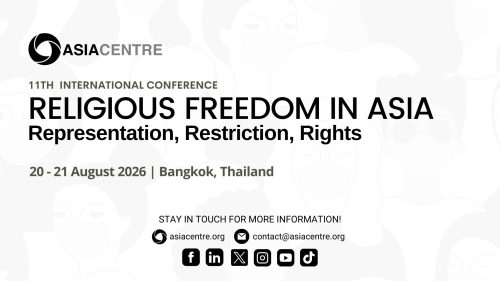
11th International Conference – Religious Freedom in Asia: Representation, Restriction, Rights
1. Overview Asia Centre’s 11th Annual International Conference will examine the current state and future trajectory of religious freedom in Asia, focusing on representation, restrictions and rights. The right to freedom of religion or belief (FoRB) is fundamental to human dignity. Article 18 of the Universal Declaration of Human Rights (UDHR) (1948) enshrines the inalienable right to adopt, change, or renounce a religion without coercion or discrimination – a principle further reinforced by the International Covenant on Civil and Political Rights (1966). In this context, the conference will examine religious freedom in Asia as a human rights issue, based on legal standards, state responsibility, and institutional accountability. By convening stakeholders from a range of organisations, the event seeks to identify threats to religious freedom, foster dialogue and develop actionable frameworks. This is to ensure that religious freedom is a justiciable right that states are obligated to protect and individuals are empowered to claim. It is hoped that insights gained from the conference will inform effective practices and support policy development that recognises religious freedom as integral to broader democratic and human rights commitments, while fostering a community of practice. Conference Themes The conference will examine the following sub-themes: FoRB as a Human Right: International Norms and Domestic Obligations Legal and Structural Restrictions on Religious Freedom Division Between Secular and Religious Courts The Bureaucratic Control of Religion Religious Freedom in Conflict Zones and Authoritarian Regimes Transnational Repression of Religious Activists and Asylum-Seekers Religious Fundamentalism, State-Sanctioned Religion and the Erosion of Pluralism Uncivil Society and Social Hostilities against FoRB Representation and Marginalisation of Ethno-Religious Minorities Online Harassment and Surveillance of Religious Communities Gender, Religion, and Intersectional Discrimination Indigenous People, Atheists, and Non-Believers From Tolerance to Accountability: Responses from Civil Society and Media Note: The above sub-themes are a preliminary guide. Flexibility is encouraged, and partners may propose additional topics aligned with their expertise under the overarching theme of Religious Freedom in Asia to ensure contextual relevance and innovation. 3. Objectives The conference aims to achieve the following objectives: Examine the state of religious freedom in Asia. Identify threats to religious freedom and current responses. Build strategies and actions for advancing religious freedom in the region. 4. Conference Structure The conference will consist of short opening remarks, keynote speeches, plenary sessions, and breakout sessions arranged according to themes and/or region and country-specific discussions. 5. Conference Participants Registration is open to participants from national, regional, and global organisations, including civil society organisations, faith-based NGOs, human rights organisations, media and journalism associations, legal and policy entities, parliaments and political parties, technology firms, government agencies, and intergovernmental organisations. 6. Programme Outline Day 1, Thursday, 20 August 2026 9:00 – 17:00 Morning & Afternoon Panels Day 2, Friday, 21 August 2026 9:00 – 17:00 Morning & Afternoon Panels 17:00 – 20:00 Networking Hour 7. Inquiries Please contact us at conference@asiacentre.org For the full concept note, please click here. 8. Registration We invite all participants to register through this Google Form.
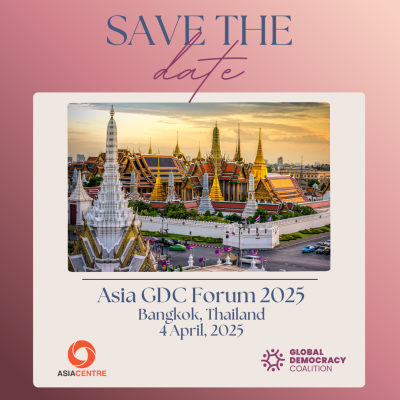
Asia Global Democracy Coalition Regional Forum 2025: Youth, Democracy & Elections in Asia: Issues & Challenges
Global Democracy Coalition Asia Regional Forum 2025: Youths, Democracy & Electoral Legitimacy in Asia The Asia-Pacific region is characterised by a wide range of political systems, from full democracies to authoritarian regimes. Recent reports indicate a decline in democratic governance in the past decade, with concerns over electoral integrity being particularly prominent. The region is also home to over 700 million young individuals, many of whom face significant barriers to political participation. Institutional restrictions, limited representation, and political repression create a challenging environment for youth engagement. Nevertheless, their involvement is essential for sustaining democratic governance. The upcoming special issue of the Kyoto Review of Southeast Asia, published by Asia Centre, will examine how ruling regimes manipulate or dismantle electoral systems to maintain their control. Despite these challenges, young people are leading the charge for democratic advocacy. This forum brings together both regional and international voices to explore ways to enhance youth political participation and safeguard democracy. To find out more, attend the regional forum: Date: 4 April 2025Time: 8:30 AM to 5:30 PM (Bangkok Time, GMT+7)Venue: Online and On-site (Bangkok, Thailand)Language: English Register here: https://forms.gle/vTmBkkMjx8kSF6xB6
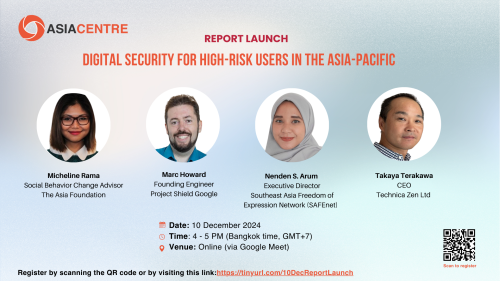
Report Launch – Digital Security for High-Risk Users in the Asia-Pacific
Digital Security for High-Risk Users in the Asia-Pacific examines the key challenges that users such as parliamentarians, policymakers, rights defenders, and journalists – among others – face in the online sphere that impact their digital security. Since the mid-2000s, the internet has increasingly influenced politics in the Asia-Pacific region. With the rise in internet and social media penetration, individuals and organisations using these technologies to advocate for public accountability face growing risks. In 2022, the region accounted for 31% of global cyberattacks, with governments and their proxies often identified as key perpetrators. Targets range from governments to opposition politicians and rights defenders. Methods of attack include digital surveillance, hacking, and disinformation campaigns. Existing mitigation measures, such as VPNs and multi-factor authentication, remain inadequate, and digital security is not widely prioritised. Against this backdrop, there is an urgent need for enhanced digital security training tailored to the needs of high-risk users. This report presents a needs assessment to identify critical elements required to bolster digital security in the region. The findings highlight three key clusters of threats: legal regulation, digital surveillance, and information operations. To address these challenges, the report recommends: Developing contextualised and region-specific digital security training. Strengthening monitoring systems to detect and respond to threats. Promoting the use of open-source technologies to build robust defences. As technology evolves, regularly updating digital security strategies and training curricula is vital to ensure ongoing online safety for those advocating for public accountability. To find out more, attend the report launch and discussion. Discussants Michelin Rama, Social and Behavior Change Specialist, The Asia Foundation Marc Howard, Founding Engineer of Google’s Project Shield Nenden S. Arum, Executive Director, Southeast Asia Freedom of Expression Network (SAFEnet) (Awaiting confirmation) Takaya Terakawa, CEO, Technica Zen Ltd Moderator: Dr Marc Piñol Rovira, Asia Centre Research Manager Emcee: Lina Sakina Salim, Asia Centre Programme Coordinator Date: 10 December 2024 Time: 4pm to 5pm (Bangkok time, GMT+7) Venue: Online on Google Meet Language: English Registration link: https://tinyurl.com/10DecReportLaunch Contact: research@asiacentre.org
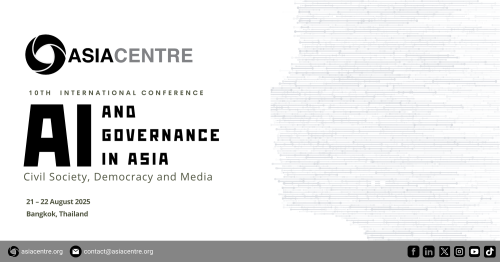
10th International Conference – AI and Governance in Asia: Civil Society, Democracy, and Media
Overview Asia Centre’s 10th Annual International Conference will explore the impact of artificial intelligence (AI) on governance, in particular its impact on civil society, democracy and media in Asia. Artificial Intelligence (AI) is poised to become the next transformative technology, with significant implications for governance across the region. Various stakeholders in the region have adopted AI strategies to maximise its opportunities. However, there are significant disparities in AI adoption across countries, as reflected in the Government AI Readiness Index (2023). This index, which measures readiness on a scale from 0 to 100, where 100 indicates the highest level of preparedness, shows that Singapore leads with a score of 82, followed by South Korea at 76 and Japan at 75. In contrast, several countries are lagging far behind, with Cambodia scoring 32, Myanmar and Nepal both at 31 and Timor-Leste at 30. These disparities underscore the uneven pace of AI integration in governance and highlight the challenges faced by lower-scoring nations in harnessing AI’s potential. While the Government AI Readiness Index shows governmental preparedness for AI, it is essential to assess AI’s impact on civil society, democracy, and media. Since indices for these areas are still developing, a qualitative assessment is needed initially before creating a comprehensive AI and Democracy Index. This will help ensure AI integration supports democratic processes, civil society, and media freedom in Asia. In this context, the conference will explore both the challenges and opportunities presented by AI in the effort to strengthen civil society, democracy and the media in Asia. By fostering dialogue and collaboration among a range of stakeholders, the conference aims to develop actionable insights and solutions for advancing the responsible and equitable use of AI. This is particularly important given the current contraction of democratic spaces and the increasing restrictions on freedoms in the region. The goal is to address these issues and promote AI’s role in supporting and enhancing good governance. It is hoped that following the conference, the analysis can also move AI and Democracy from a qualitative to a quantitative assessment. For more information, please click here. Themes The conference will examine the following sub-themes: AI and Democracy in Asia: Opportunities and Challenges AI and Electoral Integrity AI and Parliaments AI-Driven Election Campaigns The Role of AI in Strengthening Civil Society AI and Human Rights AI, Gender and Inclusion AI and its Impact on Civic Spaces Building Public Trust in AI-generated Media AI’s Role in Shaping Public Opinion AI and Media Sustainability AI and Disinformation AI Regulatory Frameworks Data Privacy and Security in AI-Enhanced Governance Ethical Implications of AI in Politics Objectives The conference aims to achieve the following objectives: Convene stakeholders interested in how AI intersects with democracy in Asia Examine the impact of AI on democracy, civil society, and media in Asia Evaluate the challenges and opportunities to harness AI for democracy in Asia Conference Structure The conference will consist of short opening remarks, keynote speeches, plenary sessions, and breakout sessions arranged according to themes and/or region and country-specific discussions. Conference Participants Registration is open to participants from academic institutions, media outlets, journalist associations, businesses, national and regional civil society organisations, international NGOs, political parties, parliaments, technology companies, government agencies, and intergovernmental organisations. This inclusive approach aims to facilitate knowledge sharing and networking among diverse stakeholders. Programme Outline Day 1, Thursday, 21 August 2025 9:00 – 17:00 Morning & Afternoon Panels Day 2, Friday, 22 August 2025 9:00 – 17:00 Morning & Afternoon Panels 17:00 – 20:00 Networking Hour Conference Fee This is a self-funded conference, hence a flat, base fee of USD 350 will be charged to all presenters, participants and drop-in visitors. This will go towards covering the cost of the venue, equipment and logistics, coffee breaks on all days, certificates for participants, conference communications and staff. Conference fee (USD 350) does NOT cover a flight ticket, accommodation, and any other expenses related to travel advisory. Conference Partnerships This conference is currently open for title partnerships at Tier 1 and Tier 2 to lead the shaping of the conference programme. Fees from the title partnerships will be utilised to cover the expenses associated with the venue, equipment and logistics, coffee breaks and meals throughout the event, certificates for participants, conference communications, and staff. Once the key title partnership lineups are confirmed, the conference will be open to participants. Partnership Packages Benefits Presentation of welcome remarks or keynote address at the conference Closed-door Meetings with partners and donors Networking Welcome Dinner Table-top space to display and distribute promotional materials during the conference Inclusion in Asia Centre website reporting on the conference Logo on conference online and offline publicity materials Social media promotion of the panel(s) through Asia Centre’s networks MOU signing and partnership opportunities for 2025 Additional Options Sponsor participants by buying conference tickets. Sponsor a keynote speaker by providing a financial grant to the conference. Provide corporate sponsorship (in-kind and/or financial grants) and be featured on promotional materials. Inquiries and Registration Please contact us at contact@asiacentre.org Please register here to indicate your interest in self-participation
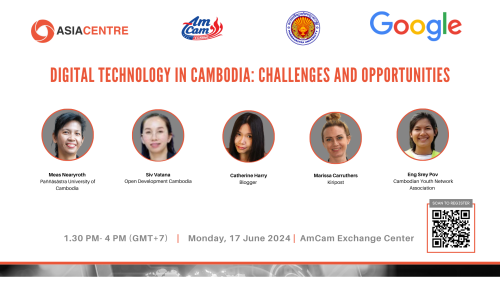
Digital Technology in Cambodia: Challenges and Opportunities
Background Since the late 2000s, the use of digital technology has increased rapidly across Cambodia. This has happened in a context where the internet penetration index has increased sharply in the country. In 2012, it stood at 12%, and by early 2024, it had increased to 56.7%. The widespread adoption of social media platforms has particularly driven this surge in internet usage. As of 2024, 68.4% of the population are active social media users, with Facebook, Instagram, and TikTok emerging as the most popular platforms. Additionally, instant messaging applications such as Telegram, Messenger, and Whatsapp enjoy considerable popularity. The rapid expansion of internet users has significantly reshaped daily life in Cambodian society. Social media platforms have played a crucial role in enhancing communication and networking, allowing individuals to maintain close relationships across geographical barriers. Furthermore, digital tools have revolutionised the media landscape, providing a diverse range of information sources and enabling user-generated content. Additionally, online learning platforms have bridged the education gap between urban and rural areas by granting students in remote locations access to lectures, tutorials, and educational resources. Furthermore, in the realm of business and commerce, the rise of e-commerce platforms has transformed the way goods and services are bought and sold. Small businesses and entrepreneurs can now reach a wider audience beyond their immediate vicinity, facilitating economic growth and market expansion. Amid Cambodia’s rapid digital transformation, significant challenges have arisen. The digital divide persists, with urban areas enjoying robust internet access while rural communities struggle, exacerbating inequality. Furthermore, many Cambodians lack digital literacy, making them vulnerable to misinformation and cyber threats. Cybersecurity concerns are also prominent, with individuals and organisations facing increased risks of cyberattacks and data breaches. Addressing these challenges requires concerted efforts to bridge the digital divide, improve digital literacy, and strengthen cybersecurity measures to ensure equitable access and protect against digital threats. Programme Date: Monday, 17 June 2024 Time: 1:30 – 4:00 pm Venue: AmCam Exchange Center Registration:https://forms.gle/9h3MXMXretKwQPau6 Session on “Digital Technology in Cambodia: Challenges and Opportunities” Speakers Meas Nearyroth, Paññāsāstra University of Cambodia Siv Vatana from Open Development Cambodia Catherine Harry, Blogger Marissa Carruthers, Kiripost Eng Srey Pov, the Cambodian Youth Network Association ModeratorKum Somaly, Asia Centre For enquiries, contact: Somaly KUM (somaly@asiacentre.org)
Oxfam Young Leaders Fellowship Programme 2024
Development challenges continue to rise in many parts of Asia as democratic civic engagements fall due to repressions and restrictions, raising concerns about inequality, social justice, gender rights, and climate change is becoming a challenge amid rising authoritarian trends. In a world with declining democracies, retreating of human rights, and shrinking civic engagement, the need to empower the next generation of empathetic leaders has never been more pressing. Building on the success of the inaugural cohort, Oxfam in Asia and Asia Centre are thrilled to announce the 2nd Cohort of the Oxfam Young Leaders Fellowship Programme in Asia. This transformative initiative aims to equip the selected group of young leaders with tools, skills, knowledge and networks to drive positive change in their communities. Through close mentorship and hands-on practice, this initiative offers an invaluable opportunity for the fellows to strengthen their capacity to make social change happen and sustain. Benefits International learning opportunities and exposure Stipend: Each fellow will receive a total amount of USD 3600 (USD 400 per month x 9 months) as a monthly stipend paid in 3 monthly intervals. Opportunity to be mentored by experienced international professionals in various fields. Opportunity to work with Oxfam in Asia and Asia Centre leadership teams from different regions. Support to independently organise a smaller network for influencing and campaigning. An opportunity to understand and learn about the international development sector Criteria for Nomination Prospective young fellows must meet the following criteria: Aged 27 or below. Be a citizen of one of the following countries within Oxfam in Asia offices: Bangladesh, Cambodia, India, Indonesia, Laos, Myanmar, Nepal, Pakistan, Philippines, Sri Lanka, Thailand, Timor-Leste, or Vietnam. Completed Undergraduate or Master’s degree in Social Sciences and Computer Sciences. Demonstrate creativity and motivation to make social change happen and sustain. Showcase skills and aptitude to use digital/other tools for advocacy. Professional English proficiency (written and spoken). We encourage women and those from minority communities to apply. Not currently employed and will not take full time employment during the fellowship. Interest to contribute to the following thematic areas: Expectations/Tasks Dedicate a minimum of 40-50 hours per month to implement the proposed activities agreed with mentors for 9 months from the starting date. Attend an in-person induction workshop in Bangkok, Thailand. Create and maintain a network of 50 or more youth individuals. Attend monthly online meetings and report progress and setbacks to mentors. Undertake leadership and activity roles throughout the fellowship, including during the induction workshop, monthly meetings and end-of-project convening. Develop content for the “Civic-Asia” website. Attend an end-of-project convening either online or onsite (to be determined later). Application Process Candidates must submit their CV, a cover letter identifying the areas of interest as mentioned above and a motivation letter which provides a rationale for why they are interested in specific thematic areas, any previous work/assignment carried out, relevant academic background, their career ambition, and aim from the fellowship via this Google Form. Candidates are also required to submit two recommendation letters from relevant individuals who can vouch for their skills, achievements, and professionalism Short-listed candidates will be interviewed by a panel of judges, who will use the criteria (see Judging Criteria below) in selecting eight Young Fellows to participate in the Programme. As part of the selection process, candidates will be tasked with a written exercise to further demonstrate their commitment to the programme. Timeline Judging Panel The Judging Panel will consist of media professionals and inequality experts, members of Asia Centre, Oxfam International, and independent practitioners. Judging Criteria To apply for the fellowship, fill in this Google Form. If you are facing difficulties accessing the Google form, please use the alternative application form link here If you have any questions regarding the application process, please email: contact@asiacentre.org. Frequently Asked Questions Q: I am neither a citizen nor a full-time resident of the following countries with an Oxfam office in Asia: Bangladesh, Cambodia, Hong Kong-SAR, India, Indonesia, Laos, Myanmar, Nepal, Pakistan, Philippines, Thailand, Timor-Leste, or Vietnam. Am I eligible? A: Only those from the specified countries are eligible to apply. Q: I am a citizen of one of the mentioned countries. But I am currently residing outside the country. Am I eligible? A: Only citizens who are currently residing in one of the mentioned countries are eligible to apply. Q: I am 27 years and some months old. Am I eligible? A: Only those whose age is no more than 27 years old by 1 July 2024 are eligible to apply. Q: When does the fellowship start? A: The fellowship commences on 1 July 2024. A week-long introductory meeting will be convened in Bangkok in the last week of June 2024. Q: When does the fellowship end? A: The fellowship concludes on 31 March 2025. All selected fellows are required to fully join the fellowship programme as agreed. Q: Can I apply as a representative of an organisation? A: We are looking for individual fellows to be guided by experienced mentors. Q: Can I submit application documents in my local language? A: Only application documents in the English language will be accepted. Q: Is it possible to pursue part-time employment during the fellowship period? A: While full-time employment isn’t permitted, fellows can explore part-time opportunities with prior consent from their mentors. Q: What is the policy concerning refunding bank charges incurred during the fellowship? A: Unfortunately, we do not reimburse bank charges. Q: What is the protocol for terminating or leaving the fellowship midway? A: It’s important to clarify that Asia Centre & Oxfam reserve the right to terminate the contract. Additionally, if a fellow needs to leave for any reason, Oxfam & Asia Centre will assess the situation and decide accordingly. Q: Will we get any hardware or software support during the fellowship? A: Necessary software support to execute tasks might be considered, but the fellows are required to use their personal laptops and