
International IDEA: Support Needed for Democratic Actors in the Region
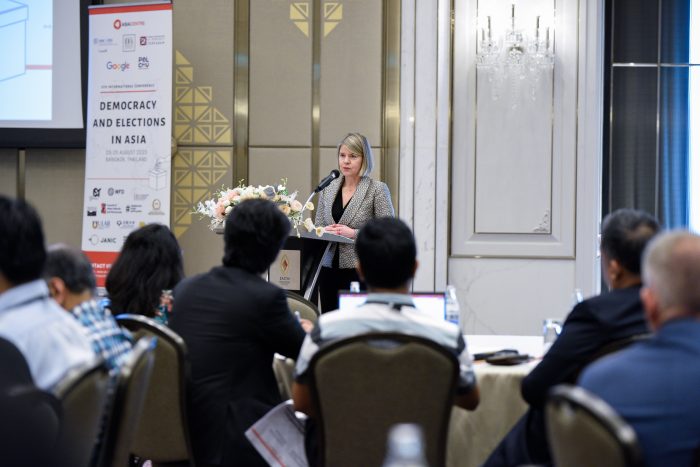
The International Institute for Democracy and Electoral Assistance (International IDEA), a title partner for Asia Centre’s 8th International Conference on “Democracy and Elections in Asia”, hosted two panels and a demonstration session. During the three-day conference, panel speakers convened by International IDEA emphasised the importance of offering support and fostering solidarity with democratic actors in Asia. This importance was underscored during the opening remark on 23 August by Leena Rikkilä Tamang, International IDEA’s Director for Asia and the Pacific. She emphasised that, given the numerous challenges to democracy posed by electoral manipulation, the importance of solidarity and cooperation among civil society actors has become even more critical. International IDEA’s opening panel of the conference titled “Perspectives and Prospects for Future Democratic Elections in Myanmar.” Moderated by Marcus Brand, Head of the Myanmar office, the panel delved into the range of issues surrounding the election to be conducted under the junta regime. The consensus among the panellists was that civil society and democratic actors should withhold legitimacy and institutional support for the forthcoming election until the junta guarantees a free and fair electoral process for the citizens of Myanmar. Three speakers discussed inclusivity issues and democracy in Myanmar. Debbie Stothard, Coordinator/Founder of Alternative ASEAN Network on Burma (ALTSEAN-Burma), pointed out that there is a lack of inclusivity of young people and ethno-religious minorities – who play a huge role in the democratisation efforts – during the transitionary period. These actors are crucial for a future electoral model that is free and fair. Thinzar Shunlei Yi, Deputy Director of the Anti-Sham Election Coordination Committee (ASECC) and Human Rights Advocate added that civil society actors have to be properly included in the process to develop a post-coup regime that is truly democratic and responsive to the needs of the citizens of the country. Igor Blaževič, Head of Prague Civil Society Center, speaking from the vantage point of the international community, emphasised that INGOs should use their positions to discourage giving legitimacy to the election and instead provide needed support to key civil society organisations in the country. On the second day and in the second International IDEA panel “Leaving No Voters Behind: Facilitating The Right to Suffrage of Migrants”, moderated by Senior Programme Manager of International IDEA’s Asia and the Pacific Regional Programme, Adhy Aman, panellists – experts from India, Nepal, and the Philippines – highlighted the inconsistent treatment of migrants’ electoral rights as a major roadblock to enhancing voting accessibility and inclusiveness in Asia. Dr Banasmita Bora, independent researcher, illustrated the situation in India. The country has a significant migrant population facing disenfranchisement, with fewer than a quarter actually using their right to vote due to the financial constraints of having to vote in-country. This issue extends to internal migrants, who constitute a substantial portion of the migrant population and are also significantly disenfranchised in local elections. Commissioner Marlon Casquejo, Commission of Elections, Philippines, noted that civil society should advocate for a holistic approach towards overseas voting, which includes easier voter registration, more opportunities for Filipino nationals to vote from other countries, as well as study the possibility of internet voting. Dr Gopal Siwakoti, INHURED International (Nepal), pointed out that the lack of provisions for out-country voting or online voting in many countries further disenfranchises the migrant population who already lack political and financial leverage. This is particularly the case in migrant-sending countries such as Nepal. Antonio Spinelli, International IDEA, built on the points made by other speakers and concluded that a lack of mechanisms to facilitate absentee voting jeopardises the right to universal suffrage which lays a foundation for the right to self-determination. Overall, the panel showed that those advocating for absentee voting have not been properly supported and have not been given a platform to speak up on the issue. It is therefore important that more focus be given on the topic. The International IDEA, on the third day of the Conference, also showcased its “Electoral Redistricting App (ERA)”. Developed on the backdrop of unfair gerrymandering of electoral districts worldwide, the App makes it easier to create electoral redistricting maps that conform to international principles and best practices. Facilitated by International IDEA’s Senior Programme Manager Adhy Aman, conference participants tried out the App themselves and came up with various ideas of how a better electoral district could look like in their respective countries. Civil society can also use the redistricting app to advocate against gerrymandering with their respective governments. This conference helped strengthen the two organisations’ partnership which was already a year in the making. In the lead-up to this conference, Asia Centre and International IDEA signed an MOU in December 2022 to formalise their partnership. The two organisations also co-convened a closed-door consultation on “Digital Authoritarianism in Southeast Asia” with representatives from diplomatic missions, UN agencies and civil society actors based in Bangkok, Thailand. Earlier in December 2022, Dr. Gomez delivered a presentation on the rise of disinformation and its relation to the distrust in media in an International IDEA-hosted event, “Democracy in Asia and the Pacific 2023 Outlook Forum”, in Bali, Indonesia. In October 2023, the two organisations will co-convene this year’s edition of the “Democracy in Asia & the Pacific 2023 Outlook Forum” in Bangkok, Thailand. To view the main conference article, articles on individual title partners who convened panels, as well as the TikTok videos and photo album, go to the main conference piece here. The International Conference is Asia Centre’s annual event where it brings together its partners to share the outcomes of their programmes and network for future collaborations. Over the years, the conference has become a platform for a range of actors to meet and discuss key human rights issues. If you would like to become a Conference partner for Asia Centre’s 9th International Conference “Civic Space in Asia: Stories of Resistance and Pushback” or explore other collaboration opportunities, email us at contact@asiacentre.org. For more information on the 9th Conference, click here.
IDRC: Strengthen Inclusivity & Research Capacity in Asia
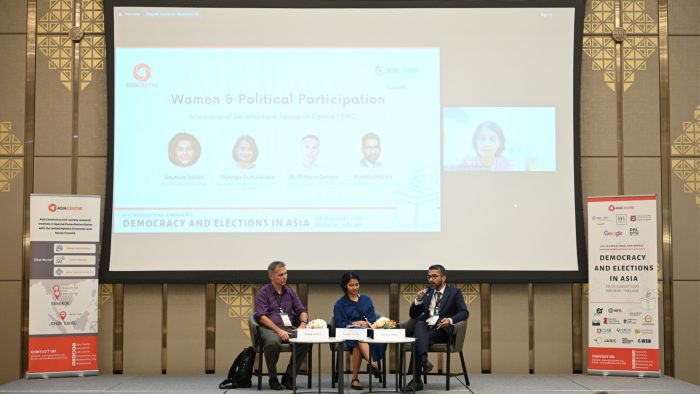
IDRC, as title partner for Asia Centre’s 8th International Conference “Democracy and Elections in Asia” from 23 to 25 August 2023, called for greater inclusivity and the strengthening of research capacity in Asia. IDRC made these calls through the two panels it convened at the three-day conference, in which speakers discussed the key challenges women in Asian countries face to engage in politics and how researching democracies can be improved. These calls were framed by the opening remarks of Caroline Ford, Director for Democratic and Inclusive Governance at IDRC, who said that civic spaces serve as a vital platform for representing communities and marginalised groups but are vulnerable to challenges like misinformation. Thus, safeguarding civic spaces is essential for upholding democratic legitimacy and preventing violence, particularly in post-conflict settings such as Myanmar and Afghanistan. Within this framework, democracy is perceived as a value system grounded in a peaceful, inclusive, and dynamic civic context, closely interconnected with values like inclusion, justice, human rights, equality, and equity. Ms. Ford emphasised IDRC’s support for Asia Centre’s conference on democracy and elections, which aligns with their broader mission to strengthen civic spaces, promote democratic knowledge, and foster collaboration among research communities. On 24 August, in the first of the two panels, titled “Women and Political Participation in Asia,” the plenary session featured three speakers: Saumya Surbhi, Youth Environmental Human Rights Defenders Protection Coordinator at the UNDP Bangkok Regional Hub; Viyanga Gunasekera, a PhD candidate at the Australian National University and a researcher at the International Centre for Ethnic Studies in Sri Lanka; and Dr Philippe Doneys, Associate Professor in Gender and Development Studies at the Asian Institute of Technology in Thailand. Moderated by Kundan Mishra, Senior Program Officer at IDRC, the session was a platform to underscore the intricate challenges impeding women’s engagement in politics across distinct contexts. Viyanga Gunasekera and Dr Philippe Doneys outlined how the convergence of identities becomes a barrier, particularly for women from ethnic minorities, in participating in political spheres within post-conflict societies like Sri Lanka and Myanmar. Building on this, Saumya Surbhi stressed the need for capacity building for young women in the context of climate protests, given the lack of inclusion of this group in traditional decision-making processes. After the input shared by all three speakers and insights provided by the moderator, panel attendees raised questions and articulated their views. The questions covered a range of topics and delved into various key factors that hinder women’s participation in politics and how to overcome them. A key point that was discussed during the interaction between panelists and participants was that Active political participation by women is an enduring concern within the political landscapes of Asia, underscoring the fact that politics continues to be predominantly male-dominated. This dynamic, panelists explained, significantly undermines democratic governance and requires urgent attention. To address the problems undermining the role of democratic governance, speakers highlighted the importance of developing political communication strategies at the grassroots level, conducting more research to understand and compare the challenges faced by women at national and local levels, the necessity of parliamentary quotas, and the establishment of solidarity networks to empower women. Finally, despite the likelihood of persisting challenges, the panelists emphasised the importance of providing appropriate educational tools to enhance awareness and foster more inclusive political spaces, enabling equal participation. On 25 August, the second panel organised by IDRC, titled “Researching Democracies” featured three presenters: Joel Mark Baysa-Barredo, Strengthening Human Rights and Peace Research and Education in Southeast Asia (SHAPE-SEA); Prof Puja Kapai Paryani, Hong Kong University; and Rahul Verma, Centre for Policy Research in India. The panel was moderated by IDRC’s Kundan Mishra. During this session, the speakers delved into the intricacies of democracy research beneficiaries. They distinguished between those who possess the capacity to actively apply research findings to the democratic process and those who merely exhibit a passive interest. This differentiation shed light on the existing power asymmetries within the realm of democracy, underscoring the unequal distribution of influence and resources among participants. These insights underscored the challenges in translating research into actionable democratic practices and highlighted the need for more equitable access to research-driven tools and knowledge for a more inclusive and effective democratic engagement. The speakers also explored the nuanced challenge of adapting international recommendations for democracy enhancement to fit local contexts. They emphasised the importance of ensuring that these recommendations are not only applicable but also sensitive to the unique needs and dynamics of specific regions. Additionally, there was a critical examination of the “foreign interference” narrative, with speakers pointing out its shortcomings in adequately representing minority interests. This perspective sheds light on the complexities of balancing the implementation of global recommendations with the imperative to maintain inclusivity and prioritise the concerns of marginalised groups within the democratic framework, underscoring the need for more context-aware and inclusive approaches to democracy promotion. In this context, the panellists put forward several recommendations aimed at strengthening democratic governance. They stressed the need to translate research into actionable steps to ensure that voices from all social groups are heard and that the political landscape becomes more inclusive. Furthermore, they highlighted the importance of developing specific, context-tailored indigenous frameworks for each country. This approach was seen as crucial for understanding democracy in ways that align with national needs, advocating for a departure from uniform approaches in favour of nuanced, localised perspectives. The speakers also underscored the significance of creating deliberative democratic platforms to engage various segments of society, including women and youth. The panel concluded with a question-and-answer session in which participants sought further clarification on the insights shared by the panellists. IDRC’s participation at Asia Centre’s 8th International Conference is its second showing. In 2022, at the Centre’s 7th International Conference, IDRC convened the panel “Knowledge Systems and Fragility in South and Southeast Asia – The Faraway Future” to discuss the unique challenges faced by knowledge systems and scientific research in South and Southeast Asia, particularly in fragile contexts. Currently, Asia Centre and IDRC are