
Asia Centre Launches Report on Political Hate Sites in Singapore
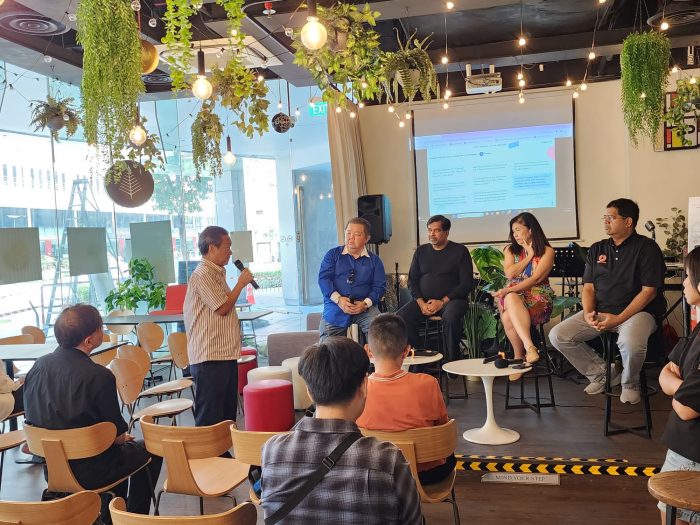
On 8 July 2023, Asia Centre held a discussion panel for the launch of its newest report, Political Hate Sites in Singapore: Flourishing without Repercussions. The event, jointly organised with two Singapore-based independent media platforms: The Independent Singapore and Wake Up Singapore, gained over 30 participants. To promote the launch event, Asia Centre released two promotional videos on its social media platforms introducing what are political hate sites in Singapore. Additionally, The Independent Singapore, one of the organising partners, published a promotional pre-event article, and The Online Citizen, a regional news platform based in Taiwan, released an audio post of Dr James Gomez, Asia Centre’s regional director, providing a summarised definition of political hate sites. Shortly after its release on 8 July 2023, Agencia EFE, a Spanish international news agency, reported the findings of the report in its article “Aumentan los discursos de odio contra opositores y activistas en Singapur, según estudio” (Hate speech against opponents and activists on the rise in Singapore, study finds) with SWI swissinfo.ch – the Swiss news and information platform. This is followed by another article published by The Online Citizen, a regional news platform based in Taiwan on 9 July 2023, “Asia Centre report highlights the proliferation of unchecked hate sites in Singapore” to share its findings. Besides, the key research findings were also promoted via an online campaign with infographics and infographic video posted on Asia Centre’s social media platforms, Facebook, Linkedin, Instagram, Twitter and Tiktok. The event, held at Palms Bistro, Singapore, was attended by lay Singaporeans, members of the opposition political parties, media activists and journalists of independent media platforms. Dr James Gomez, Asia Centre’s regional director, delivered the presentation about the report’s findings and highlighted how many Singaporeans often overlook the existence of such political hate sites due to the normalisation of hate speech in political discourse and debate in Parliament and the mainstream media. Through the 3 phases of internet control and various laws and legislations, the state has controlled and regulated political discourse and participation of the opposition parties, media advocates, independent journalists and media platforms, thereby narrowing the space of critical political discourse both offline and online. The report has identified the proliferation of hate content and hate sites online as the fourth phase of internet control, whereby Dr James expounded on the traits, tactics and targets of political hate sites by presenting 4 case studies as identified by the report. Moderated by Craig Teo of Reverse Auction & Financial Services Consultant, the findings were further discussed by Wendy Low of Eldan Law LLP, Jeannette Chong-Aruldoss, a prominent lawyer with 30 years of experience and a former politician, and Kumaran Pillai of The independent Singapore. Wendy Low presented over a pre-recorded video the strategies that victims of online hate speech can utilise to seek legal justice against their perpetrators through four main strategies; identifying the hater before taking legal actions, building one’s narrative through independent news platforms to amplify one’s side of the story, remaining above board by exercising transparency in the investigation process and using existing laws on harassments (such as POHA) against the perpetrators of hate. Jeannette Chong Aruldoss pointed out that the public has generally accepted certain behaviours and speech which disable them from identifying the hate narratives contained within them. Hate speech is a dangerous, divisive tool to society and must be curbed not just by legislation but also by civic actions from the members of society. Bringing in the insider’s perspective as an independent media practitioner, Kumaran Pillai asserts that the incumbent political party has distorted the online landscape for political discourse and restricts the space for different political parties and the general public to contest for the best ideas through constructive debates on policies and to call for accountability of public officials. In the report, Asia Centre recommends the international community, UN bodies, Singapore parliament, political parties, tech companies, and civil society organisations to 1) monitor, document, and call out cases of online hate speech in Singapore; 2) use UN mechanisms to engage with the Singaporean government to address political hate speech and commit itself to international standards of freedom of expression; 3) advocate for the amendment of laws restricting freedom of expression; 4) develop new technology solutions to improve the detection of online hate speech; and 5) work cooperatively to consider everyone’s views in the development of new strategies to address online hate speech. This small cluster of critical voices is a manifestation of a larger, suppressed and silent resistance to the ruling regime in Singapore. Improved internet freedoms and safety to voice criticisms will provide the necessary valve to express democratic aspirations in Singapore without risking unnecessary and abrupt political upheavals. Read the full report here. You can also watch the TikTok video of the report launch event here, as well as the infographic video here. This report is Asia Centre’s first report on Singapore. The Centre has published four other reports on internet freedoms in Southeast Asia: Internet Freedoms in Malaysia: Regulating Online Discourse on Race, Religion, and Royalty (2023) Internet Freedoms in Cambodia: A Gateway to Control (2021) Timor-Leste: Internet Freedoms Under Threat (2021) Myanmar: Dismantling Dissent – Crackdowns on Internet Freedoms (2021) Asia Centre is a civil society research institute in Special Consultative Status with the United Nations Economic and Social Council. It serves as a knowledge partner and undertakes evidence-based research as well as provides capacity-building training for end beneficiaries. If you would like to collaborate with the Centre, please send an expression of interest to contact@asiacentre.org.
Asia Centre Launches Report on Internet Freedom in Malaysia
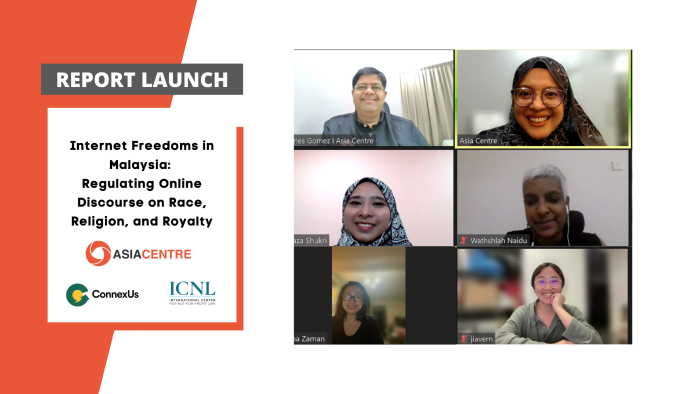
On 1 March 2023, Asia Center held a virtual launch and discussion of its latest report Internet Freedoms in Malaysia: Regulating Online Discourse on Race, Religion, and Royalty. The event drew over 60 participants and included members of academic institutions, representatives from civil society organisations, human rights activists, lawyers and journalists. The report was first released online to the public and the media on 16 January 2023. The next day, the Malay Mail published an article, Study: ‘Ultranationalist’ groups gaining traction in Malaysian online space following Umno’s defeat in 2018 polls | Malay Mail by Keertan Ayamany. In the afternoon, it also published an opinion piece, Internet freedom, an essential human right — James Gomez | Malay Mail by Dr James Gomez. The Vibes, published another opinion piece, Race, religion, and royalty to shape M’sian politics – James Gomez | Opinion | The Vibes also by Dr James Gomez. There were also two podcasts on the report. On 25 January 2023, Dr Gomez recorded a podcast discussion with Dina Zaman (a Malaysian commentator) moderated by ABC News journalist Ali Moore. The podcast was for a programme, Ear to Asia, produced by the Asia Institute, Melbourne University, that is also syndicated to the Jakarta Post. Similarly, on questions related to the findings of the report, on 28 January 2023, Dr. Gomez recorded a podcast interview with journalist Philip See for BFM’s podcast Pressing Matters: BFM: The Business Station – Podcast How Has Online Discourse Shaped Conversation On Sensitive Topics In Malaysia? that was published on 30 January 2023. The key research findings were additionally promoted via an online campaign with infographics posted on Asia Centre’s social media platforms, Facebook, Linkedin, Instagram, and Tiktok. This included an animated infographic video summarising the key arguments and recommendations of the report, and it was premiered during the report launch. When presenting the report during the launch, Dr. Gomez outlined Asia Centre’s recommendations that can be adopted by relevant government agencies, parliamentarians, the Human Rights Commission of Malaysia and NGOs, as well as tech companies to mitigate the obstruction of internet freedoms in Malaysia. While the government is strongly urged to review, repeal and amend laws that are detrimental to internet freedoms, parliamentarians, human rights advocates and NGOs have an active role to monitor and report the infringement of rights by the state. Tech companies are also urged to increase their transparency in dealing with the state to mitigate the biased removal of content on their platforms. Following the presentation during the report launch, the findings were discussed by Tham Jia Vern, Independent Researcher, #TrackerBenci Lead, Dr Syaza Shukri, Assistant Professor, IIUM, Dina Zaman, Co-founder, Iman Research, and Wathshlah Naidu, Executive Director, Center for Independent Journalism. The panel was moderated by Lina Sakina Salim, the centre coordinator of Asia Centre Malaysia. Tham Jia Vern discussed how approaches towards curbing hate speech online should be diversified beyond activating legal measures. By introducing her work in developing #trackerbenci, an AI-driven tracker identifying hate speech on Twitter, Jia Vern shared how technologies can be used positively to counter dangerous narratives online. Next, Dr Syaza elaborated on how GE15 was impacted by the different ideological views held by the Malays, namely – conservatism and populist Islam. She further added that while freedom of expression in the country has progressed over decades after Malaysia’s independence, it does not guarantee internet freedom for all. In her elaboration, Dina Zaman provided insights towards understanding the voting patterns of the majority Malays. Although social media has both negatively and positively mobilised the community during the election period, she opinionated that curbing dissenting voices through legal mechanisms may pose more significant harm than good. Sharing the results of CIJ’s social media monitoring of GE15, Wathshlah Naidu, showcased how hate speech and disinformation can be manifested in various forms online and addressed the need to provide better digital literacy which is accessible by all members of society. The report, in partnership with International Center for Not-for-Profit Law (ICNL), aims to provide a baseline study on the state of internet freedoms in Malaysia, and how socio-political developments related to race, religion and royalty has impacted the freedom of expression of its citizens. Read the full report here. Watch the Zoom recording of the event on our YouTube channel here. Asia Centre is a civil society research institute in Special Consultative Status with the United Nations Economic and Social Council. It serves as a knowledge partner and undertakes evidence-based research as well as provides capacity-building training for end beneficiaries. If you would like to collaborate with the Centre, please send an expression of interest to contact@asiacentre.org.