
Asia Centre Panel Discussion at ASEAN Civil Society Conference / ASEAN Peoples’ Forum Side Event 2023
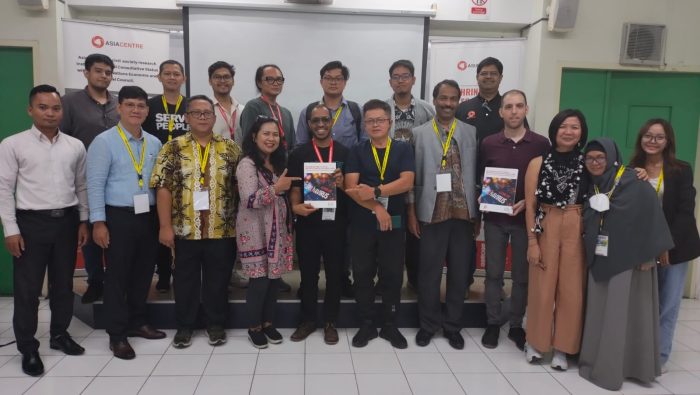
Emergency measures imposed by governments across Southeast Asia during the COVID-19 pandemic negatively impacted human rights and democracy in the region, leading to the shrinking of civic spaces and repression of human rights activists, CSOs, independent journalists, and other civic actors. Although most of these measures were initially and publicly meant for public health and safety, these governments, in practice, used these to curb civic freedoms. These include laws that criminalise protestors, silence calls for public accountability, restrict electoral campaigning, and closely surveil the population. In this context, Asia Centre, in partnership with the International Center for Not-for-Profit Law (ICNL), published a report entitled “Moving Beyond COVID-19 Restrictions in Southeast Asia: Pushing Back Against Authoritarian Pandemic Governance” and two policy briefs, Moving Beyond COVID-19 Restrictions in South Asia: Pushing Back Against Authoritarian Pandemic Governance and Moving Beyond COVID-19 Restrictions in East Asia: Pushing Back Against Authoritarian Pandemic Governance in early 2023 to explore how governments used state powers during the COVID-19 pandemic to derogate rights and extend these powers post-pandemic. The report and policy briefs provide recommendations for governments, international organisations, and CSOs to improve democratic governance after the pandemic. The SEA report and country studies on Indonesia and Thailand were presented in a panel at the ASEAN Civil Society Conference/ASEAN Peoples’ Forum 2023 in Jakarta, Indonesia, on 2 September 2023 by the Asia Centre team consisting of regional director Dr James Gomez, research manager Dr Marc Piñol Rovira, research associate Ekmongkhon Puridej with Advisory Board Member Nukila Evanty. Following the ACSC/APF 2023 theme “Reclaiming safe spaces, restoring democracy and equity in Southeast Asia!”, the one-and-a-half-hour session gave the audience an overview of the COVID-19 restrictions in Southeast Asia, with a special focus on Indonesia and Thailand. Dr James Gomez opened the panel by providing a background overview of the impact of COVID-19 in ASEAN countries and noted that much of the impacts from the implemented restrictive laws lasted and prevailed into the post-COVID-19 pandemic era today. Dr Marc Rovira continued by assessing how governments in the region implemented the emergency measures and the laws used to curb the civic freedoms of its citizens in the name of national security against the spread of the disease. For the case study of Indonesia, Nukilla Evanty delineates how the emergency measures in Indonesia have resulted in an increased number of attacks towards those who are critical of government policies. In the case of Thailand, Ekmongkhon Puridej explained the power and the misuse of the Emergency Decree which resulted in restrictions on freedom of assembly and the chilling of free speech. He also gave a brief overview of the advocacy efforts by the civil society in the region and discussed the need to include rights-protecting provisions in a possible international pandemic treaty. To further promote the findings of the report to the larger public, Asia Centre also held a booth at the ACSC/APF 2023, providing digital copies of the report for the attendees of the conference. Many of the conference participants, which include civil society actors from across Southeast Asian countries and beyond, took interest in the report, which sparked engaging conversations at the booth. The ACSC/APF 2023 also provided the Asia Centre delegates the added opportunity to meet and present and discuss the report to the head of the Expertise Agency of The House of Representatives of The Republic of Indonesia (BKD), Dr. Inosentius Samsul. Asia Centre has previously signed a 5-year MoU with The Expertise Agency (BKD) in 2022 to establish a partnership between both organisations to jointly undertake and support the publishing of research outputs, execute teaching and training programmes, and develop course outlines and materials. Earlier this year, in April 2023, the policy brief on East Asia, “Moving Beyond COVID-19 Restrictions in East Asia: Pushing Back Against Authoritarian Pandemic Governance,” was presented by Dr James Gomez at the Tokyo Democracy Forum meeting, which was organised on the sidelines of the C7 Summit in Japan. By disseminating these insights and engaging with a diverse audience at the conference and beyond in Indonesia, Asia Centre continues to play a pivotal role in advocating for democratic principles and upholding human rights in Southeast Asia. For more information on the report and its findings, please visit the provided link. For more photos of Asia Centre’s involvement in the ACSC/APF 2023, please visit Asia Centre’s Facebook page here. Asia Centre is a civil society research institute in Special Consultative Status with the United Nations Economic and Social Council. It serves as a knowledge partner and undertakes evidence-based research as well as provides capacity-building training for end beneficiaries. If you would like to collaborate with the Centre, please send an expression of interest to contact@asiacentre.org.
Asia Centre Launches Report on Burmanisation and Buddhisation
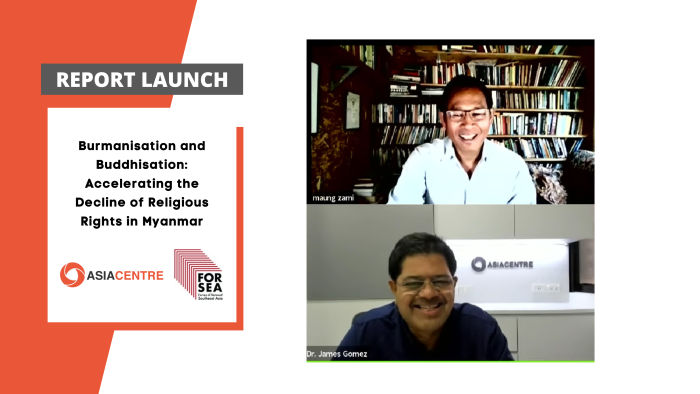
On 13 June 2023, Asia Centre and FORSEA held a virtual launch and discussion of Asia Centre’s latest report Burmanisation and Buddhisation: The Coup’s Impact on Religious Minorities. The event, which was hosted on FORSEA’s Youtube channel, received over 60 views within the first night. The report was first released online to the public and the media on 8 June 2023. The next day, The Online Citizen published an article, “Asia Centre highlights Myanmar’s alarming erosion of religious rights in new report.” Asia Centre was also invited to present the report at a closed-door meeting with representatives of INGOs and local partners interested in the state of FoRB in Myanmar. This meeting not only discussed the impacts of the 2021 coup on the state of Freedom of Religion or Belief (FoRB) in Myanmar and the ideologies of Burmanisation and Buddhisation, but also included a discussion about the impact of FoRB violations on indigenous peoples and their commitment to environmental protection. The key research findings were additionally promoted via an online campaign with infographics posted on Asia Centre’s social media platforms, Facebook, Linkedin, and Instagram. In less than a week of releasing the report online, there have already been over 1,500 downloads. In the report launch event, Dr. Gomez elaborated on the definitions of “Burmanisation and Buddhisation”, framing these two concepts as political ideologies of the Military in its pursuit of combatting terrorism and national security threats posed by the diverse ethno-religious communities of the nation. The discussion also brought comparisons between the situation in Myanmar with neighbouring countries such as Sri Lanka and Malaysia on the politicisation of national and religious identities to serve the aims of the ruling governments. The report launch also highlighted the recommendations that can be adopted by the international community, INGOs, and CSOs to reduce the impact of the coup on Religious Freedoms in Myanmar. While the government is strongly urged to review, repeal and amend laws that are discriminatory, NGOs and CSOs have an active role to monitor and report the infringement of rights by the state. The report aims to provide a baseline study on the state of freedom of religion or belief, and how developments related to the 2021 coup have impacted the rights of ethno-religious minorities. The policy report is part of Asia Centre’s FoRB Knowledge Hub efforts to publish evidence-based research and increase advocacy for the religious rights of people in Southeast Asia. Read the full report here. Watch the YouTube livestream recording here. Asia Centre is a civil society research institute in Special Consultative Status with the United Nations Economic and Social Council. It serves as a knowledge partner and undertakes evidence-based research as well as provides capacity-building training for end beneficiaries. If you would like to collaborate with the Centre, please send an expression of interest to contact@asiacentre.org.
3rd Benedict Anderson Memorial Roundtable: Gender and Nationalism in Asia
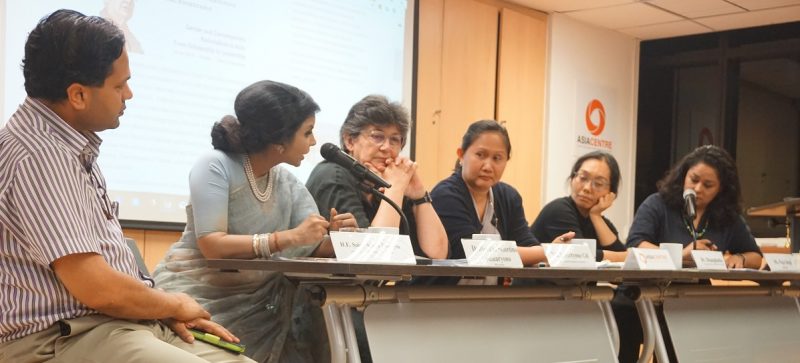
In discussions on contemporary South-East Asian politics, a gap exists between the growing discourse on nationalism and national leadership and the gendered perspective on Benedict Anderson’s narrative on nationalism. To address this gap, a diverse and experienced panel, together with an audience of around 35 attendees, held a ‘conversation’ on multiple interconnected issues surrounding feminism, nationalist expression, political control, and women’s leadership in the post-modern political landscape. The occasion was the annual Benedict Anderson Memorial Roundtable, held on 19 January 2018. Asia Centre hosts the annual Benedict Anderson Memorial Roundtable to honour the significance of the late professor’s contribution to studies of nationalism and South-East Asia, and to continue the debate around nationalism in its contemporary contexts. The inaugural Roundtable was held on 30 January 2016, with the theme Debating Imagined Communities: A Tribute to Benedict Anderson. The second Roundtable, held on 18 January 2017, centred on the topic Nationalism, Citizenship and Statelessness: Current Issues and Developments in Asia. The third Roundtable, entitled Gender and Nationalism in Asia: from Scholarship to Leadership, provided the forum to articulate and critically examine the separation of discussions on nationalism and Benedict Anderson’s work on nationalism, as seen through a gendered lens. The event was moderated by Ms Puja Singh, a teacher, speaker and doctoral candidate. She opened with a gendered reflection on Imagined Communities, Benedict Anderson’s landmark work on nationalism, inviting the audience to consider women’s identity in relation not only to men, but also to ‘nation’. Ms Emerlynne Gil, the senior international legal advisor on South-East Asia at the International Commission of Jurists’ Asia and Pacific Regional Office, argued that in post-colonial contexts, women’s political emancipation often lags behind emancipation from foreign oppression, despite the efforts of feminists within anti-colonial struggles. She argued that this disconnect remains an ongoing feature of the Congress of the Philippines, where the relatively high proportion of female politicians obscures the patriarchal forces that place them in positions of leadership and, thus, hinders the promotion of a feminist agenda. Dr Duanghathai Buranajaroenkij, a professor at Mahidol University’s Institute of Human Rights and Peace Studies, discussed her research on the growing political activism of pro-monarchist women in Bangkok and Muslim women in Thailand’s Deep South. While their entry into the political sphere is facilitated by the adoption of identities “approved” by male leaders and family members, such as overt patriotism or conservative Islamic dress, women continue to find new ways to exercise power and agency in creating space for their political participation. Dr Rosalia Sciortino Sumaryono, Associate Professor at Mahidol University’s Institute for Population and Social Research, highlighted the absence of a gendered perspective in not only Benedict Anderson’s work, but in national governments, human rights agendas, and discourses on power and nationalism. She argued that the election of more female leaders is insufficient to further the feminist agenda; these female leaders must also possess a new vision for the future, while democracy and women’s leadership within the family must be promoted. Her Excellency Saida Muna Tasneem, Ambassador of Bangladesh to the Kingdom of Thailand, noted that although numerous female leaders in South-East Asia are elected through their family connections, many have inherited nationalist sentiments from their fathers and husbands, who had themselves used nationalism to mobilise public opinion against imperial powers. She highlighted the success of Bangladeshi Prime Minister Sheikh Hasina, daughter of Bangladesh’s founding father Sheikh Mujibur Rahman, in balancing nationalism and ethnic identity through encouraging ethnic minorities to use their own languages but to use Bangla in schools. In the following discussion, the panel debated the symbolism of the hijab, its contested meaning in the context of pan-Islamic fundamentalism, and its exemplification of a broader equation of nationalism with an imposition of ‘sameness’ and growing intolerance of diversity. The panel reflected on the contributions of women in leadership roles to the promotion of feminism and women’s rights. They explored and emphasised the importance of ensuring that gender perspectives are not crowded out by emerging issues, such as the Rohingya crisis or the urgency of post-conflict statebuilding, but are instead utilised to examine these issues in greater depth. Through this continued application of a feminist agenda, the gap between discourses on rising nationalism, gendered understandings of national identity and women’s leadership can be bridged. This year’s Roundtable continued Asia Centre’s ongoing commitment to facilitating gender-centred discussion and debate around the human rights agenda. Previous events have focused on Entering Femininity: Reporting Rituals and Violations, which examined practices of female genital mutilation, and Celebrating Women in Law, featuring a panel of female lawyers who discussed access to justice in Southeast Asia. .