
China’s One Belt, One Road Initiative: What Role for Southeast Asia?
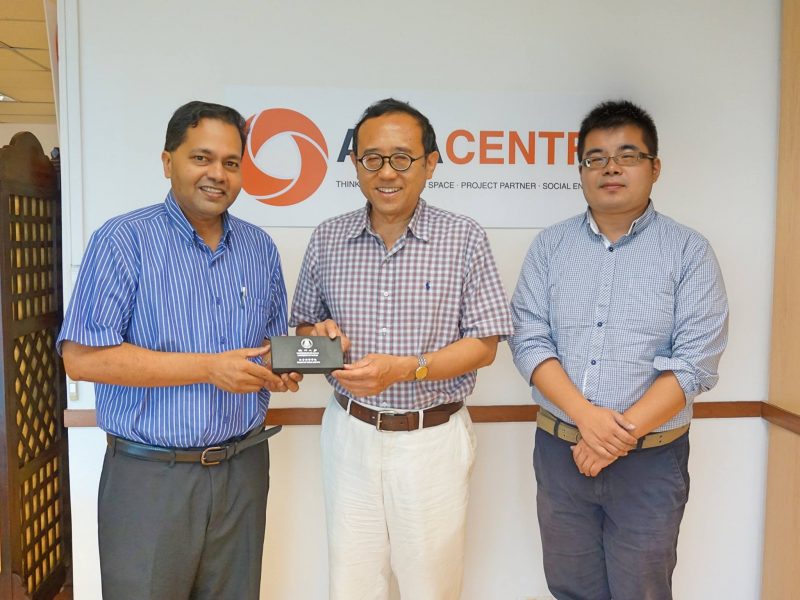
The role of Southeast Asia in China’s one belt, one road vision for its relations with Asia, Africa and Europe was the topic of discussion between Asia Centre and Dr. Wang Jianwei, Director of the Institute of Global and Public Affairs, University of Macau. China’s One Belt, One Road initiative was announced in 2013 by President Xi Jinping. It seeks to increase the connectivity between China and Asia, Africa, the Middle East and Europe. Major support mechanisms for this important initiative are China’s policy banks (China Development Bank and Exim Bank) that support a ‘going-out’ strategy, state-backed investment funds (including the 2013 China-ASEAN Infrastructure Investment Fund and the Silk Road Fund) and the Asian Infrastructure Investment Bank (AIIB). With these coordinated initiatives China has become a major player in global investment and finance. As with great powers in the past, China seeks to further integrate its own economy into the global economy and thereby increase its regional and global influence. Domestically, Southwest China becomes a gateway to the land and ocean “silk roads”. On route to connectivity between China and Africa and Europe, is Southeast Asia, which appears keen to serve as a springboard for China’s global presence. Nearly all ASEAN countries are keen to attract investments in the region’s large scale projects in areas such as transport and energy. China already has a significant presence in Cambodia, Laos, Myanmar and Vietnam. At ASEAN’s summit in Vientiane in 2016, the members were mindful of China’s growing economic presence in the region as they sought to diplomatically navigate thorny issues between China and the region, notably on the South China Sea conflict. Geopolitical issues aside, for its part, China must be mindful of local sensitivities as its economic presence is increasingly felt in places like Thailand. The latter country, for example, is the centre of the ASEAN Economic Community, where Chinese firms are exerting a solid footprint in areas such as e-commerce through companies like Baidu, Tencent, Alibaba and JD.com, in tourism through giant Chinese tour operators in places like Phuket, Chiang Mai and Pattaya that bring over 10 million Chinese tourists per year and in the real estate sector in which Chinese investors partnering with Thai companies will have invested well over 120 billion baht. Trade relations have increased with the China-ASEAN Free Trade agreement. The relationship must ultimately be mutually beneficial. Asia Centre highly appreciated the exchange of views with the University of Macau and with partner institutions in China and looks forward to continued discussions with universities and think tanks in China.
Asia Centre Leads Discussion on Human Rights and Conflict Prevention at ICIRD 2017
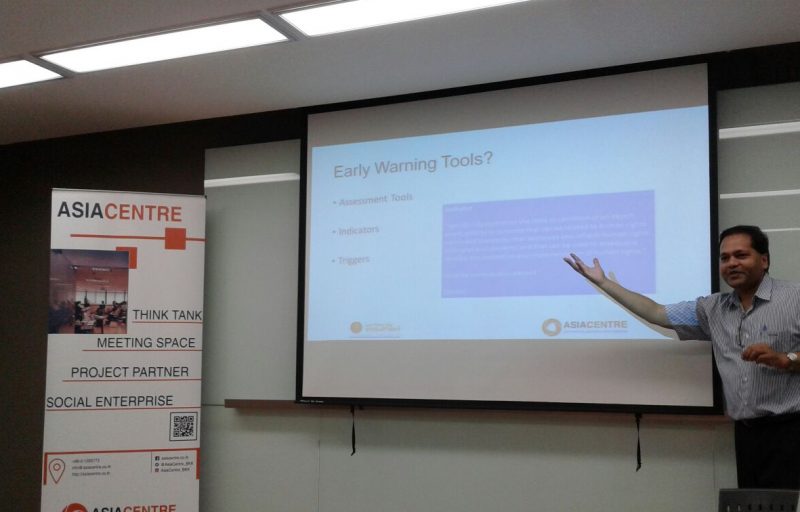
Applying human rights principles in the development of early warning systems and indicators can bolster internal – conflict prevention processes and mechanisms. This was the key discussion point at the Asia Centre-Thammasat University panel on internal conflict held at the International Conference on International Relations and Development (ICIRD) on 24 June 2017. The panel entitled, Human Rights Violations and Internal-Conflict in Southeast Asia: Identifying Conflict Prevention Processes and Mechanisms, looked at the challenges and opportunities for internal conflict prevention from conceptual and practical perspectives. Asia Centre’s Executive Director Dr Robin Ramcharan’s paper Human Rights and Conflict Prevention in Southeast Asia: The Protection Gap considered the degree to which violations of economic, social and cultural rights trigger conflict and how to identify those triggers. Dr Kenneth Houston, a lecturer with Webster University and Asia Centre Associate adopted a methodological perspective looking at how qualitative data analysis can provide monitor attitudes and thoughts that shape perceptions and consequently policies. The Proto-policy Domain as an Early Warning Resource: Options for Quantitative Data Analysis in Human Rights Monitoring in Southeast Asia considered how data can be used to take practical steps to institutionalise a more focused early warning system. Dr James Gomez, Regional Director of Amnesty International Southeast Asia and the Pacific and Asia Centre Advisory Board Member offered a practical perspective in his paper Human Rights Violations and Political Conflict in Southeast Asia: The UPR as a prevention mechanism? Dr Gomez presentation considered how human rights violations and conflict are inherently linked to conflict and considered how the UPR can address protection gaps. The panel was chaired by the Centre’s Programme Coordinator Michelle D’cruz who facilitated the ensuing discussion that covered the role of the media, integrating conflict prevention indicators into existing human rights mechanisms and processes as well as challenge in developing an early warning system. The panel attracted an audience of academics, NGO representatives and journalists who were keen to engage on the role of human rights in conflict prevention. The session builds on Asia Centre’s Human Rights Programme which focuses on evidence- based research on human rights mechanisms in Southeast Asia. The Centre is also developing a Conflict Prevention Programme.
Violations by Businesses Against Human Rights Defenders An Emerging Trend
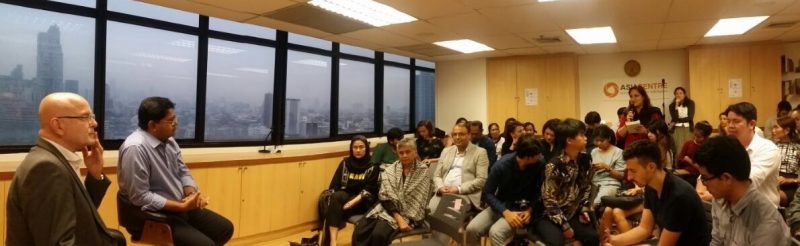
In addition to States, increasingly the office of the UN Special Rapporteur for the situation of human rights defenders (HRDs) is using its mandate to hold businesses accountable for human rights violations. States no longer are the only violators, around the world violations against HRDs are also being committed by companies in the areas of mining and forestry as well as other sectors. This was one of the key trends affecting the situation of human rights defenders Mr. Michel Forst highlighted during his public lecture at the Asia Centre. Over 70 people turned up to hear Mr. Michel Forst that included participants from academia, civil society, the UN, the Ministry of Foreign Affairs (Thailand) as well as Thai Human Rights Commissioner Mrs. Angkhana Neelapaijit. Mr Forst told the packed room that around the world human rights defenders face the following challenges: Judicial harassment through the passing of laws that criminalises the work of HRDs Non-state harassment by private security companies, religious groups, hate groups Vilification of HRDs over state-owned media and social media Harassment of women through gender specific attacks Surveillance and harassment of family members, friends and supporters of HRDs During the Q and A session moderated by Dr. James Gomez, Executive Director of the Asia Centre, members from the audience raised the issues of China’s influence on human rights in the region, the funding crunch faced by NGOs and the plight of human rights defenders working on refugee issues. Given the range of issues raised, Mr. Forst invited members of the audience to consult the reports submitted by reports of the Special Rapporteur on HRD for ideas. He also welcomed those in the region to be part of the 20th anniversary of HRD declaration in 2018 meetings to strategise a way forward for Southeast Asia. The Mandate for the situation of the human rights defender was established in 2000 following the Human Rights Defenders declaration in 1998. The role of the Rapporteur is to present Annual Reports to the Human Rights Council and General Assembly, undertake country visit and take up with States complaints of human rights violations Mr Forst has held the post of UN Special Rapporteur for the situation of human rights defenders since June 2014 and was travelling unofficially through Thailand on his way to Cambodia. His public lecture was jointed hosted by Forum-Asia and Asia Centre.
Asia Centre Human Rights Briefing for Georgia Tech, USA
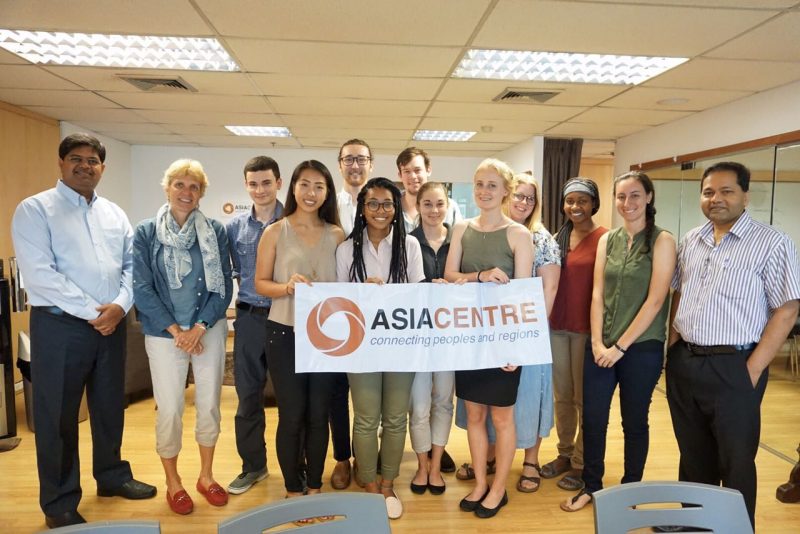
Asia Centre held a briefing session on 22 May 2017, in Bangkok, for visitors from the Southeast Asia Study Abroad Program of the Sam Nunn School of International Affairs of Georgia Tech, which is based in Atlanta, Georgia, USA. Dr. Robin Ramcharan and Dr. James Gomez led the briefing and discussions. Dr. Katja Weber led the group from Georgia Tech. The session focused on challenges facing human rights protection and democratic transitions in ASEAN, and on contemporary governance challenges that affect human security including the difficulties of providing social protection. Institutional differences between ASEAN and other regional bodies were highlighted. The value of the Universal Periodic Review (UPR) of the UN Human Rights Council to human rights protection in the region was emphasized and appraised. The critical role and impact of civil society organizations highlighted. It was noted that their formal exclusion from ASEAN regional mechanisms rendered the UPR even more appealing since CSOs and other stakeholders are consulted in the UPR peer-review process. The study group were apprised of the capacity and need for the UPR dialogue process to tackle hard civil and political issues. One of those is the shrinking space for freedom of expression (FOE) across the region, which faces threats from the criminalization of political opposition, restrictive cyber and telecommunications laws, restrictions on social media and presidential decrees in one-man or one-party authoritarian States. Participants from the study group engaged in discussion on FOE challenges, ethnic conflict and problems of social inequality. The study group, which was touring several countries in Southeast Asia, stopped by Asia Centre to exchange views on challenges facing the region and to share their insights on the same. Asia Centre looks forward to continued interaction and future collaboration with the Sam Nunn School of International Affairs.
Civil Society Needs to Innovate to Combat Shrinking Space in Southeast Asia
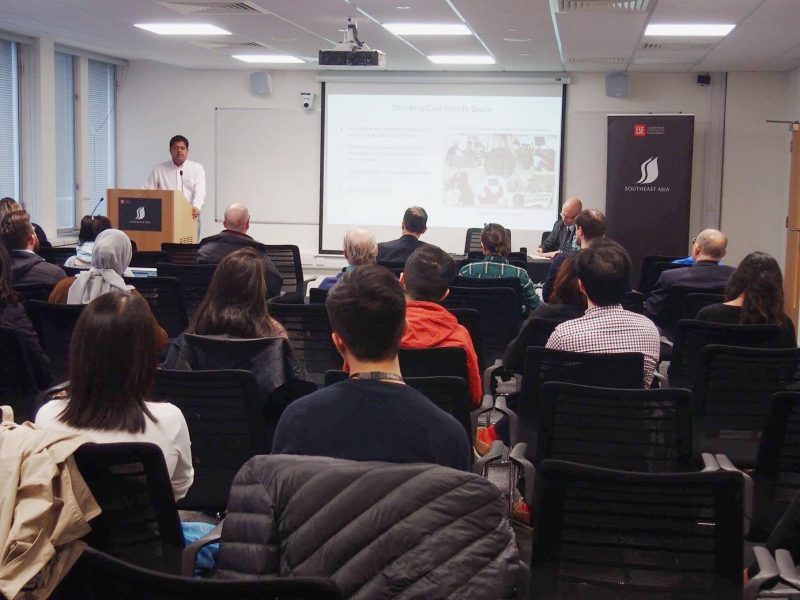
Civil society needs to innovate if it wants to step up to the challenges of shrinking space, this was the crux of Dr James Gomez’s vision for the future of human rights in Southeast Asia. Dr Gomez shared his perspective at a public lecture hosted by the Saw Swee Hock Southeast Asia Centre, London School of Economics and Political Science on 3 May 2017. Titled Civil Society and Shrinking Political Space: the future of human rights in Southeast Asia, the lecture attracted some 30 participants who were interested in the trajectory of human rights in a region that is slipping back into authoritarianism. In this presentation, Dr. Gomez outlined four key challenges facing civil society which stem from: pressures imposed by the state in the form of legislation and reporting measures to monitor and control civil society activities and funding sources; problems within civil society’s rank and file such as organisational structures, internal political divisions within organisations and cross organisational competition for limited grant resources; emerging trend in donor and grant funding adjusting their priorities to more politically conservative environments, both back home and in target countries in the region; and the impact of China on national governments in Southeast on human rights issues connected to Chinese engagement in the region. To illustrate the impact of these key challenges, Dr Gomez highlighted the workings of human rights mechanisms such as the UN’s Universal Periodic Review, ASEAN Intergovernmental Commission on Human Rights, national human rights institutions and cause lawyering in the region. Drawing from his years of experience working for international organisations as well as a well published human rights researcher, Dr Gomez argued that civil society needs to innovate if it wants to rise above these four key challenges. The counter-measures he proposed are as follows: engage with conservative governments in the region while at the same time advocating publicly for human right issues; operate civil society initiatives through new organisational structures and approaches that see smaller boards, more decentralisation and being closer to the ground; approach funding with an entrepreneurial vision where civil society goes beyond donor funding and grants, and generates income through consultancy and services; and build coalitions across national, regional and international lines to withstand and seek support against Chinese interference into regional human rights issues. To sum up, Dr Gomez emphasised that approaches to human rights advocacy needs to constantly be calibrated without compromising on principles. Innovation is especially needed at present times in Southeast Asia as countries in the region regress towards authoritarianism. A podcast of the full speech can be accessed here.