
Asia Centre Delivers Digital Security Training in Timor-Leste

From 23 to 28 October 2025, Asia Centre delivered a series of training sessions in Timor-Leste aimed at strengthening digital security and raising awareness on online safety. Supported by Google in Asia and the Pacific, together with national and local partners, the programme offered Timorese partners and participants a valuable opportunity to engage with experts, exchange experiences, and acquire practical digital protection skills. Many attendees emphasised the significance of the initiative, noting that such insightful, interactive, multi-stakeholder engagements are rare in Timor-Leste and play a crucial role in strengthening the country’s digital resilience. The programme commenced on 23 October with a public panel discussion on Digital Resilience and Cybersecurity Awareness at Universidade de Dili. Co-organised by Asia Centre, Fundasaun Hadomi Timor (FHT), and Universidade de Dili, with support from The Asia Foundation, the event was opened by the the Second Vice Prime Minister of Timor-Leste, H.E. Mariano Sabino ‘Assanami’. It convened over 120 representatives from civil society, academia, the media, and the ICT sector to explore strategies for strengthening the national digital security ecosystem and promoting digital literacy. Following the panel, Asia Centre and Fundasaun Hadomi Timor conducted an extended digital security training session at the hall of Universidade de Dili, equipping participants with practical skills in online privacy, secure communication, and misinformation management. The programme continued on 26 October with a second training session in Aileu District, reaching more than 45 local community members beyond the capital. The session focused on strengthening digital security awareness among local youth, community leaders, and ICT practitioners. In-country activities concluded with two Training of Trainers (ToT) sessions held on 27 and 28 October, engaging a total of 58 individual trainers, including hard-to-reach participants and people with disabilities. The first ToT was conducted as a national initiative in partnership with Fundasaun Hadomi Timor and The Asia Foundation Timor-Leste, while the second was organised in collaboration with Oxfam Timor-Leste. These sessions equipped emerging Timorese trainers with an advanced understanding of facilitation skills, enabling them to deliver inclusive digital security training within their organisations and communities, thereby ensuring the long-term sustainability of the initiative. The October 2025 digital security activities built upon Asia Centre’s earlier training sessions conducted in 2024 in Timor-Leste. Under the same Google in Asia and the Pacific support, Asia Centre collaborated with the Fundasaun Hadomi Timor and other key Timorese partners to deliver in-person digital security training on 17–18 December 2024 in Dili. This initiative brought together digital rights advocates, media professionals, and civil society representatives. Through these Google-supported initiatives in 2024 and 2025, more than 300 individuals from a range of organisations across Timor-Leste enhanced their capacity to identify and mitigate online risks, including AI-generated threats. The training sessions covered essential topics such as human-centred digital safety, password security, data protection, safe communication, and phishing awareness, thereby strengthening cybersecurity practices among both individuals and participating organisations. The 2025 digital security training sessions held added significance, coinciding with the national celebration of Timor-Leste’s official accession to ASEAN on 25 October — a milestone in the country’s regional integration. In light of this important development, Asia Centre reaffirms its commitment to supporting the creation of a safer, more inclusive, and resilient digital environment in Timor-Leste, aligned with the nation’s continued integration into the ASEAN community.
Asia Centre Advances Human Rights Collaboration in Denmark

Between October and November 2025, Dr. James Gomez led Asia Centre’s engagements in Denmark to solidify existing partnerships and forge new ones. The focus was on building collaboration around human rights issues and positioning the Centre as a regional implementing partner. During this period, Dr. Gomez participated in three major conferences. The first was held on 28 October 2025, where Dr. Gomez attended the Freedom of Religion or Belief (FoRB) in Practice conference in Copenhagen, organised by the Center for Church-Based Development (CKU) and Digni. The conference brought together Danish and Norwegian grantholders, international partners, and FoRB stakeholders to share insights from the FoRB Learning Review, exchange practical approaches, and strengthen the implementation of FoRB initiatives worldwide. It was an opportunity for the Asia Centre to reconnect with FORB partners in Europe. The second, from 29 to 31 October, was the 23rd Informal ASEM Seminar on Human Rights and Artificial Intelligence, where Dr. Gomez participated in discussions that explored the intersection of emerging technologies and human rights. During the seminar, Dr. Gomez noted that while the EU is developing consolidated hard laws on AI, much of Asia still relies on non-binding guidelines. As a result, he said, CSOs and human rights defenders in Asia would likely choose to refer to international treaties to point out rights gaps, while governments can be expected to adapt elements of the EU framework for national laws that focus on state security rather than on individual rights. Watch a short video of his comments here. Dr. Gomez returned to Copenhagen for the third conference on 10th November 2025. This time to speak on the panel “Protecting Democracy: Tackling Disinformation in Elections”, during the Copenhagen Conference on Information Integrity held at UN City, Copenhagen, 11-12 November. During the panel discussion, Dr. Gomez noted that election campaigning is continuous, and that it’s half-truths that make up the bulk of disinformation. He drew attention to the rise of “Incentive Politics” in Asia which he explains in the short video here. Prior to the start of the conferences, Dr. Gomez had meetings with several Danish INGOs. On 27 October 2025, Dr. James Gomez met with the Danish Institute for Human Rights. As it was a first meeting, both introduced each other’s organisations and discussed topics on democracy, human rights, and technology. During the meeting, Dr. Gomez was also introduced to the Digital Democracy Initiative (DDI), a project supported by DANIDA, the Danish International Development Agency and funded by Danish Ministry of Foreign Affairs, which aims to strengthen democratic processes, protect human rights, and build digital resilience in civil society through practical strategies and technology-focused interventions. Both organisations agreed to connect further on this topic. Later that day, Dr. Gomez visited the 200 year old Danmission in Hellerup, Copenhagen. Since 2023, Asia Centre has cooperated with Danmission in the region, hence it was an opportunity to meet up with the leadership team in Denmark. The discussion centered on developing joint project ideas for implementation in Asia. On 27 October, Dr. Gomez met with key members of the International Media Support (IMS) team at its office at Vox House, Ryparken, Copenhagen. The meeting was an opportunity for Asia Centre to present its regional implementation experience as well as update the IMS team on the ongoing project on climate disinformation and indigenous people in Asia. Dr. Gomez also received some updates on IMS’s projects in Asia, and both organisations expressed a continued desire to work together. This visit to Copenhagen marks a new milestone for Asia Centre, expanding its presence and partnerships in Denmark. By engaging in key discussions and forging collaborative ties in Copenhagen, Dr. Gomez advanced Asia Centre’s work as a regional implementing partner on human rights in a rapidly evolving political and technological landscape.
Asia Centre Advances Democratic Resilience at TAEF’s Inaugural Indo-Pacific Think Tank Summit

On 8 October 2025, Kartini Sunityo, Partnership Manager at Asia Centre, represented the Centre at the inaugural New Southbound Policy+ (NSP+) Think Tank Summit on “Prospects for a Resilient Indo-Pacific Policy” in Taipei, Taiwan. Hosted by the Taiwan-Asia Exchange Foundation (TAEF) in partnership with the Ministry of Foreign Affairs, the event marked a significant step forward for regional policy dialogue and civic diplomacy. The NSP+ Think Tank Summit serves as a platform for prominent institutions across the Indo-Pacific to engage in policy-focused dialogue and explore avenues for collaboration. Key themes included security resilience, democratic resilience, and the development of supply chains independent of authoritarian influence. Asia Centre was among more than twenty leading international network organisations invited to participate in this inaugural edition of what is set to become a biennial convening. In Session II: “Democratic Resilience Chain: Defending Shared Values Across the Indo-Pacific with Taiwan as a Key Partner”, Asia Centre’s Kartini identified key democratic challenges in the region—including electoral erosion, disinformation, surveillance, and AI-enabled social control—citing Indonesia and Thailand as examples. Framing these issues as an opportunity for an Asian-led action, she urged a strategic, long-term approach that views democracy as both a core value and a security imperative, grounded in local contexts and strengthened by civil society. Highlighting Taiwan’s crucial role alongside Japan and South Korea, she emphasised the importance of multilateral partnerships, grassroots engagement, and sustained investment in democratic research and development, capacity-strengthening, and movement-building. Asia Centre’s participation in the Summit reflects its ongoing partnership with TAEF, one that has steadily deepened over several years. On 18–21 September 2025, Dr. James Gomez served as a discussant in the opening roundtable of “The Evolving Crisis of Democracy in Asia: Challenges and Resolutions”, co-organised by Asia Centre, TAEF, and the Advanced Research Centre for Humanities and Social Sciences (ARCHS) in Taiwan. The session, “Democracy in Crisis and Possible Ways Forward,” reaffirmed Asia Centre’s role in regional democratic discourse. Earlier, on 4 April 2025, during Asia Centre’s forum “Youths, Democracy & Electoral Legitimacy in Asia”, TAEF Executive Director Dr. Alan H. Yang shared Taiwan’s experience in youth activism and called for stronger connections with Southeast Asian youth networks. On 18 March 2025, during the 8th Yushan Forum in Taipei, Asia Centre’s Regional Director Dr. James Gomez and TAEF Chairman Dr. Michael Hsiao signed a landmark Memorandum of Understanding (MoU), committing both institutions to joint efforts in think tank collaboration, NGO networking, policy research, and public dialogue. The foundations of this partnership date back to December 2019, when Asia Centre’s Dr. James Gomez, Dr. Robin Ramcharan, and Charlotte Yuchun Tseng met with TAEF’s Executive Director Dr. Alan H. Yang, Director and Senior Research Fellow Sherry H.C. Liu, and Assistant Research Fellow Nina Ning Yen on the sidelines of the 3rd Biennial Southeast Asian Studies Conference (SEASIA) in Taipei to explore avenues for future collaboration. Together, Asia Centre and TAEF continue to champion democratic resilience and regional cooperation for a stronger, more connected Indo-Pacific relation.
Climate Disinformation in Thailand: Negating Indigenous Peoples’ Identity
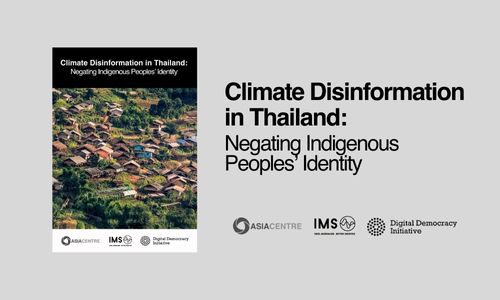
Download Full Report In Thailand, the rapid digitalisation of media and widespread use of social media since the early 2000s have accelerated the spread of climate disinformation. This has reinforced the systemic negation of Indigenous Peoples’ (IPs) identity. Climate disinformation disproportionately affects IPs, who make up nearly 14% of the population and inhabit forested areas most vulnerable to climate change and deforestation. From one-sided reporting and greenwashing to false climate solutions and scapegoating IPs as drivers of deforestation, these narratives contribute to their exclusion from decision-making, criminalisation, forced evictions and intimidation and violence. It sets out targeted recommendations, urging the government, international bodies, civil society, media sector and technology companies to integrate climate disinformation into human rights monitoring, expand Indigenous-led counter-narratives and ensure meaningful IP participation in climate governance. Tackling climate disinformation is essential to safeguarding IP identity and ensuring inclusive, rights-based and effective climate action in Thailand.
Indigenous Peoples’ Identity Key To Counter Climate Change

The negation of Indigenous Peoples’ (IPs) identities by climate disinformation in Thailand hampers their ability to counter climate change. Given that much of climate disinformation is disseminated via the country’s so-called trusted mainstream media, Indigenous media can be one pillar in countering such narratives. This was a suggestion made by speakers during the meeting to discuss the preliminary findings from Asia Centre’s forthcoming report, “Climate Disinformation in Thailand: Negating Indigenous Peoples’ Identity”. The event was held in partnership with International Media Support (IMS) on 30th September 2025 in Chiang Mai, Thailand. The convening gathered 17 representatives from Indigenous organisations and communities, civil society organisations, international NGOs, academia and the media. Asia Centre’s Programme Manager, Sanjay Gathia, opened the event by emphasising the urgent need to address the consequences of climate disinformation, which has become a tool to subvert and negate the identities of IPs in Thailand. Vanessa Chong, Programme Manager at IMS, highlighted the crucial role of the media in ensuring accurate information circulates to counter these narratives. Following the opening, Ekmongkhon Puridej, Researcher at Asia Centre, presented the key findings of the draft report for validation and feedback. He first outlined how climate disinformation emerges against a backdrop of successive laws and policies that erase Indigenous identities. Fuelled by the digitalisation of media, climate disinformation is also used to diminish IPs’ roles in environmental stewardship and knowledge. Second, he outlined the four types of climate disinformation in Thailand: one-sided reporting on climate change, greenwashing, false climate solutions and scapegoating IPs as drivers of climate change. Collectively, he stressed that climate disinformation operates within a larger context where official communications rely on partial truths – malinformation. This allows state and corporate entities to conceal environmental damage while portraying IPs as forest destroyers and restricting their land access. Third, he evaluated the detrimental impacts of climate disinformation on IPs in Thailand, which entails their exclusion from decision-making, criminalisation, forced evictions and experiences of intimidation and violence. Collectively, these issues reinforce the systemic negation of Indigenous identities, undermining their crucial role in mitigating climate change. Finally, Mr Puridej outlined the report’s main recommendations, intended for diverse stakeholders such as UN bodies, INGOs, government ministries, CSOs, media, technology companies and Indigenous communities. He emphasised that these recommendations must prioritise Indigenous self-determination and identity. The presentation was followed by a roundtable discussion, moderated by Vanessa Chong. Four discussants shared their insights, drawing from both the report and their personal experiences, to explore the findings and their implications in managing climate governance. Phnom Thano, Indigenous Media Network (IMN), stressed that Indigenous Peoples and Indigenous civil society organisations (CSOs) must strategise and develop communication plans to use media as a tool for asserting their identities and climate roles against dominant narratives informed by climate disinformation. He added that partnerships with non-Indigenous CSOs could amplify IP voices more effectively. Pyrou Chung, Knowledge for Development Foundation, highlighted that climate disinformation is rooted in colonial histories of resource extraction, where Indigenous Peoples were blamed to justify resource seizure. She underlined the importance of asserting both their knowledge and identity to counter climate disinformation while ensuring Indigenous Peoples control how their knowledge is represented. Marco Haenssgen, Department of Social Science and Development of Chiang Mai University, emphasised that Indigenous narratives must reflect modern expressions of Indigeneity to assert identity within a rapidly changing climate and social landscape. By foregrounding resilience, adaptation and innovation, Indigenous communities can demonstrate their role in contemporary climate action. Nina Sangma, International Land Coalition, frames climate disinformation as deliberately designed to silence Indigenous Peoples, driven by legacy media, the state and big tech, all of whom profit from erasing alternative worldviews. The role of Indigenous CSOs in this regard is to break dependency on mainstream outlets and build transboundary solidarity to assert their identity and place in climate action. In closing, Sanjay Gathia thanked IMS, panellists and participants for their valuable contributions. He noted that the feedback was well received, and relevant suggestions will be incorporated into the final report. Watch TikTok highlights of the event here.
Asia Centre Strengthens Democratic Ties in South Korea

On 30 September 2025, Asia Centre extended its reach into East Asia, with a symbolic presence in Seoul, South Korea. This marks a significant step in expanding and strengthening the Centre’s regional cooperation on democracy and human rights. At the ribbon-cutting ceremony, Dr. James Gomez represented Asia Centre, alongside Korea Democracy Foundation officials, members from IDEA, V-Dem and Indo-Pacific Democracy Forum to inaugurate Korea Democracy Foundation’s Center for Honorary Offices of the International Organisations. This step represents another milestone in the growing relationship between Asia Centre and the Korea Democracy Foundation that has evolved steadily over recent years. The partnership was formally established through a Memorandum of Understanding signed on 7th November at the 2024 KDF Global Forum, Seoul, South Korea. It laid the institutional groundwork for cooperation and the creation of the honorary office. The three year MOU was to promote the development of both parties and international democracy through cooperation and friendship. However, the collaboration between the two organisations can be traced back to 2018, when Dr. James Gomez was awarded the Korean Democracy Research Fellowship by KDF. The fellowship, which allowed Dr. Gomez to research on the rising challenges of “Fake news” and its impact on electoral integrity, not only facilitated academic inquiry but also opened pathways for Asia Centre’s integration into South Korea’s civil society networks, creating a foundation for ongoing cooperation. On 1st January 2025 , in recognition of his dedicated leadership and significant contributions, Dr. James Gomez was awarded Goodwill Ambassador by the Korea Democracy Foundation for the years 2025–2026. The inauguration of the Honorary Office marks a new phase for Asia Centre and KDF, one focused on implementing their shared vision. The office will enable joint research, programs and policy forums that connect both organisation’s experiences with ongoing challenges faced by democracies throughout Asia. Overall, it is a symbol of the enduring partnership and the belief that regional cooperation is important for supporting democratic progress.
Asia Centre’s Digital Security Training in Kolkata

From 8 to 10 September 2025, Asia Centre’s representative – Mr. Sanjay Gathia, the programme manager – conducted a series of Digital Security Trainings (DST) in collaboration with partner institutions in Kolkata, India. In total six DST sessions were conducted over three days. Five were DST End-Beneficiary (DST-EB) engaging 446 participants, where 169 participants expressed interest in becoming master trainers. One was a DST Training of Trainers (DST-TOT) conducted with Digital Empowerment Foundation, where 46 participants were coached as trainers. The expectation is that each Master Trainer will then go one to train 30 end-benificiaries fulfilling their requirement as master trainers. The objective of the Kolkata series was to strengthen participants’ understanding of digital risks, equip them with practical tools to safeguard personal and institutional data, and promote safer online practices. The participants were primarily high-risk, digitally vulnerable groups, i.e. rural and semi-urban community leaders, youths, educators, and members of the press. The training sessions commenced on September 8th with a session co-organised with the School of Media, Communication, Fine Arts and Performing Arts, Sister Nivedita University (SNU). This session engaged youths, academics, and journalists, and attracted 230 participants. On the same day, Asia Centre conducted another DST in collaboration with Brainware University in Kolkata. This session was aimed at young people from semi-urban areas on the outskirts of the city, and it was attended by 105 participants. On 9 September, Asia Centre conducted an in-person DST-Training of Trainers (DST-ToT) in partnership with the Digital Empowerment Foundation (DEF), as part of the Udyamini program. The training was attended by 46 participants, including 35 Soochnapreneurs (Info-prenuers) from rural areas of West Bengal and 11 DEF representatives at district and state levels. Later the same day, Asia Centre held a DST-End Beneficiary (DST-EB) session in collaboration with Press Club Kolkata (PCK). The session was attended by 20 participants representing print and digital media groups. On 10 September, Asia Centre partnered with NSHM Knowledge Campus Kolkata to conduct two DST-EB sessions. The sessions, held pre- and post-lunch, engaged 81 participants, comprising both youths and educators. Across the six DST sessions in Kolkata, participants gained practical insights into core digital security topics, including data privacy, online threat recognition, encryption tools, and responsible digital engagement. Through partnerships with SNU, Brainware University, DEF, Press Club Kolkata, and NSHM Knowledge Campus, Asia Centre continues to equip individuals and organisations with the knowledge and skills necessary to navigate the digital environment securely. This initiative supports Asia Centre’s broader mission to protect online freedoms and digital rights, and to advance inclusive digital literacy across the Asia-Pacific region. For further information on Asia Centre’s Digital Security Training or to explore partnership opportunities, contact: training@asiacentre.org. Watch TikTok highlights of the event here.
Asia Centre Brings Digital Security Training to Delhi

In early September 2025, Delhi, India, Asia Centre representatives – Dr. James Gomez, the regional director, and Mr. Sanjay Gathia, the programme manager, conducted a series of Digital Security Trainings in collaboration with our partners. While in Delhi, meetings were also set up with new interested partners who are interested in collaboration for DST delivery for their networks in Delhi. Three DST End-Benificiary (DST-EB) sessions were conducted reaching over 150+ participants belonging to the high-risk, digitally vulnerable groups. With 67 participants expressing interest in becoming potential master trainers after completing the training. The participants were youths, educators, members of youth networks, community leaders, human rights defenders, members of faith-based organisations, representatives of civil society organisations, community leaders, educators, journalists, retired senior officials, journalists and other digitally vulnerable communities. The training sessions aimed to equip participants with essential knowledge and practical skills to identify digital threats, protect personal and organisational data, and strengthen online safety practices. The training sessions kicked off on September 2nd with a session co-organised by the Association for Democratic Socialism (ADS) and the Schumacher Society Delhi. It was attended by 27 people. The following day, on September 3rd, the second session was held in partnership and collaboration with Women in Security, Conflict Management and Peace (WISCOMP) and India International Centre (IIC). This training brought together a broad & diverse group of 110 participants. The final session of the Delhi series took place on September 6th, and was co-organised with White Dot Solidarity (WDS), the session brought together 16 people. This Digital Security Training sessions focused on strengthening the participants’ understanding of digital risks while equipping them with the knowledge and practical skills needed to adopt safer and more responsible online practices. These sessions also enabled participants to gain practical insights into core cybersecurity topics, including strengthening data privacy, recognising online threats, applying encryption tools, and fostering responsible digital engagement. The sessions created a valuable platform for exchange, equipping participants with critical knowledge on digital security while fostering dialogue on how different sectors of society can collectively strengthen safe and resilient online practices. Apart from the trainings, Asia Centre representatives, Dr. Gomez and Mr. Gathia also met with Women in Security, Conflict Management and Peace (WISCOMP), India International Centre (IIC), India Habitat Centre (IHC), Press Club of India (PCI), Digital Empowerment Foundation (DEF), ASAP-Asia, Haiyya, Network of Women in Media, India (NWMI), and South Asian University (SAU) to discuss the next suite of training sessions scheduled for 1-6 Dec 2025. Through such future partnerships Asia Centre hopes to empower more individuals and organisations in India to navigate the digital world securely. This initiative aligns with Asia Centre’s broader mission to protect online freedoms & digital rights, and advance inclusive digital literacy across the Asia-Pacific region. For further information on Asia Centre’s Digital Security Training or to explore partnership opportunities, contact: training@asiacentre.org. Watch TikTok highlights of the event here.
The Asia Foundation: Balancing Innovation and Inclusion in the AI Era

Artificial intelligence (AI) has the potential to transform governance in Southeast Asia, but the uneven distribution of its benefits risks exacerbating inequality, disrupting labour markets and placing additional stress on the environment. To mitigate these risks, inclusive frameworks are crucial. The frameworks that protect digital labour, balance power between governments and technology companies and ground AI in local values and community-driven solutions. This was the core message delivered in a panel discussion hosted by The Asia Foundation (TAF) during Asia Centre’s 10th Annual International Conference “AI and Governance in Asia: Civil Society, Democracy and Media” in Bangkok from 21 to 22 August 2025. In his opening remarks on 21 August 2025, Thomas Parks, Vice President of The Asia Foundation, underscored the importance of advancing dialogue on democracy in Asia at a time when many development organisations face funding challenges. He stressed the need for collaborative, cross-institutional approaches to ensure sustainability. While AI offers opportunities to enhance civic participation and strengthen governance, Parks cautioned that it also brings risks, particularly around misinformation. He argued that discussions on equity, rights and public trust remain essential to shaping AI responsibly. Following his remarks, TAF convened the plenary session titled “Governance 4.0: What is the Future of Tech-Enabled Governance in Southeast Asia?”, Moderated by Thomas Parks, the panel examined how AI could reshape state–citizen interactions, resource distribution and service provision. Parks highlighted both opportunities and blind spots in governance and policy, particularly issues related to equity, public data ownership and technocratic automation. He emphasised that Asian states must harness AI to create governance systems that are adaptive, effective, responsive, accessible and equitable. The panel featured three speakers: Elina Noor, Senior Fellow with the Asia Programme at the Carnegie Endowment for International Peace, criticised the market concentration of large technology companies. She pointed to exploitative relationships and echoes of colonial extraction. Noor argued that AI development must be inclusive and rooted in local contexts, community needs and traditional values rather than shaped solely by corporate or geopolitical interests. Pauline Tweedie, Chief Project Management Officer at The Asia Foundation, warned that uneven adoption of AI could deepen inequality by widening the digital divide and disrupting labour markets, particularly for low-skilled workers. She cited the Philippines’ business process outsourcing sector as an example of a sector that is especially vulnerable to automation, raising concerns about migrant labour and brain drain. Tweedie emphasised the need for community-led interventions such as shown in Timor Leste, and local ownership in AI governance, including measures to address environmental concerns and ensure equitable benefits. Dr. Janjira Sombatpoonsiri, Research Fellow at the German Institute for Global and Area Studies in Hamburg and an assistant professor at Institute of Asian Studies, Chulalongkorn University, Thailand, highlighted the lack of digital labour protections in Southeast Asia’s AI governance frameworks. She linked this gap to broader structural inequalities. Janjira called for renewed collective action – particularly involving youth – to foster inclusive AI governance. She stressed that empowering local ownership and participation is critical to reducing inequality and ensuring that AI supports, rather than undermines, democracy. During the Q&A session, participants raised concerns about the geopolitical and environmental implications of data centre ownership and digital infrastructure, including risks of concentration, regional control and the impact of tech-enabled surveillance on journalists and civil society. Questions also focused on how governance can safeguard press freedom while addressing these challenges. In response, panellists underscored the importance of sovereignty and taxation in curbing the dominance of major technology companies in Southeast Asia. They called for strong regional cooperation that prioritises environmental and social considerations and promotes community-driven solutions. Asia Centre’s International Conference is its flagship annual gathering, designed to bring partners together to present outcomes, share expertise, and develop future collaborations. Over the years, it has become a trusted space for open dialogue on democracy and human rights in Asia. Asia Centre is a civil society research institute in Special Consultative Status with the United Nations Economic and Social Council. It serves as a knowledge partner and undertakes evidence-based research as well as provides capacity-building training for end beneficiaries. If you would like to collaborate with the Centre, please send an expression of interest to contact@asiacentre.org. Follow Asia Centre’s social media channels for updates.
International IDEA: Strengthening Democracy Through Ethical and Inclusive AI

Artificial intelligence (AI)’s growing role in shaping elections, governance and civic participation presents both opportunities for democratic transparency, but at the same time, challenges of authoritarian misuse. To safeguard democratic resilience in Asia, governments, media and civil society groups must work together to ensure ethical frameworks and inclusive innovation that proves AI strengthens democracy rather than undermining it. This was the main message from a panel discussion hosted by International IDEA during Asia Centre’s 10th Annual International Conference, held in Bangkok from 21 to 22 August 2025 under the theme “AI and Governance in Asia: Civil Society, Democracy and Media”. In her opening remarks on 21 August 2025, Leena Rikkilä Tamang, Regional Director for Asia and the Pacific at the International IDEA, emphasised the urgent need for greater awareness, stronger regulation, and robust AI safeguards to address challenges such as bias, data misuse and security risks. However, she underlined, while AI poses serious threats to democracy, it also offers potential benefits – for example, improving campaign logistics and strengthening monitoring of campaign finance – if guided by ethical frameworks and human oversight. Following her remarks, International IDEA convened a plenary session titled “AI and Democracy in Asia: Opportunities and Challenges”. Moderated by Adhy Aman, Senior Programme Manager for Asia and the Pacific at International IDEA, the session explored AI’s role in elections, legislative work and governance. The panel featured four speakers: Antonio Spinelli, Senior Advisor on Electoral Processes, International IDEA, examined the growing influence of AI in elections. While acknowledging its value in campaigning, he warned that AI can also undermine trust, spread disinformation, intimidate opponents and harm democratic institutions. He recommended independent oversight of AI use in campaigns, investment in detection and verification tools and leveraging democratic innovation to enhance election preparedness. Dr. Janjira Sombatpoonsiri, Research Fellow at the German Institute for Global and Area Studies in Hamburg and an assistant professor at Institute of Asian Studies, Chulalongkorn University, Thailand, discussed the suppression of civil society and political opposition in Bangladesh as a case example of how AI and social media tools can both aid democratisation and exacerbate inequality. She noted that AI’s power and resource demands may disadvantage civil society, given their financial vulnerabilities, budget cuts and limited resources – underscoring the urgent need for stronger institutional guardrails. Rachel Judhistari, Lead Public Policy Specialist, Asia, Wikimedia Foundation, stressed that online knowledge production is deeply tied to power, bias and the ongoing struggle for digital rights and freedoms. She highlighted Wikimedia’s critical role in AI development due to its extensive, regularly updated knowledge base. However, she noted that Wikimedia and its contributors face challenges such as state control, surveillance and harassment, which create significant psychological and political pressures. Peter Brimble, the Vice President of the AI Asia Pacific Institute, addressed AI’s potential to strengthen democratic institutions, improve citizen participation and measure public sentiment. At the same time, he cautioned that misinformation, manipulation and digital inequality threaten democracy and risk excluding marginalised communities. He called for regional cooperation to advance AI literacy, safeguard digital rights and develop governance models that balance innovation with accountability. During the Q&A session, participants raised questions about AI’s role in governance, civil society and democratic processes. Panellists emphasised that while AI can enhance capacity – for instance, by improving financial literacy – it can also reduce critical thinking if over-relied upon. They stressed the need for governance, regulation and safeguards to prevent misuse, and called for environmental impacts to be included in AI policy discussions. Asia Centre’s International Conference is its flagship annual gathering, designed to bring partners together to present outcomes, share expertise, and develop future collaborations. Over the years, it has become a trusted space for open dialogue on democracy and human rights in Asia. Asia Centre is a civil society research institute in Special Consultative Status with the United Nations Economic and Social Council. It serves as a knowledge partner and undertakes evidence-based research as well as provides capacity-building training for end beneficiaries. If you would like to collaborate with the Centre, please send an expression of interest to contact@asiacentre.org. Follow Asia Centre’s social media channels for updates.