
Civil Society Needs to Innovate to Combat Shrinking Space in Southeast Asia
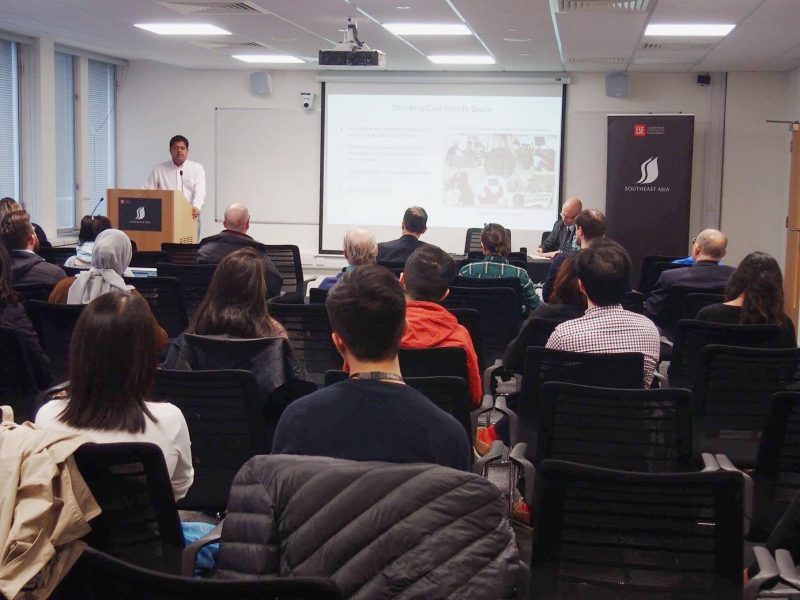
Civil society needs to innovate if it wants to step up to the challenges of shrinking space, this was the crux of Dr James Gomez’s vision for the future of human rights in Southeast Asia. Dr Gomez shared his perspective at a public lecture hosted by the Saw Swee Hock Southeast Asia Centre, London School of Economics and Political Science on 3 May 2017. Titled Civil Society and Shrinking Political Space: the future of human rights in Southeast Asia, the lecture attracted some 30 participants who were interested in the trajectory of human rights in a region that is slipping back into authoritarianism. In this presentation, Dr. Gomez outlined four key challenges facing civil society which stem from: pressures imposed by the state in the form of legislation and reporting measures to monitor and control civil society activities and funding sources; problems within civil society’s rank and file such as organisational structures, internal political divisions within organisations and cross organisational competition for limited grant resources; emerging trend in donor and grant funding adjusting their priorities to more politically conservative environments, both back home and in target countries in the region; and the impact of China on national governments in Southeast on human rights issues connected to Chinese engagement in the region. To illustrate the impact of these key challenges, Dr Gomez highlighted the workings of human rights mechanisms such as the UN’s Universal Periodic Review, ASEAN Intergovernmental Commission on Human Rights, national human rights institutions and cause lawyering in the region. Drawing from his years of experience working for international organisations as well as a well published human rights researcher, Dr Gomez argued that civil society needs to innovate if it wants to rise above these four key challenges. The counter-measures he proposed are as follows: engage with conservative governments in the region while at the same time advocating publicly for human right issues; operate civil society initiatives through new organisational structures and approaches that see smaller boards, more decentralisation and being closer to the ground; approach funding with an entrepreneurial vision where civil society goes beyond donor funding and grants, and generates income through consultancy and services; and build coalitions across national, regional and international lines to withstand and seek support against Chinese interference into regional human rights issues. To sum up, Dr Gomez emphasised that approaches to human rights advocacy needs to constantly be calibrated without compromising on principles. Innovation is especially needed at present times in Southeast Asia as countries in the region regress towards authoritarianism. A podcast of the full speech can be accessed here.
Asia Centre at FCCT discussion on Human Rights in Southeast Asia
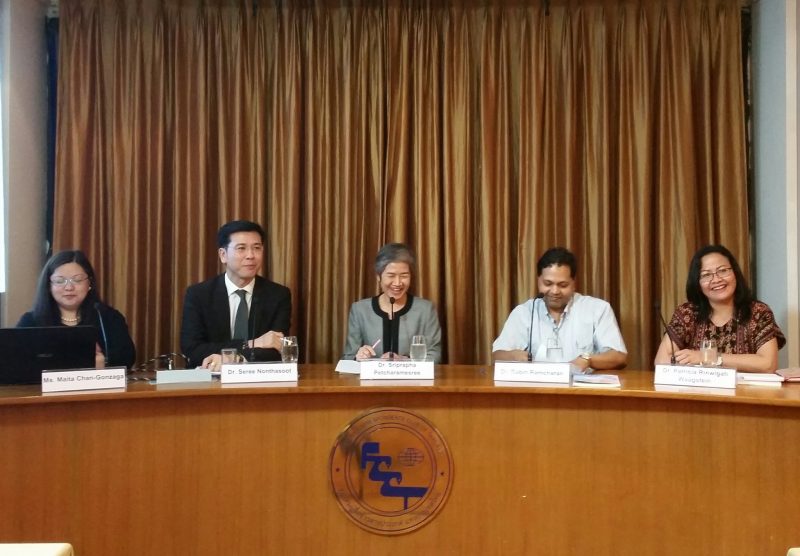
Asia Centre’s Dr Robin Ramcharan was part of panel discussion on the topic Human Rights in Southeast Asia: Retrospect and Prospect at the launch of SHAPE SEA’s Human Rights Outlook in Southeast Asia 2014-2015. Held on the evening of 9 March at the Foreign Correspondents Club Thailand, the event attracted about 40 participants from international and regional organisations, members of civil society, journalists, academics and students. Dr Ramcharan’s address focused on the positive trajectories for the future of human rights in the region, pointing to, inter alia, State engagement on human rights issues through the Universal Periodic Review (UPR). He highlighted the need for more effective engagement with the UPR and a better understanding of how it can impact developments at the national and regional level, He pointed to Asia Centre’s forthcoming book on The Universal Periodic Review of Southeast Asia: Civil Society Perspectives which reviews civil society’s engagement with the UPR across two cycles, as an example of research that is filling a gap and supporting the work of civil society. Joining Dr Ramcharan on the panel were Dr. Seree Nonthasoot, Thailand’s representative to the ASEAN Intergovernmental Commission on Human Rights (AICHR), Ms Maita Chan-Gonzaga from Ateneo Law School Philippines, Dr Patricia Rinwigati Waagstein from Indonesia and Dr. Sriprapha Petcharamesree,Chair of the SHAPE-SEA programme. Programme Coordinator Michelle D’cruz and Research Intern Francesco Franzoi also represented the Centre at the event to introduce Asia Centre’s work, harness opportunities for collaboration with other institutions and organisations and raise awareness of upcoming projects such as the July 2017 International Conference on National Human Rights Institutions in Southeast Asia: Challenges of Protection, which builds on and extends the Centre’s research into the UPR.
2nd Benedict Anderson Memorial Roundtable: Nationalism, Citizenship and Statelessness
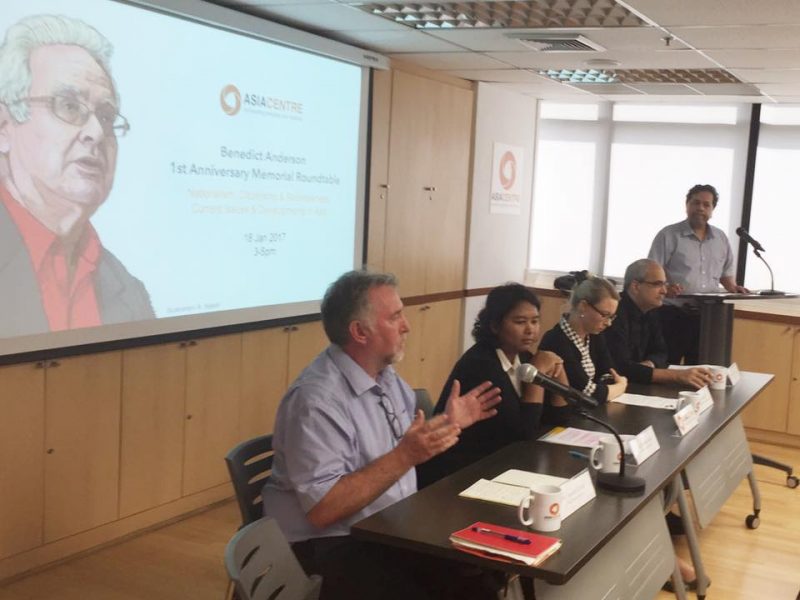
The Benedict Anderson 1st Anniversary Memorial Roundtable was a tribute to the life and legacy of the late professor. Centring on the topic Nationalism, Citizenship and Statelessness: Current Issues and Developments in Asia, the discussion attracted an audience of some 65 people, and featured a panel of diverse expertise. This event follows our inaugural memorial Debating Imagined Communities: A Tribute to Benedict Anderson held on 30 January 2016, and will be an annual feature in the Asia Centre calendar. Professor Kenneth Christie of Royal Roads University in British Columbia, Canada, and an expert on peace, development and security, provided an overview of Anderson’s concept of “imagined communities”. The point was made that the nation-state and nationalism are modern constructions. Citizenship entailed a sense of shared community among diverse peoples with common values and rights. The construction of shared communities was a global phenomenon as Anderson sought to show in his comparisons of nationalist experiments around the world. Ms Chontida Auikool, a lecturer from Thammasat University’s ASEAN-China programme provided insight into the Indonesian Chinese community’s struggle for inclusion and integration, and how anti-Chinese sentiment plays out in contemporary developments. Maritime nomadic communities in the region who face inter-generational statelessness are often rendered invisible according to Asia Pacific Refugee Rights Network (APRRN) Senior Programme Officer Ms. Helen Brunt. Using a case study of the communities in the Sulu Zone, she argued that migration flows in the region predate the development of nation states, a legacy that contributes to statelessness. Their lack of documentation and being labelled ‘illegal migrants’ condemns them to continued discrimination. Dr. Kevin Downey, a lecturer at Thammasat University and expert on political development, identity, civil society, and democratization in South and Southeast Asia discussed the lack of causal explanations for negative views on immigrants, ‘the other side of statelessness’. He went on to offer a hypothesis premised on the notion of insecurity and precarity in the era of globalisation, which features many dislocations and rising economic inequality. In the question and answer period moderated by Asia Centre’s Dr. Robin Ramcharan, potential flashpoints were mentioned. The two that were highlighted are: Rakhine State in Myanmar and the rise of intolerance in Indonesia. These are areas to monitor going forward, despite progress in democratizing both countries. A Life Beyond Boundaries The event also saw the Bangkok launch of Anderson’s memoir A Life Beyond Boundaries. Anderson defied his contemporaries by “globalizing” the study of nationalism and engaging in comparisons of seemingly disparate nation-states. In this work he also critically assesses the nation-state as a unit of analysis, noting that people globally formed communities around a great variety of interests that transcended boundaries and nations. A limited number of copies is available at Asia Centre for 450 Baht, if you are interested in getting a copy you can drop us an email at info@asiacentre.co.th. You can view images from the event here.